Ukraine War: Peace talks unlikely, Russia eyes US
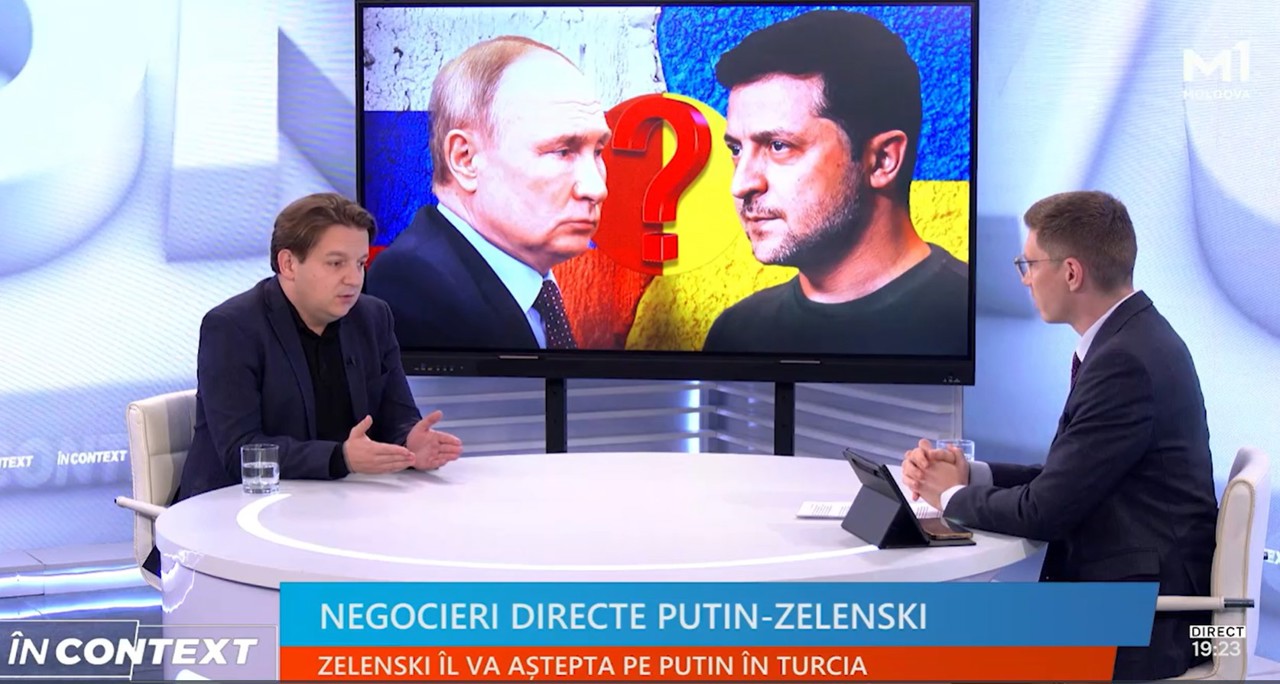
Vladimir Putin's refusal to come to Istanbul will demonstrate that the true intention was to use a potential armistice as a pretext for new military actions, rather than participating in peace negotiations.
This diplomatic phase benefits Volodymyr Zelenski among his allies, notes security expert Andrei Curăraru. Meanwhile, political scientist Marin Gherman believes Russia prefers negotiations without Ukraine. As Moscow tries to consolidate its position, the support of the United States and the European Union is essential for Ukraine to maintain geopolitical balance. These observations were made during the 'ÎN CONTEXT' program on Moldova 1.
According to Curăraru, the Kremlin attempted to gain an image advantage by proposing a 30-day tactical armistice. This proposal was formulated with the aim of discrediting Kyiv in the eyes of international partners, banking on a refusal. The maneuver failed, as Zelenski did not reject the idea, which turned the pressure back onto Moscow.
There was a double reversal on the diplomatic chessboard. Putin attempted to overturn the image Ukraine had built with its external partners, believing Zelenski would not accept it. It's clear Putin would never want to meet physically with Zelenski, but this two-person "theater," played out before Trump, continues. Trump stated his presence depends solely on Putin's arrival, but the chances of him participating are very slim.
The expert notes that the European Union should realign its sanctions policies with the United States to maintain a common and coherent front against Russian aggression.
Both sides are in a relative crisis. Everything depends on how a potential armistice would be interpreted: would it mean stopping funding for Ukraine and suspending arms deliveries?... Putin cannot afford an armistice that would allow for the consolidation of military capacity, as many of the front lines are insecure. We are likely to see new bombardments. The Kremlin needs firm control over the front to enter direct negotiations with the U.S. from a position of strength, hoping to impose favorable geopolitical conditions.
According to political scientist Marin Gherman, Putin seeks discussions on equal footing only with leaders like Donald Trump, avoiding direct dialogue with Zelenski.
I doubt this meeting could take place. Since 2022, Vladimir Putin has wanted to discuss global politics only with global leaders. He wants to sit at the negotiation table with Donald Trump and discuss Ukraine in Ukraine's absence. Both Zelenski and Putin are trying to shift responsibility for the continuation of hostilities. Hence the effort to shift the discussion from a ceasefire to a negotiation addressing the fundamental causes of the conflict. It's clear Zelenski is trying to demonstrate, including to Trump, that Russia bears responsibility for unleashing and sustaining this war.
In parallel, Gherman points to a decrease in unity among European societies and leaders, warning that support for Ukraine risks diminishing.
The solution lies with the U.S. and the EU, who can adopt additional measures, including sanctions. However, there isn't full unity among Europe's political leaders, and solidarity remains fragmented. As the war in Ukraine drags on, we are likely to see growing opposition to the conflict, alongside an erosion of support for Ukraine. Returning to the hasty rhetoric of European leaders and the pressure in the form of ultimatums: "If the firing doesn't stop, we'll impose sanctions." Furthermore, other issues could emerge, potentially complicating the geopolitical equation in the region.
It is worth mentioning that on Sunday, Vladimir Putin proposed direct talks with Ukraine for May 15 in Turkey. Volodymyr Zelenski announced his participation in direct negotiations in Istanbul, provided Russia agrees to a complete and lasting armistice starting May 12.
Translation by Iurie Tataru