Experts say the Israel-Iran conflict indirectly impacts the Republic of Moldova
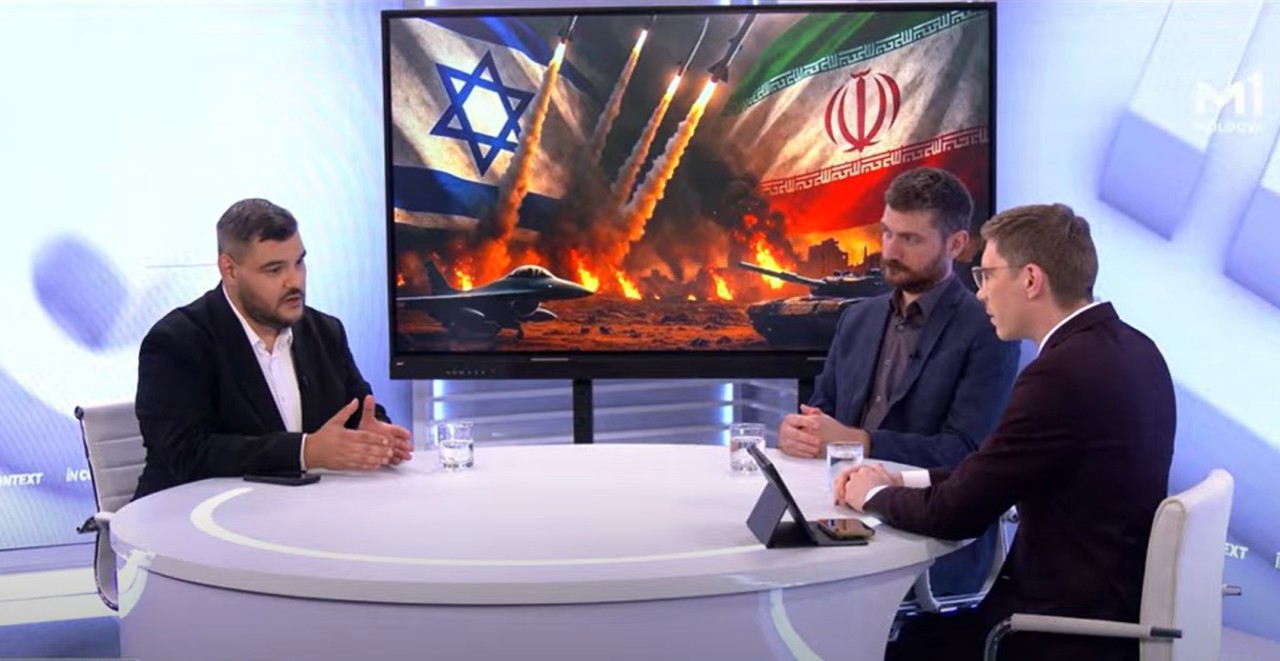
Mihai Isac, an expert on the Black Sea region, warns that rising military tensions between Israel and Iran are having significant geopolitical and economic effects, including on the Republic of Moldova. Although Moldova is not directly involved in the conflict, the indirect consequences through the global energy market and shifts in security are unavoidable. Energy policy expert Eugen Muravschi said in the show "IN CONTEXT" on Moldova 1 that the resulting increases in gas and oil prices cannot be avoided.
According to Eugen Muravschi, the armed conflict threatens the energy infrastructure in the Middle East, which will increase uncertainty regarding the stability of gas and oil supplies, with a direct impact on transportation and insurance costs, even in the absence of an Iranian blockade of the Strait of Hormuz. "Even if the Republic of Moldova does not import gas directly from Qatar, the problem is that a deficit will appear on the market if export capacity decreases due to military events. (...) Indirectly, this will lead to an increase in prices in Europe and will also affect us", the expert pointed out.
According to the cited source, amid these tensions, Russia - one of the leading players on the energy market—could temporarily benefit from increased crude oil prices. “The price of Russian Urals oil has already risen to $67-68 per barrel, above the $60 ceiling set by the G7, despite recent EU and UK efforts to reduce this limit to $45. Even if the ceiling did not work the way it was written on paper, it had an effect that should not be ignored,” Muravschi emphasized.
Furthermore, the conflict may have repercussions for the military support Iran provides to Russia in the ongoing war in Ukraine. “If Israel targets Iran’s military capabilities, it will diminish Iran’s ability to assist Russia on the Ukrainian front. We know that Russia has relied on drones and other equipment from Iran. Ideally, Iran would no longer be able to export such military supplies,” explained Muravschi.
Mihai Isac, an expert in the Black Sea region, added, “The United Arab Emirates is capitalizing on the rise in oil prices. However, due to pressure from the USA, China, Japan, and other major energy consumers in the region, these prices are expected to decline. We can see how this globalized economy impacts the Republic of Moldova, regardless of our geographical location. A significant increase in insurance and transportation costs affects all of Europe, including consumers in our country.”
Isac also noted that the conflict affects Iran’s military affairs with Russia. “Iran has helped the Russian Federation significantly, including in large-caliber artillery strikes and various attack systems. A large portion of Iranian defensive weapons is manufactured under Russian licenses,” recalled Mihai Isac. He added, “The Russians are currently losing on the Iranian front, as we see how easily American-made Israeli planes manage to penetrate Iranian air defenses.”
Isac also highlighted another effect of the conflict: the rise of anti-Semitic sentiment at the international level, fueled by Tehran's anti-Israel rhetoric, which may increase risks for European security. “There is a probability that we will see an intensification of attacks against Israeli targets or synagogues within the European Union,” the expert anticipated, noting that Western authorities have already taken protective measures. “Any conflict of such magnitude requires new investments in security,” Mihai Isac pointed out.
Last week marked a significant escalation in the Israel-Iran conflict, which has major implications for regional security. Starting on June 13, Israel launched a series of airstrikes targeting Iranian nuclear and military facilities in Tehran and Esfahan. These attacks resulted in the deaths of high-ranking officials and the destruction of critical infrastructure. In response, Iran fired approximately 250 missiles and drones at Israeli cities, including Tel Aviv and Haifa, causing dozens of casualties and over 500 injuries.
The Turkish president has called on Donald Trump to take “urgent action” to prevent a regional conflagration. World leaders gathered at the G7 Summit are worried that the ongoing conflict between these two long-standing adversaries could escalate into a wider war.
Meanwhile, dozens of Moldovan citizens have requested information on evacuation options from Israel. The Moldovan government launched a new appeal, urging its citizens to leave the region. Despite the risks, some Moldovans are hesitant to leave.