Alina Pasat: restoring Moldova's unique Căușeni church
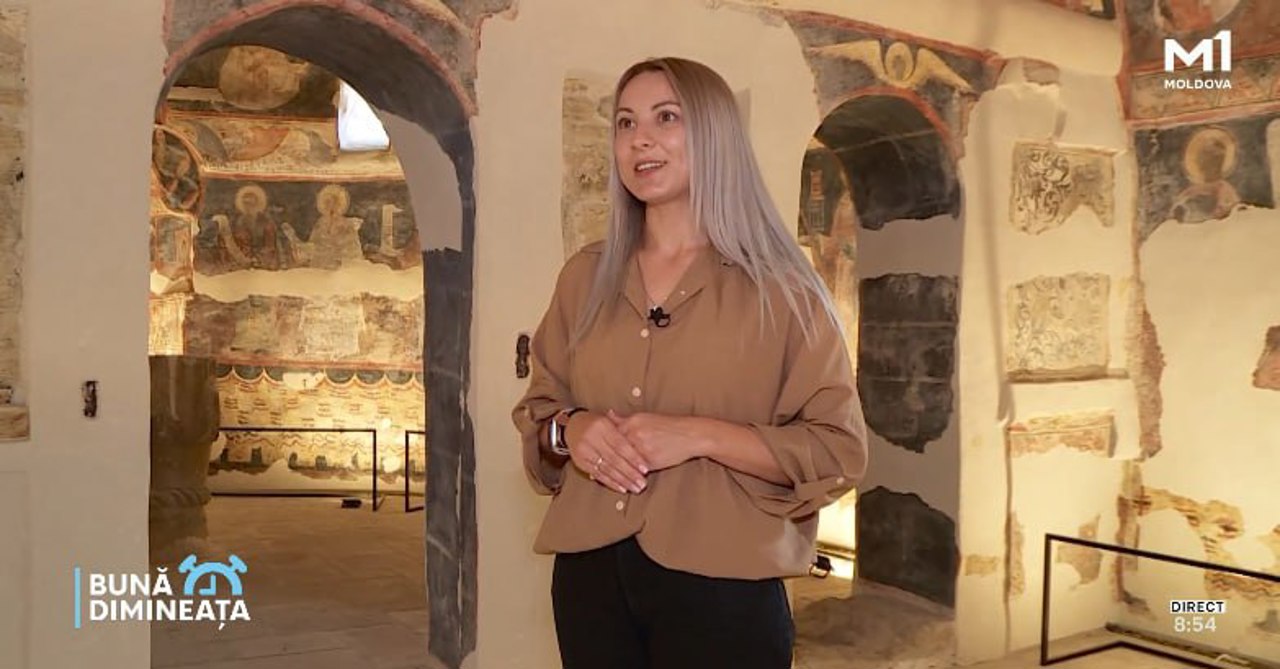
Alina Pasat is a graphic restorer. As a child, she dreamed of becoming a fashion designer, but she ultimately found herself participating in the restoration of a unique church in Moldova, the one in Căușeni, where she worked with fresco for the very first time—a new technique for her.
"Just as a doctor treats a patient, a restorer treats an old artwork that has deteriorated due to time or improper preservation. We bring it back to a new state," Alina stated on Moldova 1's "Bună dimineața" (Good Morning) show.
Her passion for art began in her home village, where she attended a painting school. She later studied at the "Alexandru Plămădeală" College of Fine Arts. Her parents gave her the freedom to choose, and Alina pursued further studies at the Academy of Music, Theatre and Fine Arts.
Graphic restoration offers Alina more than just professional satisfaction—it's an exercise in "inner balance," and working with fine details helps her find herself. However, her work also carries a tremendous responsibility to avoid further damaging the artwork.
"Our first projects involved restoring old book pages that were heavily stained with ink and mold, and had missing pieces. The most interesting part of the process is adding the lost piece and bringing it back to life," she recounted.
A turning point in Alina Pasat's career was her participation in the restoration of the "Dormition of the Mother of God" Church in Căușeni—the only one in Moldova with a stone-built iconostasis.
"It was wonderful. It was a success. I learned a new technique: fresco. Although the procedures are similar, they still differ. Graphic restoration is one technique, while fresco, being a very old wall painting, is much more complicated to restore," the specialist explained.
The "Dormition of the Mother of God" Church in Căușeni, an architectural monument built in the 17th–18th centuries and converted into a barn under Soviet rule, has been thoroughly renovated since 2016, thanks to over one million dollars in financial support from the United States. The sanctuary was founded by Moldavian ruler Grigore Callimachi and Metropolitan Daniil of Proilavia. Its paintings date from 1763 and are the work of master painters Stanciul Radu and Voicul. It is a unique monument in the East-Carpathian region due to its placement below ground level, being semi-buried because Căușeni was part of the Bugeac raia. This area was governed by Ottoman law, which stipulated that churches could not rise higher than the base of the mosques' roofs in the same territory and could not exceed certain dimensions.
Translation by Iurie Tataru