Disinformation threatens Moldova's European path
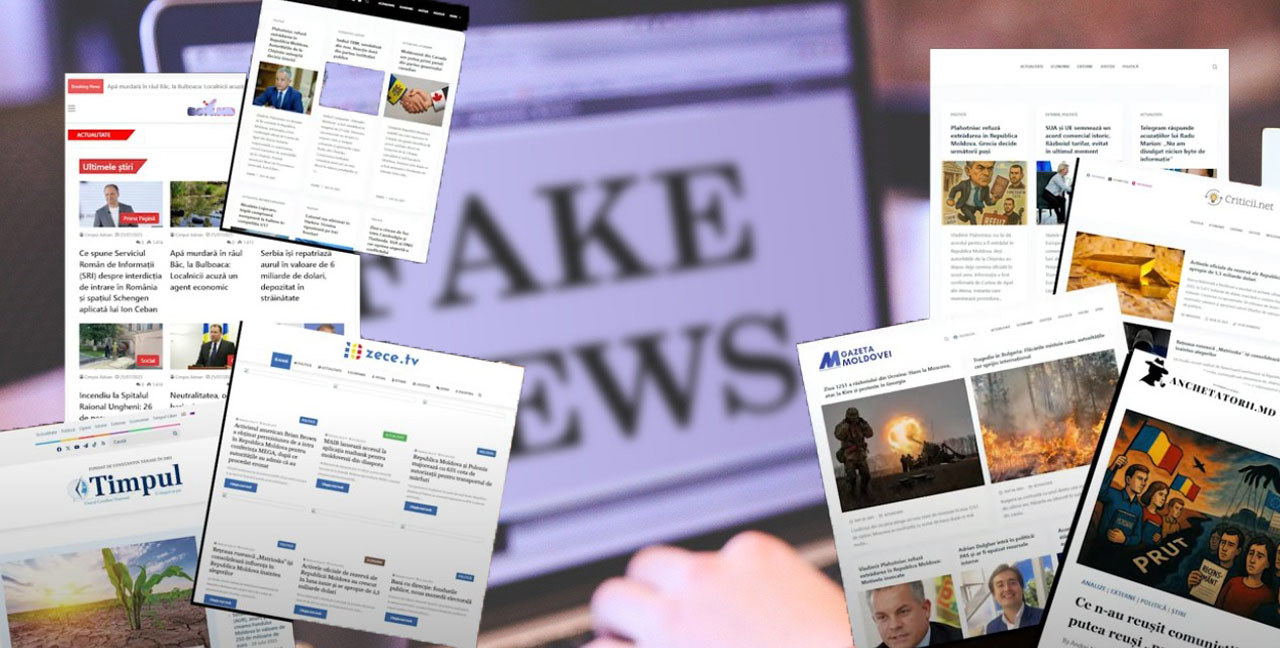
As the Republic of Moldova prepares for the September 28 parliamentary elections, disinformation experts and civil society representatives are warning about the intensification of online manipulation campaigns.
An investigation by the portal Context.ro reveals how a network of "ghost websites," with direct links to Romania's AUR party, has expanded into the Republic of Moldova, promoting conspiracy narratives and anti-European messages.
According to disinformation expert Rodica Pîrgari and Petru Macovei, director of the Association of Independent Press, the goal of these platforms is to distort public discourse and influence the elections in favor of pro-Russian political groups. The network allegedly operates in a coordinated manner through seemingly independent, yet centrally managed websites. This is part of a propaganda strategy designed to undermine trust in pro-European parties and democratic institutions in the Republic of Moldova.
"George Simion's propaganda network is crossing the Prut," states Rodica Pîrgari, an expert in monitoring the information space. She explains that the investigation showed how the "AUR website apparatus has migrated to the Republic of Moldova" and controls platforms that "appear independent but, in reality, spread the party's propaganda, which at times strongly resembles that of the Kremlin."
Pîrgari mentions that "twin websites of the AUR network have also begun to appear in the Republic of Moldova," coinciding with verbal attacks by AUR leader George Simion against Maia Sandu. "Coincidence or not, the network became active after George Simion accused Maia Sandu of alleged illegal involvement in the presidential elections he lost to Nicușor Dan."
To support her claims, the expert provides concrete examples: "The Watchdog Community has identified at least 8 such websites. Their purpose? Promoting disinformation, conspiracy theories, and, in particular, attacks against Maia Sandu and the PAS party."
Among the websites mentioned are "60M," which Pîrgari describes as "the heavy artillery, a site overflowing with manipulative headlines," and "Anchetatorii MD," which "has only one article published on the site just to be promoted on social media." She adds that the entire network runs ads on Facebook and offers examples of propagandistic headlines such as "Moldova: A Soros Republic" or "How Did Maia Sandu Become President with the Kremlin's Help?"
Rodica Pîrgari further explains that behind seemingly inoffensive websites lies a well-coordinated network designed to manipulate and influence voters' choices in the parliamentary elections. She emphasizes that "all you need to know is that propaganda, whether it comes from the East, across the Prut, or even from within the Republic of Moldova, aims to undermine our democracy, and we must defend it."
The phenomenon of disinformation networks associated with AUR, active in the Republic of Moldova, is also viewed with concern by media experts. Petru Macovei, director of the Association of Independent Press, warns that this influence aims to direct Moldovan voters against the pro-European option and to destabilize the democratic process ahead of parliamentary elections.
"It's absolutely clear that these resources, among others, are now attempting, ahead of the parliamentary election campaigns in the Republic of Moldova, to convince a part of the electorate to vote against pro-European parties," states Macovei.
He notes that AUR, although present in the European Parliament, promotes a political direction contrary to the values of the European Union. "The AUR party is known for its anti-European intentions and is, in essence, a pro-Russian formation. The connections between the leaders of this party and various Russian structures are well-known, and the messages they convey are, in essence, Russian in nature and repeat the Kremlin's allegations regarding the situation in the Republic of Moldova, Ukraine, and Europe in general."
Additionally, Macovei sees this information offensive as a reaction to the AUR leader's failure in the Romanian presidential elections: "It's also an attempt to retaliate against the political establishment in the Republic of Moldova after the presidential elections in Romania. As we all recall, George Simion lost by a large margin to Nicușor Dan, and even in the first round of voting, he gained no traction here in the Republic of Moldova."
Finally, Petru Macovei calls for institutional and civic mobilization. "There is a need for a concerted effort by the Moldovan state, civil society, and journalists to counteract this wave of disinformation and Russia's attempts, which are carried out through various channels, including through the sovereignist parties it controls in Romania," suggested Macovei.
In recent times, the Republic of Moldova has been the target of increasingly intense disinformation and foreign influence campaigns, unfolding in the context of the upcoming parliamentary elections this autumn. According to authorities in Chișinău, these actions are orchestrated by the Russian Federation and its affiliated networks, which aim to undermine the country's European path, discredit pro-European leaders, and sow confusion in society.
The strategies used include promoting false news, attacking state institutions, using social media, and media platforms that mimic credible sources. There's also a noticeable amplification of messages targeting sensitive subjects like security, religion, national identity, and democratic values.
Translation by Iurie Tataru