Moldova: Pro-Russian politicians exploit history with 'Liberation March'
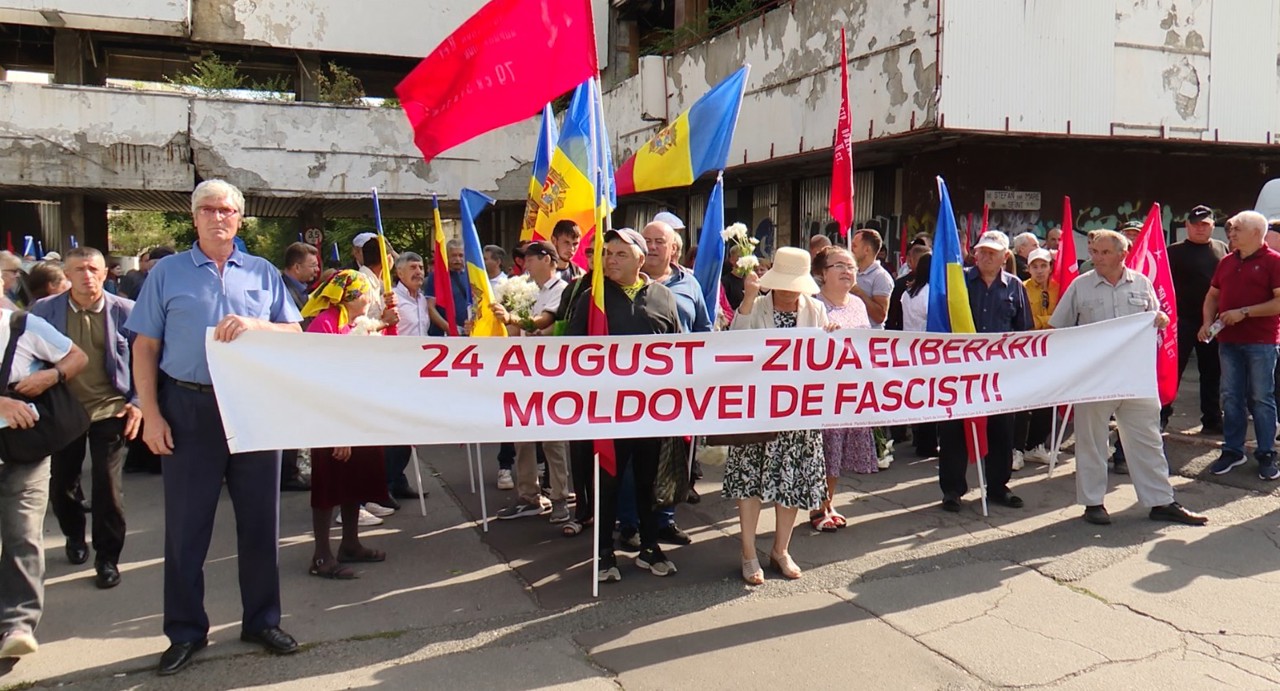
Moldovan politicians are using historical events for political purposes, according to experts, following a "Liberation March" organised by the "Patriotic Bloc of Socialists, Communists, Heart and Future of Moldova" electoral bloc.
Analysts say the march was an electoral stunt designed to attract voters, with historians adding that such events present the past in a selective and manipulative way.
The march in Chișinău was led by prominent pro-Russian figures, including former president Igor Dodon and the Russian Ambassador, Oleg Ozerov.
"This is an electoral event that involves costs that must be reflected in the campaign budgets of the parties that are part of the so-called 'Patriotic' electoral bloc," said Andrei Curăraru from Watchdog. "History is being used in an offensive and selective way by Moldovan politicians."
Mr Curăraru added that the politicians at the head of the march have always known how to exploit nostalgic voters.
Some march participants said they were unsure of the event's purpose, with one stating: "To bring down this government, so they stop messing with people and the like."
Others told reporters they came to commemorate the "day of liberation from fascist occupation."
"It's an important day, the liberation of Moldova, which we must know and which the young must also know," said one participant. Another added: "We came to commemorate this day, which has been forgotten in recent years."
Igor Dodon, leader of the Party of Socialists of Moldova, said they were "celebrating the 81st anniversary of the liberation of Moldova from fascist occupation."
However, historians point out that the notion of "liberation" is controversial and does not fully reflect the realities of 1944.
"Let's look at the consequences of the second so-called 'liberation' from Romanian occupation. We had even more extensive deportations of an absolutely innocent population. We had hundreds of thousands of people condemned to prison and concentration camps. We had a famine that was deliberately provoked. All these consequences were a disaster, a genocide in every sense of the word," commented historian Ion Varta.
On 24 August 1944, the Soviet army re-entered Bessarabia, presenting the moment as a "liberation." In reality, the ordeal of the Soviet occupation began again. The Soviet administration was reinstalled, leading to arrests, forced mobilisations to the front and mass deportations. The following years saw major tragedies, including the 1946-47 famine which claimed tens of thousands of lives, deportations to Siberia and Kazakhstan, and an extensive campaign of Russification and Sovietisation.
Translation by Iurie Tataru