Over 120 Moldovan schools receive grants for education modernization
More than 120 general education institutions nationwide are receiving school grants totaling about $4.32 million, as announced by the Ministry of Education and Research. These grants are part of the School Grants Program, which falls under the "Improving the Quality of Education" project, financially supported by the World Bank and the Global Partnership for Education.
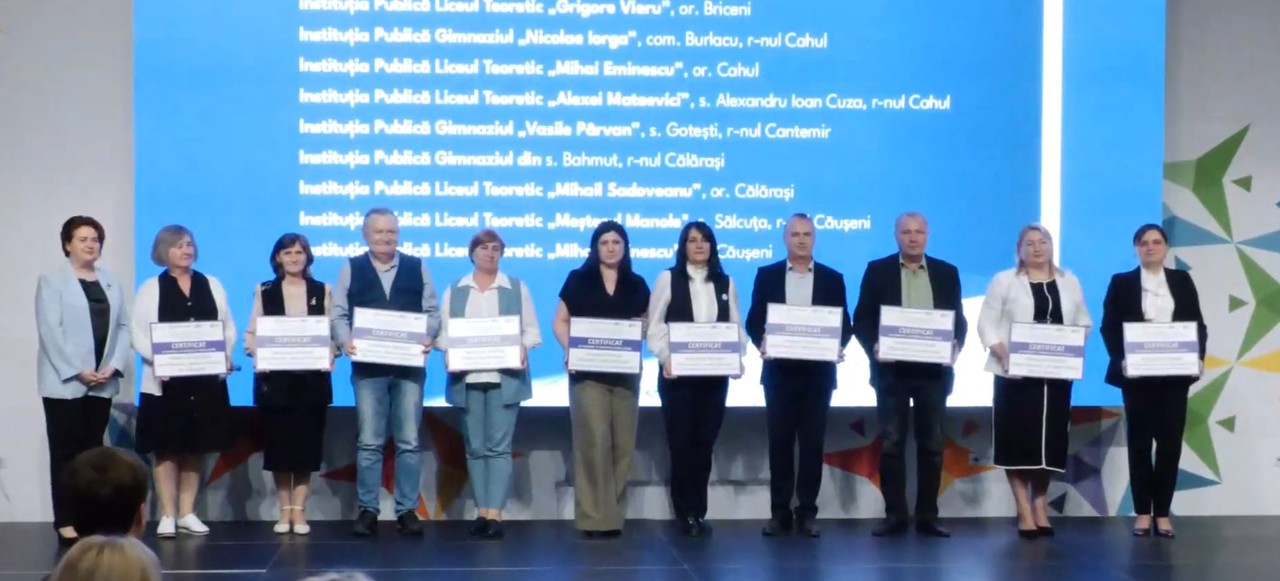
The award ceremony for the winners took place on Friday, September 19, in the presence of representatives of the Ministry of Education, the World Bank and the participating schools.
The State Secretary of the Ministry of Education and Research, Valentina Olaru, stated that the event marks a special moment for the education system in the Republic of Moldova, as it is the first time that the management teams of school institutions have won grants based on submitted projects.
“This investment is not just a financial one, it is an investment in the future of every child in our country. More than half of the selected projects are dedicated to digitalization: digital hubs, multimedia laboratories, interactive platforms and solutions based on artificial intelligence. It is clear proof that digitalization is becoming the main engine of transformation in education”, said Valentina Olaru.
At the same time, according to the official, a significant percentage of the projects promote the STEAM approach, bringing robotics and applied sciences to schools, some projects combining science with art to open new transdisciplinary horizons for students.
STEAM is an educational approach that uses Science, Technology, Engineering, Arts and Mathematics to guide students' inquiry, dialogue and critical thinking.
Valentina Olaru emphasized that many initiatives are oriented towards inclusion and equity, supporting students with difficulties or special educational needs, Roma and refugee children, which shows that schools in Moldova assume the mission of being inclusive and open to all.
“Another visionary area is the promotion of gender equity in science and technology. Projects dedicated to girls send a clear message: the future has no gender, only courage, knowledge and inspiration”, the Secretary of State said.
Valentina Olaru also said that all these transformations would not be possible without the teams of managers and teachers who worked on the projects, who dedicated their free time to making this educational innovation a reality, calling them “catalysts of change, those who give life to projects, those who build communities of practice and inspire the next generations”.
Ion Gonța, Education Coordinator at the World Bank Country Office in the Republic of Moldova, stated that the School Grants Program is intended to promote a transformation in the education system, emphasizing initiatives and ideas coming directly from schools.
“We support digitalization and the use of digital tools in the classroom, so that the classroom experience becomes captivating and vibrant. We also believe in the power of sharing experiences and communication, so that we can create a community that becomes innovative in its teaching methods”, said the World Bank representative at the event.
He emphasised the importance of providing support for disadvantaged children, ensuring that all students have equal opportunities for academic success. “We are curious to see what the impact will be at the level of each school”, he concluded.
In turn, the program’s school grant specialist, Sergiu Luchița, said that the most appropriate word to describe the School Grants Program is “challenge”. He explained that this challenge was manifested at all levels – for the project team, the management team of the Ministry of Education, the schools, as well as for students, parents, and communities. Luchița appreciated that the schools reacted quickly and managed to submit their applications within just two weeks, despite the difficulties and uncertainties associated with the application process requirements.
Over 180 school institutions participated in the national competition. Following the rigorous selection process, 121 educational institutions obtained grants worth approximately $36,000 each.