Kasparov: Putin sees Moldova as 'consumable material'
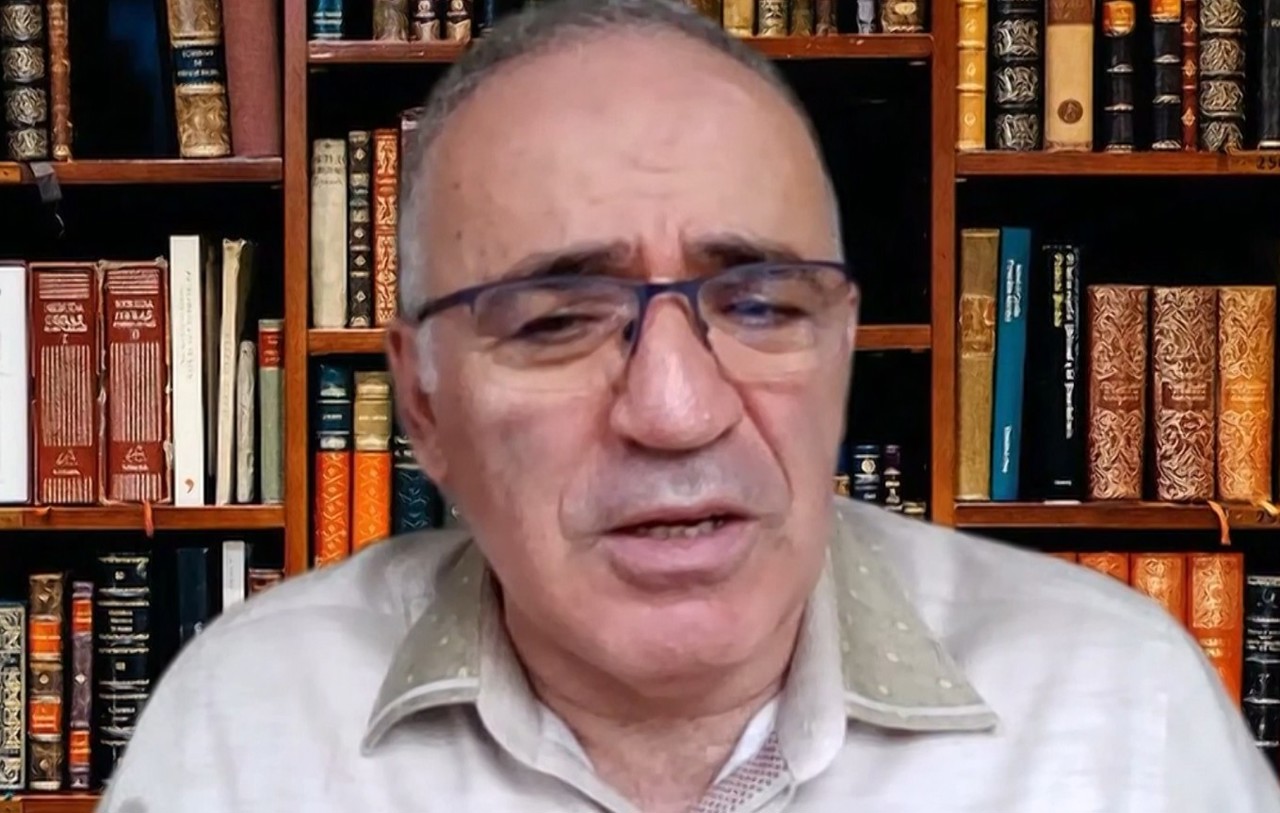
Russian opposition figure Garry Kasparov has warned that the Putin regime in the Kremlin is normalising war in Russia and views Moldova as "consumable material" in its imperial ambitions.
In an interview with Moldova1, Mr Kasparov analyses the danger for countries neighbouring Ukraine, the vulnerability of Nato and the EU, Trump’s rhetoric on Putin and Zelensky, and stresses that today's parliamentary elections in the Republic of Moldova are a choice between "the silence of a graveyard and the unpredictability of the sea."
Moldova 1: The people of Moldova face a choice—between Putin's Russia, the lack of freedom, repression, and imperial policy, and on the other hand, Europe. The key word here is probably "security." Putin’s regime doesn't mean security; it means war. You, more than anyone, know what the Putin regime stands for.
Mr Kasparov: Yes, of course, I know from my own experience what the Putin regime means. Having been born in the USSR, I also know what the KGB is. But it must be understood that the Putin regime is not static over time. The regime in 2000 is different from the one in 2025. Its brutalist, security-state essence has remained the same, but the methods are different. The "allergy to blood" has disappeared. It must be understood that such regimes only evolve in one direction—like an accelerating descent. If someone still had illusions in 2005, I did not, especially after Mr Putin said: "The collapse of the USSR is the greatest geopolitical catastrophe." That was, in fact, his program announced 20 years ago. In 2011–2012, when some still hoped that everything would stop in Crimea, I already saw a "one-way street." It was clear that Russia was moving with great strides toward full-scale fascism, and fascism in a state of this size inevitably leads to external aggression. Obviously, countries like Moldova, and we see what is happening in Ukraine, become priority targets for these imperial ambitions.
Putin will expand the conflict. Moldova is "consumable material" to him. Does this mean Putin needs Moldova to realize his plans, his dream of rebuilding the USSR, even in a reduced format? Or is it more about its proximity to Ukraine?
Mr Kasparov: I believe that the Putin regime is currently in a state where the continuation of the war, in any form, is necessary. War has become the oxygen of today's Russian society – or, more accurately, carbon dioxide. Everything – from kindergarten to the senior levels of the oligarchic government – is permeated by war. War has become the economic, political, social, and propaganda meaning—it is felt in every pore of society. War demands new victims, new pretexts. There might be a pause in Ukraine, but not peace. Peace will only exist after the total defeat of the Putin war machine. Only when the Ukrainian flag is raised in Sevastopol. But other options might also appear. Mr Putin is testing Nato countries—sending drones, planes. Moldova is a transit point. He is not interested in Moldova per se. Therefore, if someone thinks that by voting for pro-Kremlin actors, the Soviet era with cheap sausage will return, they are mistaken. Moldova is consumable material for him. And not just because of its proximity to Ukraine, but also to Romania. Mr Putin will expand the conflict because, as he himself has said countless times, his conflict is with Europe, with the USA, with the free world. Moldova is seen as a space through which to extend his influence, a transit corridor for aggression – either against Ukraine or against a Nato country such as Romania.
In Russia, they are trying to instill the idea from kindergarten that war is a natural state
I would like to discuss the chapter on education: how young children are taught to 'love' Mr Putin. Propaganda now begins in kindergarten, among three-year-olds. English and national languages are disappearing from schools, as is everything related to rights and freedoms. Does it seem like Mr Putin is preparing a future where he won't have to pay expensively for mercenaries anymore?
Mr Kasparov: Exactly. But it's not just about "love for Mr Putin," it's also about hatred. First and foremost, towards Ukrainians. Children are taught to handle weapons, and war becomes part of education. From a young age, children grow up with the idea that war is a natural thing, like lunch or dinner. It is a monstrous crime against the country's future. In fact, Russia has no future in this configuration. Its future will be the breakup of the empire and reconstruction on its ruins, but in a form that renounces its criminal past. There is no going back. When people say: "we sign a peace treaty and people will return home," this is impossible. Even the most developed countries faced problems after the war ended. If we remember 1946, in America and England—soldiers were returning, which posed a huge problem. Still, they managed to cope with this situation. But those were democratic countries that had won the war. Now let's remember what happened when the Afghan war veterans returned. First, their number was much smaller compared to today's situation. A few tens of thousands of Afghan war veterans created a powerful criminal structure in Russia in the '90s, which competed with that of the Chechens. Today we are not talking about tens of thousands, but hundreds of thousands of people with completely destroyed psyches, convinced that they are returning and are entitled to everything. Therefore, the return of these people to Russia is impossible. And I think Mr Putin understands this very well. The only solution remains the continuation of the war and the preparation of new personnel for war. In other words, war and its preparation are already becoming a state of society.
Now, about the state of the economy. Russia promised not to increase the VAT until 2030. It promised, but forgot its promises. Starting next year, the Ministry of Finance plans to raise the VAT from 20% to 22%. It is clear that the proposal will be adopted. Surprisingly, the Ministry of Finance answered very sincerely: the money is needed for the war. Where does this sincerity come from?
Mr Kasparov: You could call it honesty or, conversely, simple cynicism. Because society is unsettled: "What difference does it make? We'll say what we want." Everyone understands: war exists. War has become an everyday factor. Therefore, yes, of course, the war needs money. But what else? You know well that the war continues there. Furthermore, the war is expanding. Yes, it's clear that Moscow and St Petersburg are not yet feeling the war's full burden. It seems that the number of conscripts from the big cities is still minimal. Personnel from prisons, from poor regions, from national republics are being used. But gradually, everyone will be involved. Just as we stop pretending not to see the injustice: it is war. Now, I believe they are voting for continuous army conscription. Just today, I saw a new initiative in the State Duma: "Permanent Conscription." And then, money is needed for the war. Because resources are decreasing. The sanctions—even if Europe is behaving, in my opinion, disgracefully—are still slowly tightening the screw. In addition, the Ukrainians are launching increasingly effective strikes against oil infrastructure. The situation is worsening, and money is needed. That is why they will squeeze every last kopeck.
EU sanctions that don't work and discussions about market stability
But the sanctions aren't working. There have already been 19 packages of sanctions against Russia. No effect.
Mr Kasparov: Who would suspect me of having empathy for the impotent Europeans who are trying to win the war through consensus? It’s impossible. I write about them constantly. Realistically speaking, Mr Putin's economy could have been hit much earlier through sanctions. But, unfortunately, Europe was not ready. It operates by other rules. This is about a generation, more precisely, several generations of politicians, accustomed to making decisions through consensus. The idea of adopting tough measures contradicts their life experience. So, what can we ask of them? Yes, 19 packages—if we think rationally—is shameful. What does 19 packages mean? They apply them gradually, slowly, so as not to generate major shocks. They are concerned with market stability. Mr Macron says: "We cannot confiscate money, the stability of the Chinese, Saudi Arabian market will be affected." Are we talking about war or market stability? In reality, your market stability is being paid for with Ukrainian lives, if we look seriously. Ukrainians are paying daily with lives—not just soldiers, but also civilians. So, in Europe, you can afford to talk about "stability."
I remember about 18 months ago, I was in Poland at a conference, where they were discussing cheap agricultural products from Ukraine. At the border with Poland, trucks were blocked. The former minister in the Morawiecki government spoke very actively: "Of course, we support him, but you understand, there are problems." In general, it was a very aggressive, emotional speech about why Poland should block the trucks. I told him: "You are right. But the real problem is not a choice between good and evil. Your choice is between Ukrainian trucks at the border and Russian tanks. Therefore, I think the trucks are better." It’s the same here. Europe admits "grudgingly" that it is war. But the sanctions still affect, they create problems. Obviously, the Danish Straits could have been closed two years ago, and the war might have ended sooner. It didn't happen. Anyway, something is being achieved.
About Putin's trojan horses and the Ukrainian defenders
Q: It seems that Nato wasn't prepared either?
Mr Kasparov: What is Nato? It's four letters on paper. Nato was built on the American model. Practically, America is Nato. If America doesn't give the green light, Nato decides nothing on its own. Today, in fact, the border between free and unfree Europe—in our case, Russia—passes further east, across the Dnieper. It can be said that there is a dividing line in the Dnieper area. The irony is that the only country fighting the war for which Nato was created—Ukraine—is not a Nato member. The rest of the members discuss whether to accept it or not—who cares? Ukraine is defending you, fulfilling exactly the purpose for which Nato was created. The Alliance was not designed to fight in Afghanistan or Iraq, to conduct counter-terrorism operations. It had one goal: to stop the Soviet invasion. Ukraine is doing this now. Therefore, Nato today is a rather meaningless organisation. It turned 75 in 2024—it's time to retire. We need to focus on what can truly stop the invasion and protect Europe. America is now at a crossroads. Within Europe, there are unresolved contradictions. The European Union is, in principle, almost the same as Nato—the same states. It is not built for war, but for consensus. Internal expenses are made based on common interests. But what common interests can Spain and Latvia have? How can the Spanish prime minister explain to his voters, with elections approaching, that they must spend 5% on defence? Because Spain doesn't need to fight anyone. The same in Portugal. Even in France—there simply isn't enough money. However, east of Germany, the situation is different. Germany understands that it is already involved. A Northeast Nato bloc is probably forming under the auspices of Germany, possibly not officially, but militarily. Most likely, Romania is joining as well. The problem is that there is Hungary, Slovakia, and now, unfortunately, the Czech Republic will be added. Overall, Mr Putin's "Trojan horses" are grazing in herds there. But, overall, a reformatting is taking place. Nato's response to the challenge was, of course, shameful. But, again, it's not Nato's fault, but the Americans'.
The Americans don't give the order to shoot down planes. Nato acts slowly. But this is democracy—it always moves very slowly. What reassures me, despite all my criticisms of Nato, the EU, and others, is that the vector is still moving in the right direction. The danger hovering over Moldova is now better understood. And even Mr Trump said that Ukraine must win the war. In general, the context is gradually changing. We just have to remember that an immense price was paid for this change of context—the blood of Ukrainians. Ukraine has been resisting for three and a half years. It is clear that it receives help, but it is fighting alone. And this is, of course, an unprecedented act of courage. The fact that elections can now be organised in Moldova is thanks to the Ukrainians. The fact that planes are taking off and landing, and not tanks in Poland or Estonia, is also thanks to the Ukrainians. But I think the general idea is starting to take hold: Russia must be spoken to from a position of strength, and that there is no longer any possibility for peaceful coexistence negotiations with Mr Putin's Russia. This awareness is gradually forming in people's minds.
"Trump believes Putin is impotent" Q: We observe another change in Mr Trump’s rhetoric. This time, seemingly in favour of Ukraine, he calls Russia a "paper tiger," because Mr Putin is fighting in Ukraine without a clear goal. He now considers that Ukraine can retake all its territory. How consistent will Mr Trump be? We see what Mr Medvedev said. Probably, it is a position transmitted to a certain audience. And Mr Medvedev said: "Anyway, next week or in two, we will make Mr Trump change his rhetoric again in favour of Moscow," what do you think about that?
Mr Kasparov: Mr Trump, of course, is a changeable person, let’s say, within limits. But it must be understood that Mr Trump's rhetoric doesn't come out of nowhere. Mr Trump is a retransmitter—he doesn't have his own ideas. He only has two thoughts: money and fame. Regarding substantive political issues, he reacts to what he hears. His new rhetoric, which was expressed a few days ago, reflects, in my opinion, the change in the informational context around Mr Trump. And this somewhat correlates with his perceptions. From Mr Trump's perspective, it is clear that Mr Putin is sympathetic to him, just like all dictators. Maybe there are old ties, it doesn't matter. But Mr Trump, of course, wishes Mr Putin were better at winning. Mr Trump gave Mr Putin at least six months—"Fine, win the war. With fewer weapons, we don't impose sanctions." But he gave him time to finish the war. Mr Putin, it seems, promised that "we will finish here, now we will occupy the region." What did Mr Trump see? That Russia has lost more territory. Mr Trump believes Mr Putin is impotent. Mr Trump doesn't like to lose, and Mr Putin now looks like a loser. And this is good news. It is also seen in the relationship with Mr Zelensky: Mr Trump has started to look at him differently. He operates like a mafia—he reacts to power. And Mr Zelensky? Everything is fine with him. Mr Trump says: "Fine, take everything you can—now is your time." And now Ukraine will receive weapons. Europe pays for weapons. So, in a way, this reflects the actual situation on the ground. Mr Trump lives with his own realities, which he invents. But these realities are based on the informational noise around him, which allows him to transform the information according to his own interpretations.
Speaking of elections, I believe it is not entirely correct to give advice to people living in other countries. But, since Mr Putin is actively participating in these elections, there are no moral restrictions for me to offer advice. In fact, there is no real choice. In principle, the choice between the past and the future cannot be called a choice. The future is unpredictable. It is important to understand that there are no guarantees. Anything can happen in the future. But we know the past well. In reality, between "the silence of a graveyard and the unpredictability of the sea," we must choose the latter.
Autor: Olesea Vlas
Translation by Iurie Tataru