Director of Romania Energy Center, on Moldova 1 TV: EU supports the energy integration of the Republic of Moldova and Ukraine
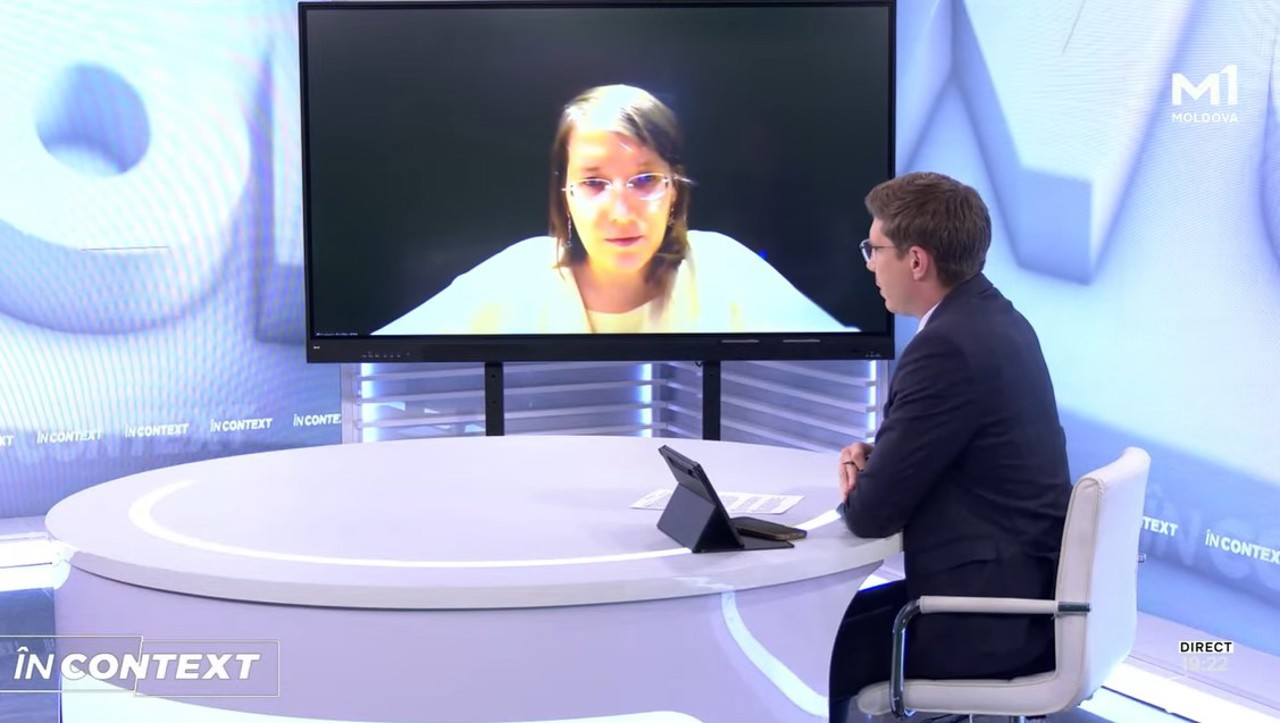
On October 20, EU Energy Ministers met in Luxembourg and decided to eliminate Russian gas imports by 2028 as part of the REPowerEU plan. They also discussed the energy security of Moldova and Ukraine. Eugenia Gusilov, director of the Romania Energy Center, highlighted during the IN CONTEXT program on Moldova 1 TV that, despite some member states' resistance, Brussels will enforce bans on Russian gas and require the development of energy diversification plans.
Ensuring gas stocks for the winter, ongoing priority
Amid Russia's ongoing military aggression against Ukraine and its impact on the entire region, the Energy Ministers of the European Union Member States met in Luxembourg, in a meeting with restricted access, to analyze, among other things, the energy security and resilience level of Ukraine and the Republic of Moldova before the cold season.
"Member States must ensure a 90% filling rate of storage facilities by November 1, it is still in force (the European regulation approved in 2022 - ed.). I believe that the member states have done their duty and made these storage facilities and I believe that the Republic of Moldova, too, has learned from last year's experience (...) and I believe that it has internalized these lessons and planned better for the winter that is beginning", said Eugenia Gusilov, on the show IN CONTEXT.
Giving up on Russian gas, a complex challenge for European companies
The EU aims to completely eliminate gas and oil imports from Russia by 2028, including liquefied natural gas (LNG), and the expert draws attention to the complexity of this transition, given that liquefied gas from Russia, but marketed by European companies, does not contribute directly to the Russian budget.
"Geologically, the source is Russia, the ownership is not Russian, so, practically, we are dealing with French companies that own this gas for which no taxes are paid to the state budget of the Russian Federation. Transported in the form of liquefied natural gas, it reaches the market in Western Europe. (...) This is an issue that, I believe, the Commission and the institutions in Brussels need to delve into more clearly and I believe that it would be a mistake to hit so many European companies, after all. But they are relying heavily on the alternative offered by the American national theater, which could make up for this deficit", explained the director of the Romania Energy Center.
Hungary and Slovakia's resistance to energy diversification
Despite the progress of many EU states, Hungary and Slovakia continue to resist the diversification of energy sources. Gusilov emphasizes that, three years after the energy crisis, European legislation could force their compliance.
"The problem is that these European Union member states have not really wanted to diversify until now, because we are not in the first month of the energy crisis. There have already been three and a half years of war and energy diversification. Many states have taken many steps, which have led to a result, namely diversification and have reduced their energy dependence and imports from Russia. It is clear that Hungary and Slovakia do not really want this diversification and are hiding behind certain excuses", noted Eugenia Gusilov.
European Union energy ministers approved on Monday, October 20, a total ban on Russian gas imports by the end of 2027, proposed by the Commission in the spring. Denmark, which holds the rotating EU presidency until the end of the year, hopes to secure final adoption by the EU Parliament by the end of this year.
Slovakia and Hungary, landlocked countries heavily dependent on Russian hydrocarbons, opposed the ban but were overruled by a qualified majority vote.
The EU has been trying to wean itself off Russian hydrocarbons since Russia invaded Ukraine in February 2022.
However, while it has almost completely stopped importing Russian oil, it remains largely dependent on Moscow for its natural gas supplies: Russia still accounted for 19% of the European Union’s total gas imports in 2024, compared to 45% in 2021.
To speed up this process, the European Commission proposed to member states in the spring to completely stop Russian gas imports by the end of 2027.
In September, the Commission also proposed bringing forward this deadline to the end of 2026, just over a year from now, for imports of liquefied natural gas (LNG).
This additional measure, proposed as part of the 19th “package” of new sanctions against Russia, was not on the agenda of Monday’s ministerial meeting, however.
For its part, the European Parliament wanted to go even further: its industry and trade committees approved a text on Thursday that aims to ban all imports of Russian gas, whether by pipeline or in the form of LNG, from 1 January 2026, with a few limited exceptions.