Trump and Putin's Donbas pressure: Ukraine's red line
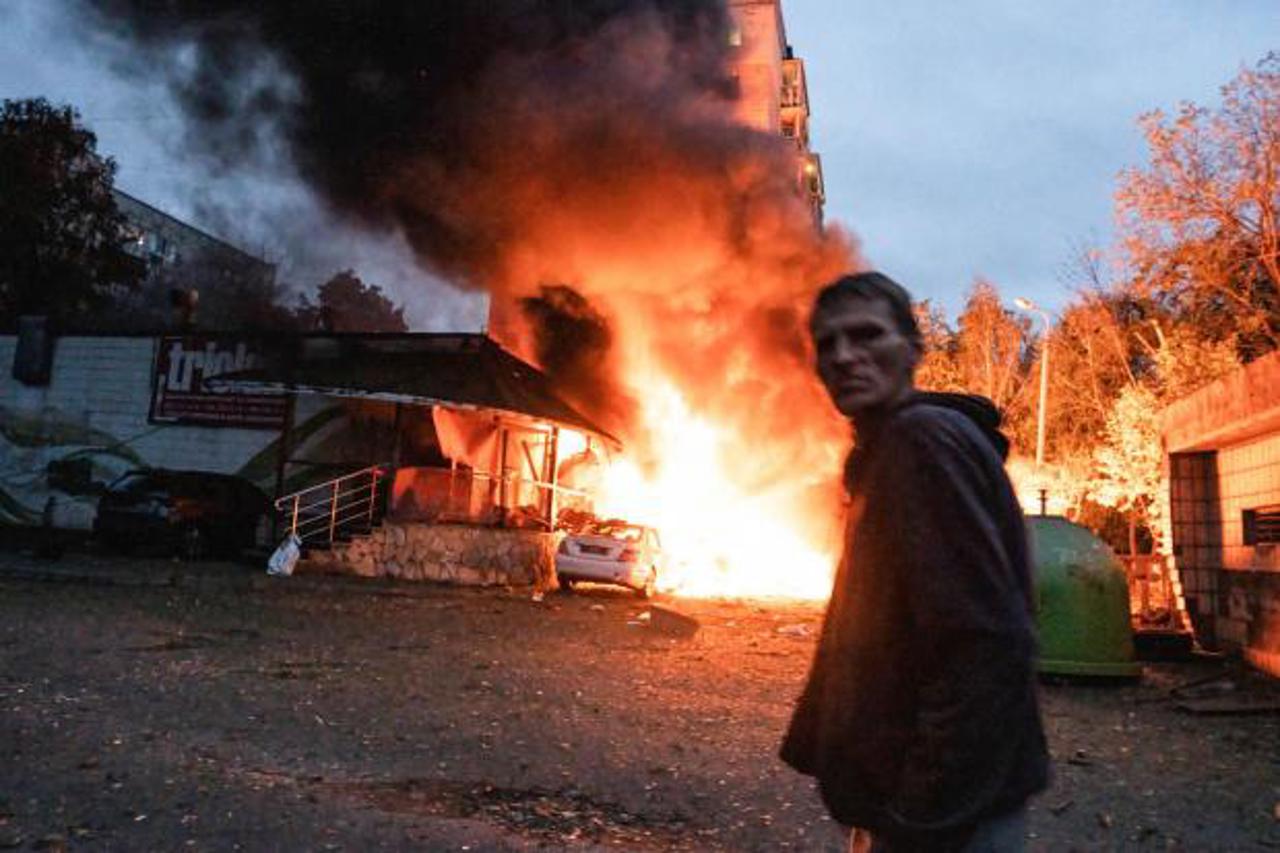
Russian President Vladimir Putin is once again trying to obtain through political and diplomatic pressure what he failed to conquer by force.
According to the Financial Times, Mr Putin is again trying to convince US President Donald Trump to pressure Ukraine into handing over the Donbas region – an eastern territory that Moscow has been fighting over for over a decade, The Kyiv Independent reports.
The US Special Envoy, Steve Witkoff, Trump's key intermediary with the Kremlin, reportedly told the Ukrainian delegation that Donbas should be surrendered because it is "largely Russian-speaking," which is, in fact, one of the Kremlin's oldest propaganda lines.
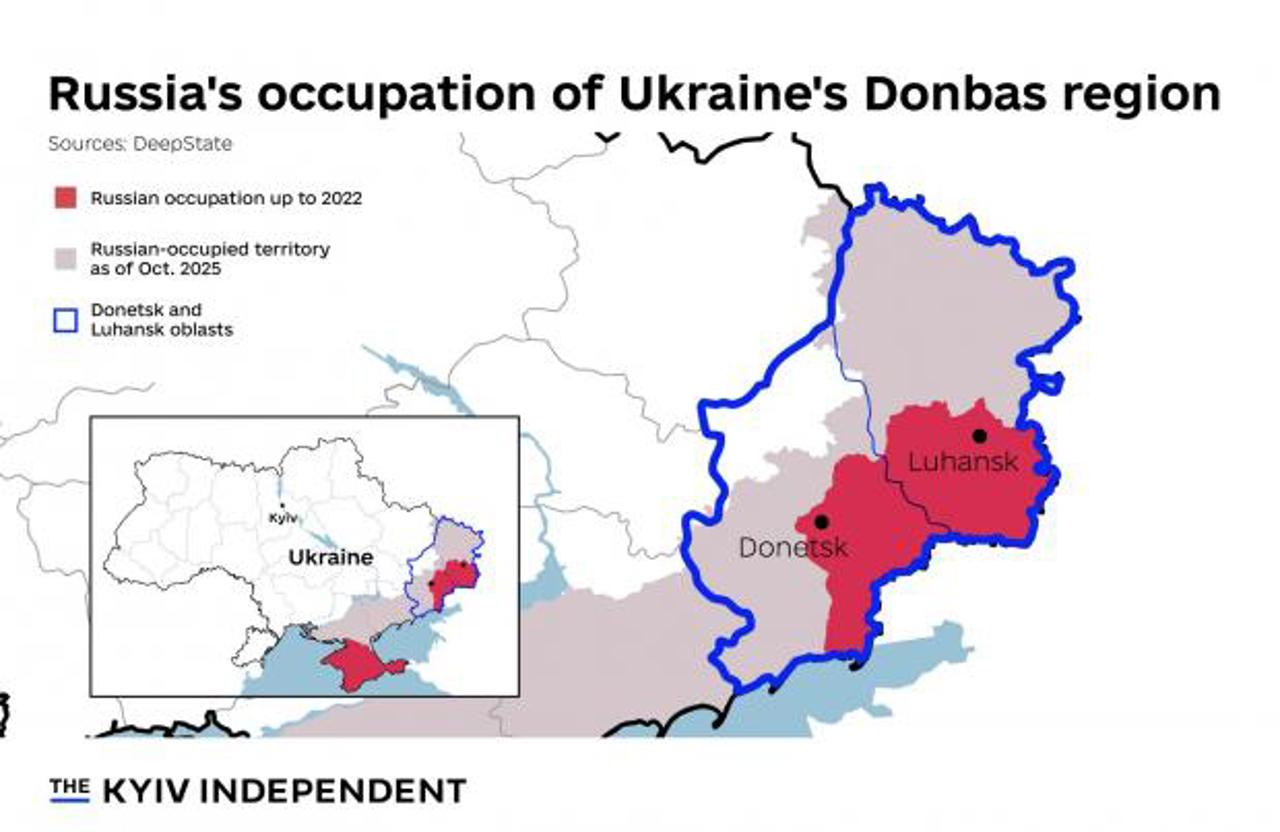
Where is the Donbas located?
The Donbas is a historical region in Eastern Ukraine. The term "Donbas" is an abbreviation for "Donets Coal Basin," named after the Siverskyi Donets River that flows through the region.
The word has been in use since the 19th Century and refers not only to the modern Donetsk and Luhansk regions but also to parts of Ukraine's Dnipropetrovsk region and even regions in Southern Russia, where the Siverskyi Donets River also flows.
The region is best known as the industrial and mining heart of Ukraine—a symbol of the country's heavy industry. However, some parts of the Donbas are also agricultural, with vast farmlands surrounding its industrial centres.
Donetsk and Luhansk, the two regions that make up the heartland of the Donbas, have long been economic powerhouses built on coal, steel, and machinery.
Russia’s War in Ukraine started in Donbas
Russia's war against Ukraine did not begin in 2022, but in 2014, with the annexation of Crimea and the invasion of the Donbas. This is why Ukrainians often refer to 2022 as the beginning of the full-scale phase of a war that had already been raging for years.
From the very beginning, Moscow tried to mask its aggression.
While it boasted about the annexation of Crimea, it denied involvement in its war in the Donbas, promoting a false narrative that alleged local "separatists" were responsible for the fighting.
In reality, there was no genuine separatist movement. The 'proxy republics' were Kremlin creations – armed, financed, and directed by Moscow as part of a broader campaign to destabilise Ukraine.
An economic engine for Ukraine
For much of Ukraine's modern history, the Donbas was its economic engine.
Before Russia's invasion, the Donetsk and Luhansk regions were home to hundreds of metallurgical, coal, and chemical plants that exported globally.
According to the London-based Centre for Economics and Business Research, the region accounted for about 15.7% of Ukraine's GDP and 14.7% of its population before 2014.
Russia's war changed everything. Activity at many of these enterprises came to a halt as Russian attacks damaged industrial assets, millions of locals fled the hostilities, and blockades between Ukraine and Russian-occupied territories abolished trade.
The invasion also led to a drop in international exports and foreign investment in Ukraine.
Between 2014 and 2021, the same research centre estimated that Ukraine lost $102 billion due to the war in the Donbas – about 8% of its pre-war GDP annually.
Nonetheless, many businesses continued to operate, despite a front line that moved closer after 2022.
Earlier this year, however, an essential Donbas coal mine was forced to close due to Russia’s advances in the area. It was Ukraine's last operational coking coal mine, dealing a blow to Ukraine’s economy.
Huge human cost, not just territory
The human cost of the war has been immense. Between 2014 and February 2021, at least 3,400 civilians and 4,400 Ukrainian soldiers were killed in Donbas, according to UN data. Nearly 20,000 were wounded.
At least two million people were forced to flee their homes due to the fighting. Approximately the same number of people continued to live under Russian occupation – amidst poverty, Kremlin indoctrination, and crossfire along the front line, as Ukraine repelled continuous Russian attacks.
Since 2022, Russia has destroyed numerous towns and villages in the region. In Mariupol alone, which was home to about 500,000 people before Moscow's full-scale invasion, estimates suggest that Russia killed up to 75,000 civilians.
The true cost of Russia’s war, beyond the figures, has not yet been fully understood.
“When you speak about the Donetsk region as a hot potato that can be passed along,” Oleksii Ladyka, a local journalist from Kramatorsk who now serves in Ukraine’s 92nd Assault Brigade, told The Kyiv Independent in August.
“I want them to remember that everyone here has their own family, loved ones, has a hope and a desire for a peaceful life and a future for their children, just like anyone else in the world,” he continued.
Russian-speaking region
One of Moscow's oldest myths is that the Donbas "naturally" belongs to Russia because many of its inhabitants speak Russian. In reality, language has never equated to nationality or political inclinations.
Before 2014, the vast majority of residents in Donetsk and Luhansk identified as Ukrainian citizens. Polls consistently showed that most wanted to remain part of Ukraine.
Russia has long exploited linguistic ties to justify its aggression—but speaking Russian does not equate to supporting Moscow.
A survey conducted by the Kyiv-based Razumkov Centre think tank between April 24 and May 4, 2025, found that 82% of Ukraine's Russian-speaking population expressed a negative view of Russia.
Russia's claims of "saving" Russian-speaking Ukrainians do not stand up against the widespread destruction. Years of neglect and war damage have left Russian-occupied areas of the Luhansk and Donetsk regions with barely functional infrastructure, leading to a water crisis in those regions in the summer of 2025.
Donbas – a military stronghold
The true reason behind Mr Putin's interest in conquering the Donbas is likely military in nature.
By mid-August 2025, Russia was occupying 19% of Ukraine's territory, according to Reuters.
The Luhansk region is almost wholly under Russian control, while Ukrainian forces continue to hold firm in parts of the Donetsk region—approximately 6,600 square kilometres, including the key cities of Pokrovsk, Sloviansk, and Kramatorsk.
For Mr Putin, full control over Ukraine's Donetsk region remains a primary demand.
As The Economist showed, the real reason lies in Ukraine’s so-called "fortress belt" – a 50-kilometre stretch of heavily fortified cities, from Sloviansk and Kramatorsk to Druzhkivka and Kostiantynivka.
This network of fortifications, trenches, minefields, and anti-tank barriers has been continuously consolidated since 2014. After the occupation of Bakhmut in 2023, Ukraine intensified its efforts to strengthen the line.
Former Defence Minister Andriy Zagorodnyuk told the Economist that enormous resources were invested in the defence network, turning Sloviansk and Kramatorsk into "fortress cities" – logistical hubs and industrial strongholds that have so far resisted Russia's advance.
What is the situation in Donbas now?
According to the Financial Times, during his meeting with Zelenskyy, Mr Trump repeatedly echoed Mr Putin's talking points—sometimes contradicting his own recent remarks about Russia's weakness.
Although he later claimed he did not ask Mr Zelenskyy to cede the Donbas, the meeting underscored the unpredictability of Mr Trump’s position and his openness to considering Mr Putin's maximalist demands.
For Kyiv, the idea of "trading away" the parts of the Donbas still under control remains politically untenable. It would mean surrendering territory that Moscow failed to conquer since the start of its 2014 invasion.
Translation by Iurie Tataru