EU REPORT | Moldova makes progress in justice, but faces major challenges in combating organized crime, migration, and border security

The Republic of Moldova is making notable progress in areas such as justice, combating organized crime, and border management. However, the effectiveness of law enforcement institutions remains hindered by limited resources, high staff turnover, and the need to fully align with EU standards and directives. This information is outlined in the latest enlargement report approved by the European Commission on November 4.
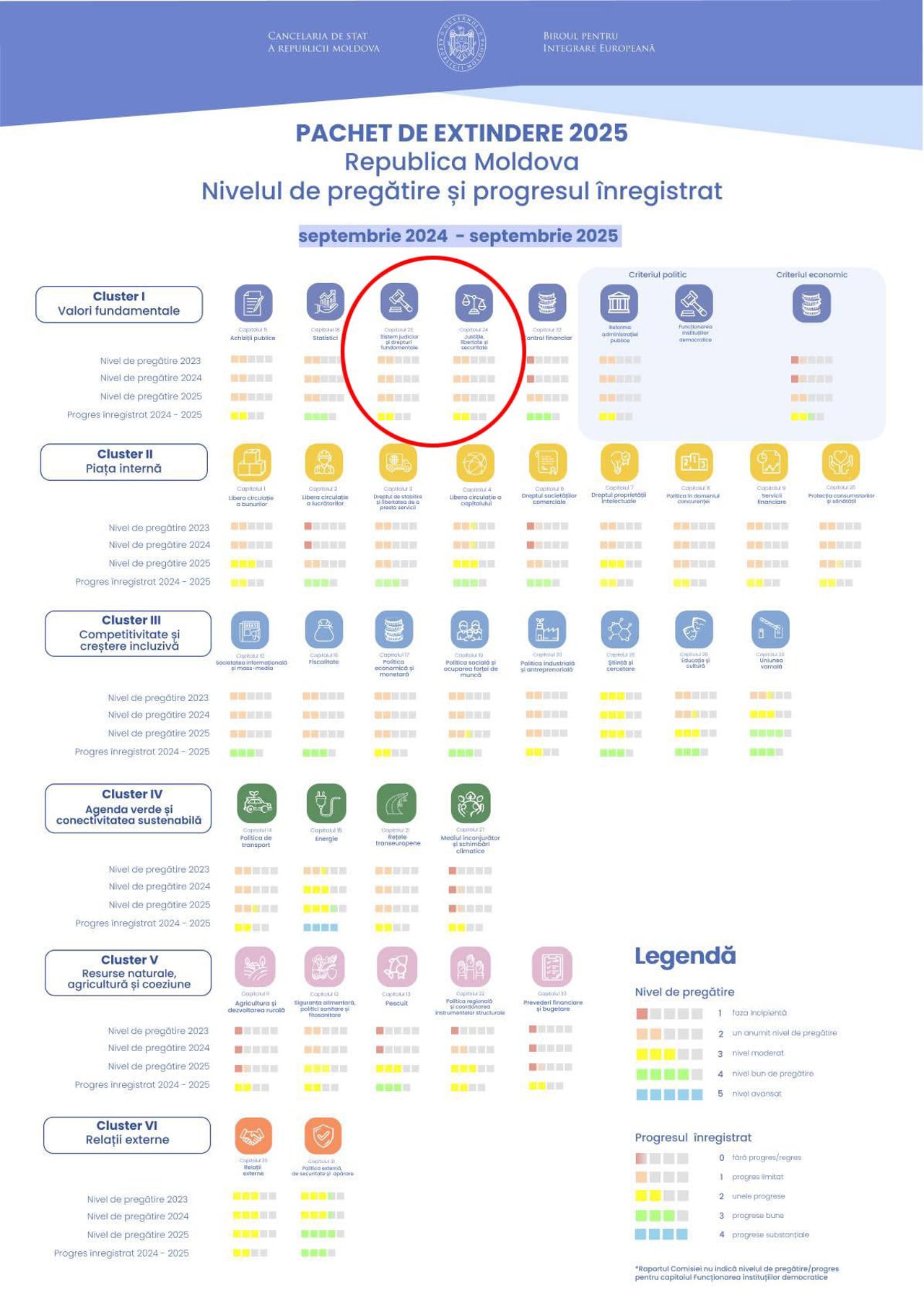
According to the document, the Republic of Moldova has made "some progress" over the past year in Chapter 22 - Judiciary and Fundamental Rights, as well as Chapter 24 - Justice, Freedom, and Security, which are part of Cluster I - Fundamental Values. The readiness of these two chapters for EU accession is considered to be at a "moderate" level.
Experts confirm that Moldova has made significant strides in reforming its judiciary and combating corruption, although hybrid pressures and the electoral context have slowed the implementation of important actions. They emphasize that these processes must be completed.
Progress in combating organized crime and asset recovery
Brussels has noted improvements in police cooperation, the recovery of criminal assets, and risk analysis in its recent report. In March 2025, reforms were enacted to strengthen the powers of the Agency for the Recovery of Criminal Assets (ARBI). Additionally, since 2024, a national registry for seized assets has been established.
The report emphasizes that “increasing transparency and efficient tracking of assets throughout the entire judicial process are essential.”
In 2024, the ARBI froze 102 assets valued at approximately 112 million lei. The Republic of Moldova is also actively participating in European platforms such as Europol, CEPOL, and EMPACT, contributing to cross-border investigations, particularly in the areas of drug trafficking and money laundering.
Challenges: Staff shortages, limited capacity, and enforcement issues
In terms of extended confiscation, authorities are encountering difficulties as there are few final convictions due to procedural appeals.
Although there is a legal framework that is partially aligned with EU standards, operational capacities remain limited. The report highlights a high staff turnover rate in law enforcement institutions and recommends that additional staff and financial resources be provided. It states, “A high number of departures and vacancies affects the operational efficiency of law enforcement bodies.”
Cybercrime and child abuse: ongoing reforms
The EU also notes, in the enlargement report for 2025, the absence of a national strategy against cybercrime and recommends strengthening the forensic laboratory and investigation capacities, including in the crypto-currency segment.
In parallel, legislative amendments to fully criminalize child sexual abuse are awaiting the final vote in Parliament.
In 2025, the National Center for Child Online Safety was also launched, and services for victims and juvenile offenders were expanded.
Migration, asylum and border protection: constant progress, increased pressure
The Republic of Moldova processed data on over 105,000 people displaced from Ukraine from 2022 to 2025 and received almost 8,000 asylum applications in 2024 alone, almost double the previous year. The asylum system is assessed as broadly satisfactory, meaning that it is broadly functioning well, but institutional capacity needs to be expanded, especially in the context of the reform of the Migration and Asylum Office into the new General Inspectorate for Migration.
As regards border management, the country has implemented the concept of integrated management and collaborates with Frontex, including through the presence of over 100 European officers at the borders. However, ‘second-line checks’ remain to be implemented.
‘Second-line checks’ mean additional and more detailed checks of passengers who raise suspicions at the border - for example, thorough document checks, interviews and consultation of extensive databases.
Trafficking in human beings and weapons
According to the European Commission, the Republic of Moldova has continued its initiatives to combat human trafficking, including through witness protection measures and regional cooperation. However, investigative capacities need to be strengthened, in particular to combat online exploitation of minors.
In the firearms segment, the authorities destroyed over 2,100 weapons in March 2025 and applied traceability markings to 1,112 weapons.
Terrorism and radicalization: strategic framework still insufficient
The assessment indicates the lack of a national strategy on the prevention of radicalization and violent extremism, as well as the absence of a coordinating institution at national level.
"The Republic of Moldova needs to develop a strategy and an action plan in line with the EU principles on the prevention of violent extremism", notes the European Commission.
At the same time, the European Commission appreciates the cooperation of the Republic of Moldova with European institutions and its active participation in security and crime prevention platforms. However, the country needs to accelerate structural reforms, improve operational capacities and complete legislative alignment in order to advance in the accession process.
Expert: "There are lessons to be learned at home"
Justice and anti-corruption reforms have made progress in the Republic of Moldova, but significant challenges remain in terms of resources, pace, and institutional coordination, according to legal expert Ilie Chirtoacă, president of the Legal Resources Center. He emphasizes that while the state has achieved important transformations, “the processes must be completed.”
"The Republic of Moldova has made some progress in the area of justice, as well as in the fight against corruption, as the data shows," Chirtoacă stated in an interview with Teleradio-Moldova.
The expert notes that the external evaluation of judges and the functioning of the Superior Council of Magistracy and the Superior Council of Prosecutors are positive developments, but the side effects of the vetting process are evident within the system.
“The duration of trials requires attention. This is essentially a result of the vetting process, since many people have left the system. The rate of case resolutions has decreased, and efforts are needed to improve this aspect. This can be achieved not only through new appointments but also by making the current system more efficient,” he explains.
Chirtoacă also emphasizes the importance of combating systemic corruption, particularly within the justice sector. Despite some encouraging signs, he insists that reforms must be completed urgently.
“The Republic of Moldova has recently established specialized anti-corruption panels, which is a positive step. However, the legislation does not currently mandate the vetting of judges serving on these specialized panels. One of the recommendations is to implement this vetting,” he highlighted.
In Chirtoacă’s view, strengthening the National Integrity Authority is also crucial.
He believes that hybrid pressures and the electoral context have hindered some reform processes, stating, "Law enforcement institutions, instead of focusing on advancing the European integration process, have been forced to respond to these hybrid attacks within an electoral context."
We would like to highlight that, according to the Report on the Enlargement of the Community Block, the Republic of Moldova has made the most significant progress in a single year toward EU accession.
Chișinău aligns itself 98 percent with the EU's Common Foreign and Security Policy and hopes to complete accession negotiations by 2028. The first clusters of negotiations are expected to be opened by the end of this year.