Minister Cristian Jardan: "The Russian Science Center has become a Kremlin propaganda tool"
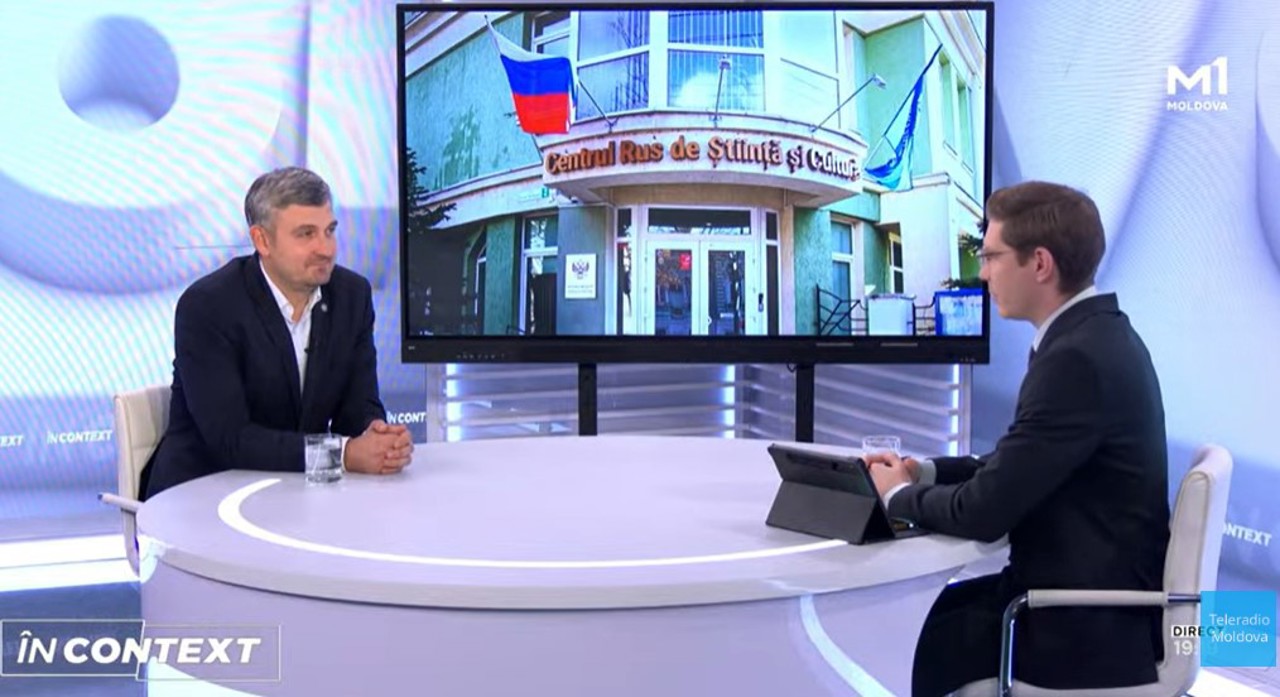
The Russian Center for Science and Culture, known as "Ruskii Dom," in Chisinau has become a propaganda tool for the Kremlin, a fact recognized at the European Union level. Minister of Culture Cristian Jardan stated on the IN CONTEXT show on Moldova 1 TV that the opposition parties' exaggerated reaction to its closure clearly indicates whose interests they serve. On November 5, the government announced the termination of the 1998 Cultural Agreement, following the decision's approval in Parliament and the official notification from Moscow regarding the closure of this entity.
"This cultural center was initially intended to promote cultural exchange, but in recent years, it has unfortunately become a tool for Kremlin propaganda. This has been acknowledged by several countries, particularly within the European Union, and even at the EU level. Since Russia's unjustified aggression against Ukraine in 2022, the 'Rossotrudnichestvo' agency, which oversees this center, has been placed under European sanctions for promoting Kremlin propaganda, specifically the idea known as 'Russkii Mir' (Russian World)," declared Cristian Jardan.
According to the minister, while the centre has been operating since 2009, its original mission has been abandoned.
"In the official documents of 'Rossotrudnichestvo', there is mention of 'Russkii Dom' (Russian House), which operates based on an agreement signed in 1998 and ratified in 2001. The Russian Center for Culture and Science in Chisinau opened in 2009. Initially, the intentions may have been noble, aiming to promote cultural exchange, especially since Chisinau expressed interest in establishing a similar center in Moscow, which never materialized," Jardan explained.
He also noted that all the employees at the Chisinau center are Russian diplomats, raising questions about the institution's true purpose.
"What is happening in Tiraspol is beyond our control. Officially, it is presented as a contact point for the 'Rossotrudnichestvo' agency. If we follow their Facebook page, we see actions that suggest a different agenda, likely coordinated directly from Moscow. However, in the case of the center in Chisinau, all its administration and employees are diplomats from the Russian embassy. I am unaware of any other cultural center in the world being led and managed entirely by diplomats," the Minister of Culture stated on public television.
Cristian Jardan added that the authorities had previously intervened, through the Ministry of Foreign Affairs, to reduce the Russian diplomatic staff.
"We took action, along with colleagues from the Foreign Ministry, to reduce the number of staff at the Russian embassy, as it was excessively large. We understand that many of these individuals were involved in this center. I regret to say this, but it is the truth: this is not a cultural center; it has turned into a propaganda center in recent years," the minister pointed out.
Cristian Jardan also cited examples of other countries that have decided to close similar institutions, even without legal constraints like those in Chisinau.
"You previously mentioned the closure of similar centers in other former Soviet states. In Ukraine, the reasons are quite evident. Recently, in 2025, Azerbaijan also closed such a center without any existing treaty. Now, the Russian Cultural Center in Chisinau is protected by the agreement signed in 1998, and unfortunately, we cannot intervene beyond the limits of this agreement," concluded Minister of Culture Cristian Jardan.
The Chisinau government has officially denounced the Cultural Agreement with the Russian Federation, six months before its expiration. This agreement includes the closure of the Russian Center for Science and Culture in Chisinau. The decision will be validated by Parliament, after which the Russian Federation will be officially notified.
Moscow has described the decision as "regrettable" and "contrary to the interests of the Moldovan population," while the Socialist Party has called for a return to "balanced dialogue" with the Russian Federation.
It is important to note that the Agreement on Cooperation in the Field of Culture between the Republic of Moldova and the Russian Federation was signed in October 1998 and entered into force in July 2001. Based on this agreement, the Russian Center for Science and Culture in Chisinau, known as the "Russian House" (Ruskii Dom), was created in 2009 under the patronage of the "Rossotrudnichestvo" agency. This agency is directly subordinate to the President of the Russian Federation and the Russian Ministry of Foreign Affairs, and it is included on the list of international sanctions by the European Union for promoting "soft power" and the concept of "Russian World" (russkii mir).
Following the outbreak of Russia's war against Ukraine, the Chisinau authorities accused the Russian Center of engaging in propaganda and hybrid influence activities while masquerading as a cultural cooperative. The Ministry of Culture, at the request of the Ministry of Foreign Affairs, initiated the process to terminate the agreement, citing it as a risk to the information security and internal stability of the Republic of Moldova.