Europe must cut US reliance on defence, Romanian officer warns
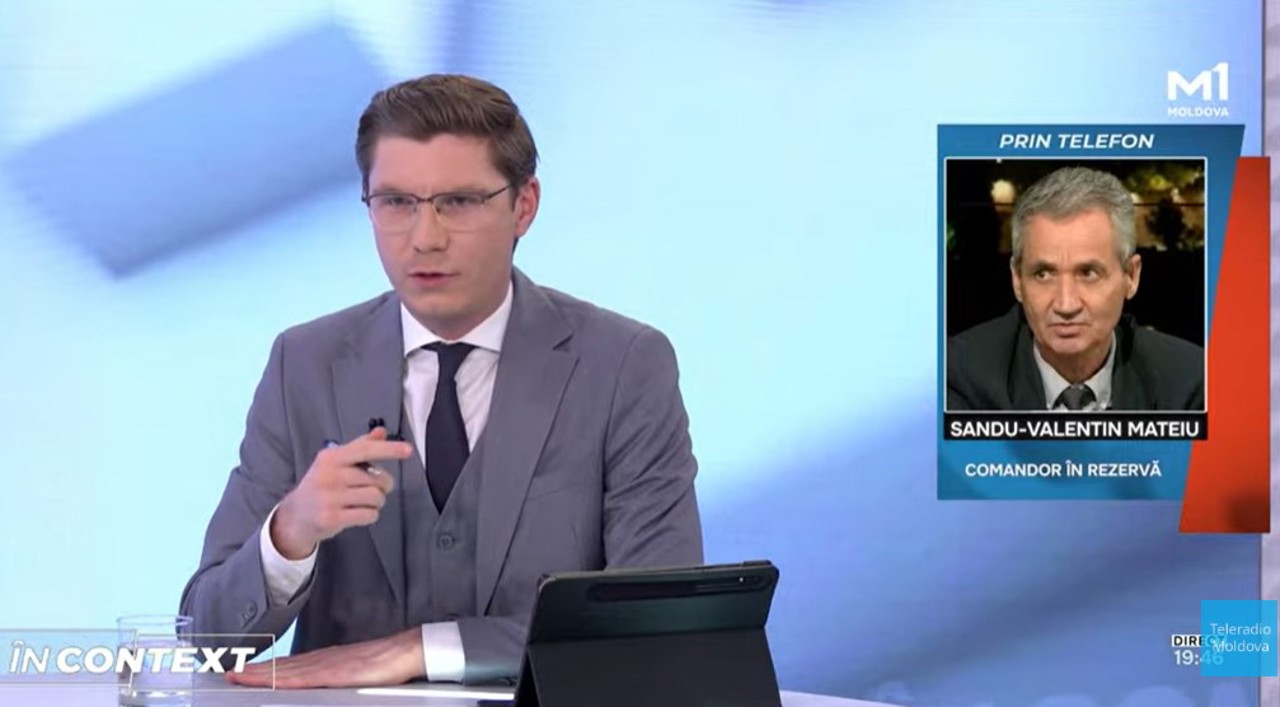
The geopolitical context has fundamentally changed how NATO and Europe conceive of collective defence, states Retired Romanian officer Sandu-Valentin Mateiu.
Investments in military technology and regional cooperation, including with Moldova, are essential for countering threats and strengthening NATO's position against Russian aggression, Mateiu stated on the "ÎN CONTEXT" (IN CONTEXT) show on Moldova 1.
According to the Romanian officer, Europe must take an active role in its own defence, reducing dependency on the US and increasing solidarity with Ukraine, the frontline of continental security.
"It all started with Russia's aggression against Ukraine, which automatically demanded a NATO reaction. Europe is addressing the conflict in Ukraine by committing to support the country. Europeans are no longer thinking as they did in 1938, waiting for the aggressor to take country after country; instead, they are saying: our security begins in Ukraine. Regarding the Cold War aspect, Europeans are starting to arm themselves after becoming complacent with the assumption that the Americans would defend them," Mateiu noted.
The officer explained the strategic necessity of defence investments, highlighting that current threats are forcing a reevaluation of resource allocation.
"The Bucharest Forum gathered key figures from the military, the defence industry, and politics to determine how the industry should equip the military. Generally, we, as Westerners, don't like the idea of spending money on weapons; we prefer our children to live in peace and to spend the money on education, health, research, and anything else. But if the threat has emerged, we are obliged to do this," Mateiu said.
Analyzing defence industry capacity, Mateiu drew a clear distinction between the approaches taken by the US and Europe. He highlighted Europe's recent efforts to revitalize its industry, mentioning France and Germany, which have maintained or relaunched production capacities, as well as the challenges faced by East European countries, affected by the "post-communist failures of underfunding and bankruptcies."
"Here, I would divide it based on our regional structure. The US has continuously produced high-performance weaponry, and the American defence industry has worked for the United States or for export. The important thing is that they maintained this dynamic. The European defence industry, in contrast, has produced more for export," the retired Romanian officer compared.
Mateiu also told the public broadcaster that West European countries have begun to prioritize defence, reflecting a strategic reorientation of Europe towards military self-sufficiency.
"When the necessity arose, we have now returned to the origin, in the sense that those in the West have started to invest heavily in the entire defence industry of Great Britain, France, Germany, Italy, but there are also countries the size of Sweden that possess truly exceptional defence capabilities," the retired Romanian officer communicated.
The same source identified significant potential for Romania, due to its resources and competitive workforce.
"Romanian companies stand to gain from this German investment opportunity in Romania. For us, it is a chance; Westerners will invest money and technology in our defence industry. We have the resources: you have cheap, trained labour, you have locations, facilities, and industrial platforms. The only thing is to get the process moving with the technology and the investment," Mateiu said, referencing a recent contract for a powder factory in Romania.
Regarding the challenges generated by Moldova's neutral status, Mateiu emphasized the opportunities for cooperation between Moldova and Romania for integration into the European defence ecosystem.
"For Moldova, it is an opportunity, but it is quite difficult. Moldova is, first of all, not in NATO. Also, it is a candidate country for the European Union, and access to the SAFE programme will be granted, but not as it is for Romania. However, I believe there are very large possibilities exactly through the Romania channel. If we manage to develop the defence industry, cooperation with Moldova is simply a matter of getting across the Prut River—nothing more. Otherwise, software companies or other firms in Moldova can easily interact with the defence ecosystem," the retired Romanian officer concluded.
Mateiu's statements coincide with the first official visit of NATO Secretary General Mark Rutte to Romania, where he discussed with President Nicușor Dan and others support for Ukraine and Moldova, the modernisation of the Romanian defence industry, and the consolidation of military capabilities. Rutte reaffirmed NATO's commitment to collective defence, in accordance with Article 5.
President Nicușor Dan declared at the NATO Industry Forum 2025 that defence investments are a "geopolitical necessity," while Rutte warned that the Russian threat persists beyond the conflict in Ukraine.
The event consolidated Romania's position in regional security and the defence industry.
Translation by Iurie Tataru