Moldova accelerates reforms for EU accession by 2030, says Munteanu
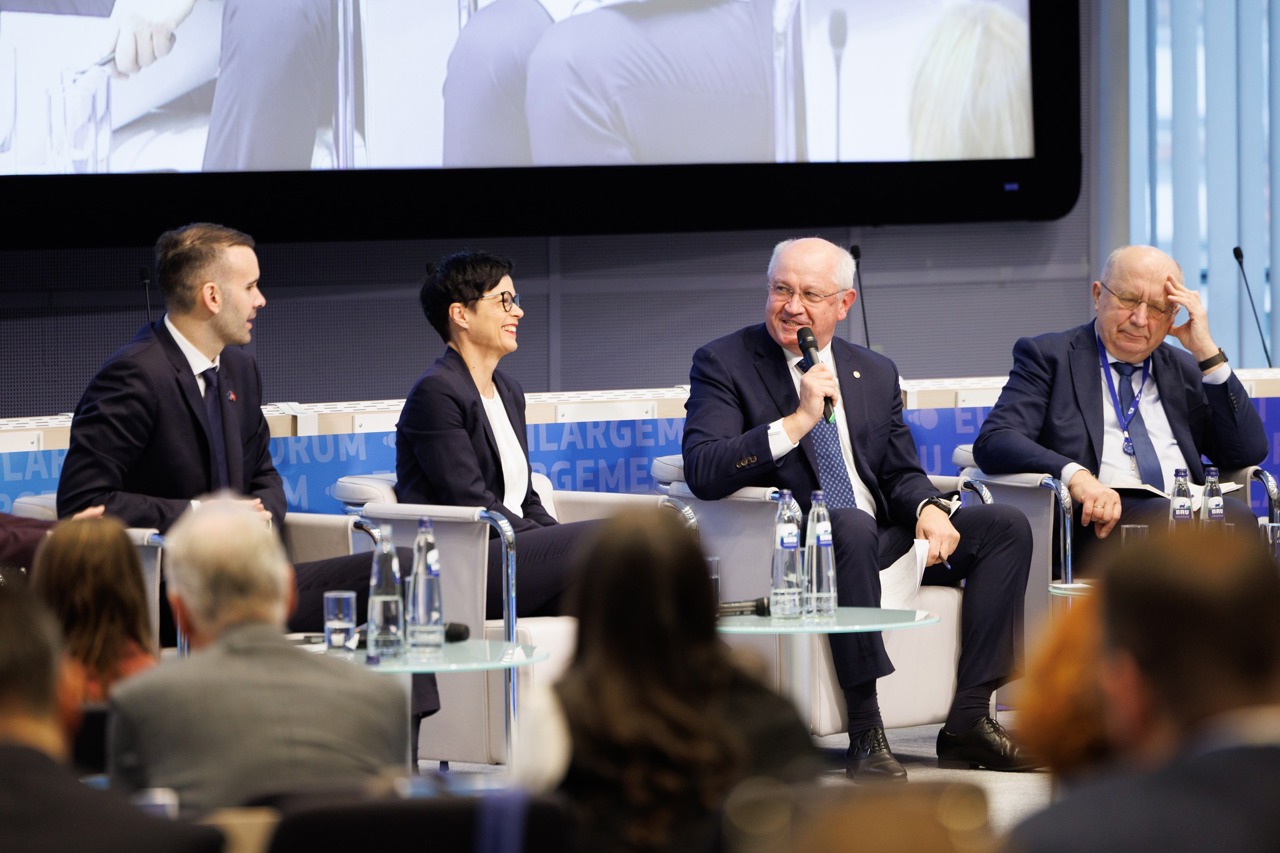
The Republic of Moldova is accelerating reforms and preparations for EU accession by 2030.
Speaking at the European Business Summit in Brussels on November 18, Prime Minister Alexandru Munteanu announced that the nation’s economy is now firmly back on a path of economic growth, with exports, digitalization, and investments structurally transforming the country.
"The Republic of Moldova has made its choice. We embrace Europe fully and without hesitation; the country is returning to where it belongs, in a space of freedom, opportunities, and development," the Prime Minister affirmed.
Munteanu addressed the recent period of global turbulence. "We have faced enough unpredictable events, those 'black swans' that Nassim Taleb talks about: a pandemic, regional energy crises, external interference, and now a major war on our border."
Despite these shocks, he emphasized that the Moldovan economy is not only stable, but accelerating, a resilience underpinned by strong performance across key sectors.
He confirmed the stabilization of the economy after the years of crisis, providing specific data: "In the second quarter of 2025, GDP increased by 1.1% year-over-year and by 1.6% compared to the previous quarter."
The Prime Minister highlighted the key growth engines: "The construction sector is growing by 7.2%, energy by 20%, and ICT by 2%. Furthermore, services exports are 10% higher and now exceed goods exports by over 26%."
Munteanu stated that the Republic of Moldova is registering the fastest progress among all EU candidate states.
"We are determined to become a full member state by 2030. Our European path is a national project. It's not just about reaching the finish line quickly, but about becoming the best version of ourselves every day. We are determined to maintain this speed and make the Republic of Moldova a full member state of the European Union by 2030," he declared.
The Prime Minister also described the EU Growth Plan for the Republic of Moldova as transformative, calling it the largest support package in the nation's history.
"Over 150 reforms will be implemented by 2027. The Growth Plan is estimated to raise the pace of economic growth up to 7% by 2028."
Munteanu pointed to new opportunities: "On September 4, we launched the first Strategic EU - Moldova Investment Call in six priority sectors, with projects starting from 10 million euros and a mandatory 15% own capital contribution. This is more than mere assistance. This represents the entry of the Republic of Moldova into the European investment architecture, a system that mobilizes private capital alongside European financial institutions."
The head of the Executive recalled the recent trade liberalizations, noting that "68% of Moldova's exports go to the EU." He added: "We have become the largest exporter of plums to the EU, and we already export poultry, eggs, and fresh meat."
Munteanu also announced the elimination of Soviet standards. "By January 2026, all GOST standards will be eliminated. We have adopted 100% of the voluntary European technical and safety standards and 90% of the global ICT standards."
Digitalization remains an essential direction.
"By 2030, the Republic of Moldova will be a fully digital state. Roam Like at Home will take effect on January 1, 2026, and we will train 1,000 artificial intelligence specialists by 2028," the premier stated.
"The Republic of Moldova is open. The Republic of Moldova is competitive. The Republic of Moldova is ready. We are part of the same family," the Prime Minister concluded, addressing the European business community.
Alexandru Munteanu's participation in this edition marks his first visit to Brussels as Head of the Executive. It represents a significant step in positioning the Republic of Moldova in the European economic circuit and strengthening its EU accession path.
The European Business Summit is one of Europe's most important economic events, organized annually in Brussels. It convenes political leaders, European Commissioners, economists, company directors, and global investors.
The Summit serves as a strategic dialogue platform between the business community and the European Union's decision-makers, addressing competitiveness, investment, innovation, and the future of the European economy.
Translation by Iurie Tataru