Moldova state budget 2026: PAS and PSRM clash over capital investments
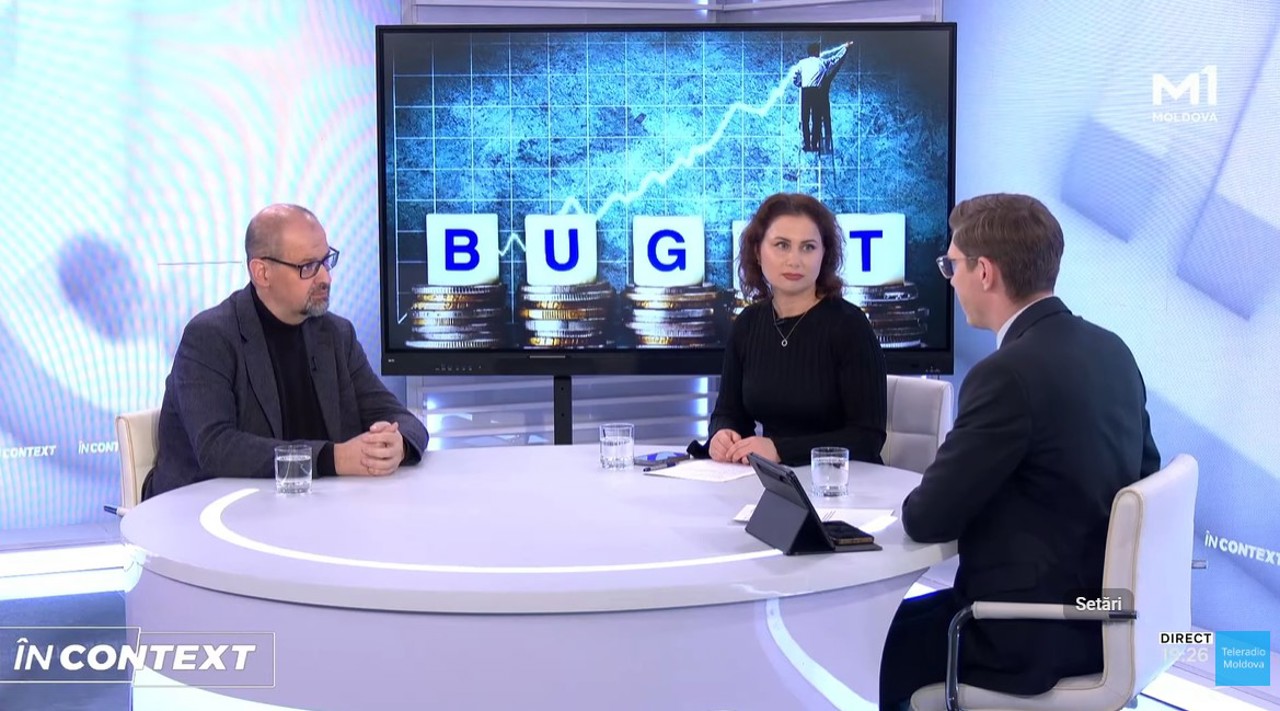
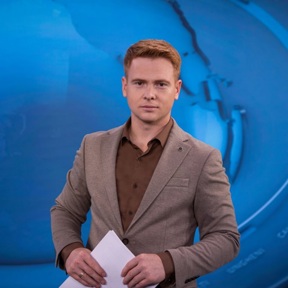
A heated dispute over the Draft Moldova State Budget Law for 2026, approved by the Government on December 4, took place between Deputy Larisa Novac of the Party of Action and Solidarity (PAS) and Deputy Adrian Lebedinschi of the Party of Socialists of the Republic of Moldova (PSRM) during the "ÎN CONTEXT" show on Moldova 1.
The opposition contends that the three billion lei allocated for capital investments is a meager sum, while the ruling party asserts this allocation is unprecedented and one billion lei higher than the current year's figure.
Socialist Deputy Adrian Lebedinschi vehemently contested the classification of the sum as an investment, arguing that its lack of a multiplier effect renders it nothing more than simple current expenditures.
"Three billion lei for capital investments is a very small amount for the budget. We must analyze what these capital investments truly are and in which fields they are targeted. If they fail to produce added value or bring supplementary revenues to the budget, then they are not capital investments; they are just current expenditures," Lebedinschi stated. "We are not only talking about the fact that we spent borrowed money at that moment."
The Government’s Response: A Focus on Responsible Investments in the 2026 Budget
PAS Deputy Larisa Novac defended the project, emphasizing that the 85 projects span essential sectors.
"Perhaps it is not sufficient, that is true. But for the first time, we have this three-billion-lei sum—one billion more compared to last year. These are 85 capital investment projects in key areas such as transport, energy. We certainly need interconnections. We need education, health, and environment projects," Novac noted.
She described the budget as a budget focused on responsible investment, designed to generate sustainable economic growth and consistently increase the population's income.
"The proposed budget for 2026 is the budget of responsible investments. We aim to ensure sustainable economic growth through this budget so that we can constantly increase the population's revenues. That is our promise and commitment," the PAS deputy added.
"It depends on how we view the budget deficit – it is largely formed because we want to invest more. We will use the instruments at our disposal, such as organizations for entrepreneurship development, to support farmers and businesses, thereby creating jobs and securing higher incomes for the population," she concluded.
"Investments are only those that bring added value"
Adrian Lebedinschi insisted that social infrastructure projects, however vital, should not be labeled as investments in the economic sense.
"Important projects, very important—yes, I agree. But do not call them investments, because they are not investments; they are necessary state expenditures," he countered. "If we manage to build at least one school next year, that will be a plus. We will build a kindergarten, or at least finish the hospital project in Bălți. These are not investments; investments are the projects we proposed, the ones that will provide added value and bring money into the national economy."
"Let there be public-private partnerships (PPP) where the state intervenes with a portion of the funds. We would even accept loans," was Lebedinschi's sharp reply.
He then framed the budget as a consumer loan taken by a poor family, without real prospects of repayment.
"I would compare the 2026 budget like this: the minimum wage in the economy is 6,000 lei. A two-person family has 12,000 lei in income, and with that income, they borrow an additional 3,000 lei for upkeep, resulting in 15,000 lei total. This is a consumer loan at 20 percent annual interest," the PSRM deputy rhetorically asked. "Imagine that this person has no guarantee of being able to repay the money. That is the 2026 budget. How and who will repay it?"
"We must ensure development in localities"
Larisa Novac brought the discussion back to the pressing needs of localities and the concrete support promised to citizens.
"We have a program highly requested by mayors called the 'European Village' program. I want to ask you: what should we tell the mayors? That we won't fund projects to connect localities to water and sewage, to build schools, repair kindergartens, medical offices, or repair roads?" Novac replied.
"We must ensure development in all localities. We will allocate money for this. For roads—650 million in 2026. For farmers, we will allocate 2.2 billion lei, because this is what we discussed and what farmers are requesting, and we must support them. These are important projects for the people," she concluded.
End of the Show: Accusations of Political Discrimination (PAS vs PSRM)
Tempers flared at the end of the broadcast. Adrian Lebedinschi accused the government of politically discriminating against opposition mayors: "I agree, give to everyone. Give to those from other parties, and to the blackmailed mayors—give to all of them."
"Yesterday Mr. Bolea (Deputy Prime Minister Vladimir Bolea) posted the list with the roads [to be renovated]. Look how much will be given to the socialists!" PAS Deputy Larisa Novac shot back.
The Moldova state budget 2026 was approved by the Government with revenues of 79.6 billion lei and expenditures exceeding 100.5 billion lei. Consequently, the budget deficit for 2026 stands at 20.9 billion lei, or one-fifth of the planned expenditures.
The main categories of expenditures detailed are: over 3 billion lei for the economy, nearly 640 million for public order, over 630 million for education, nearly 590 million for health, and approximately 371 million lei for environmental protection.
In the investment segment, allocations include 1.1 billion lei for small and medium enterprises, 465 million for the development of agriculture and rural environment, and 195 million for the Railway.
The Government's Reserve Fund will amount to 150 million lei, and the Intervention Fund – 230 million lei.
Translation by Iurie Tataru