Moldova’s high divorce rate: 9,500 dissolutions against 14,800 marriages

Marriage numbers are plunging while the high divorce rate remains an alarming constant.
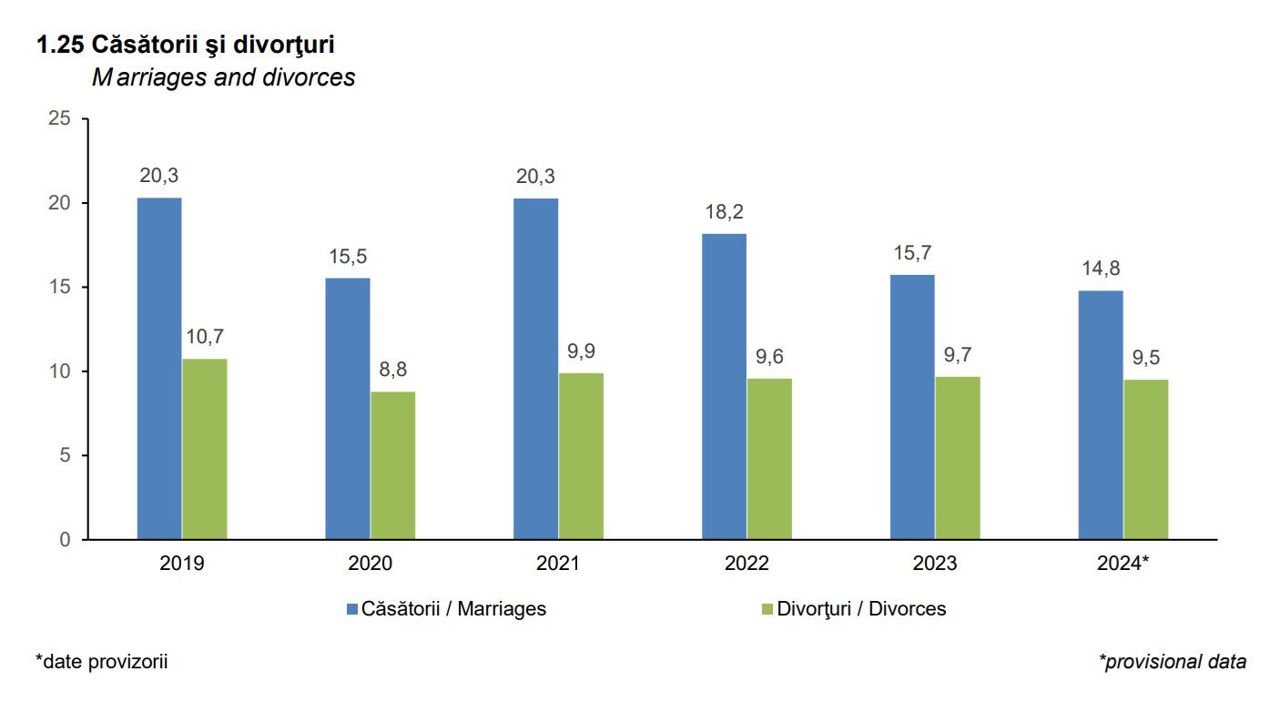
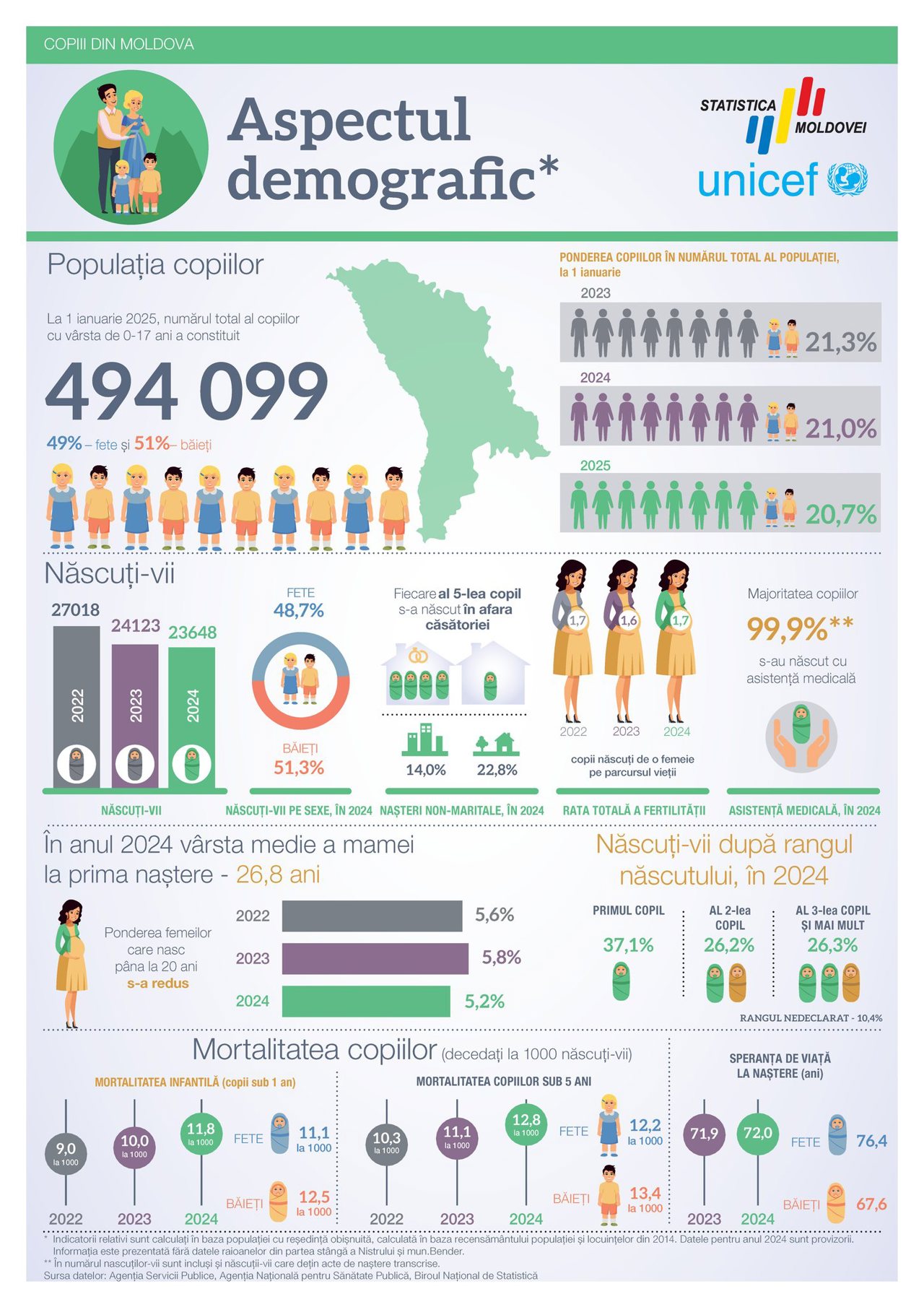
Consequently, the traditional family in the Republic of Moldova faces a prolonged crisis. The "Children of Moldova 2025" report, published on December 5 by the National Bureau of Statistics (NBS), reveals the stark reality: 14,800 marriages were registered in 2024, against 9,500 divorces. Specialists affirm that these figures are driven by profound societal transformations fueling the Moldova family crisis, including mass migration, economic pressures, and changing social values.
Demographer Valeriu Sainsus notes that Moldova's trajectory now mirrors the challenging family dynamics observed in Western Europe during the 1970s and 1980s, where mobility, material hardship, and cultural shifts eroded marital stability.
"Fewer and fewer young people of marriageable age are entering the demographic circuit. We are in the exact reality that France went through in the '70s and '80s, only for us, the marriage instability is far more severe here," the expert told Teleradio-Moldova, highlighting the nation's demographic decline in Moldova.
The Impact of Migration
The report paints a vivid picture: 16% of families with children have at least one member working abroad. Sainsus confirms that this phenomenon shatters family bonds over the long term.
"Long-term emigration of a family member is a major factor of instability. In many families, one parent leaves, and the other is left alone with the children," the demographer stated.
Another key trend is the sharp rise in births outside of marriage. "Births are increasingly occurring outside of marriage. This shows the devaluation of the family institution. This is not a novelty given the demographic shifts we are experiencing," Sainsus added.
Rural Divorce Rate Surpasses Cities
For the first time in recent history, the divorce rate is higher in rural areas than in cities—a phenomenon the expert labels "unusual and alarming."
"Traditionally, in Europe, divorces were more common in cities. With us, the rate is now higher in villages. This is the harsh impact of migration," Valeriu Sainsus explained.
The report highlights that 10.5% of households with children are single-parent households, a direct consequence of divorces, separations, and departures abroad. The emotional and social impact on children is significant.
"Single-parent families cannot cover social risks. What a single parent can provide cannot replace the family life and values a child receives from both parents," Sainsus noted.
The expert also stressed the diminishing influence of moral and religious values on maintaining family stability. "The status of the family is being devalued. And, with the reduction of religious values, the role of the family in educating younger generations also decreases," he emphasized.
Delayed Marriage and Financial Strain
Sainsus observes that young people are struggling to enter marriage and give up on their unions much easier.
"Young people enter marriage with more difficulty and give up much more easily. Children no longer appear immediately, and if a child does not appear within two to three years, the risk of divorce increases enormously. Conversely, families with two or more children divorce much less frequently. Responsibility for the young generation keeps them together," the expert asserts.
Poverty and material shortages remain a powerful catalyst for family breakdown. "Shortages and shortcomings have always been a cause of divorce. When the mother earns more than the father, there is an increased risk of conflict and breakdown," Sainsus added.
The demographer warns that the absence of clear government policies to support young families risks accelerating the nation's demographic decline in Moldova.
"In some states, young people receive real support when forming a family. Here, there is no consistent support to motivate young people to marry and have children," he stated.
The consequence is clear in the low birth rate: "I remain pessimistic. We could reach only 15,000 births annually in a country of two million. And we have no guarantee that those children born in the diaspora will ever return. It is crucial for the state to support the family at the exact stage when it is formed and reproduces. Otherwise, family stability and the future of children remain profoundly vulnerable."
Sainsus concludes that family and marriage are undergoing profound transformations, shaped by migration, modernization, and shifting values. The age at first marriage is consistently rising, couples are establishing families later, and cohabitation is often chosen over formal marriage.
He attributes this fragility to "economic instability, labor migration, and the reduction of the role of traditional and religious values which weaken family cohesion, reflected in the decrease in marriages and the maintenance of a high divorce rate."
"In this context, the family structure becomes more fragile, and the probability of a child growing up in a single-parent household or a family affected by migration is higher than in previous decades," Valeriu Sainsus concluded.
Translation by Iurie Tataru