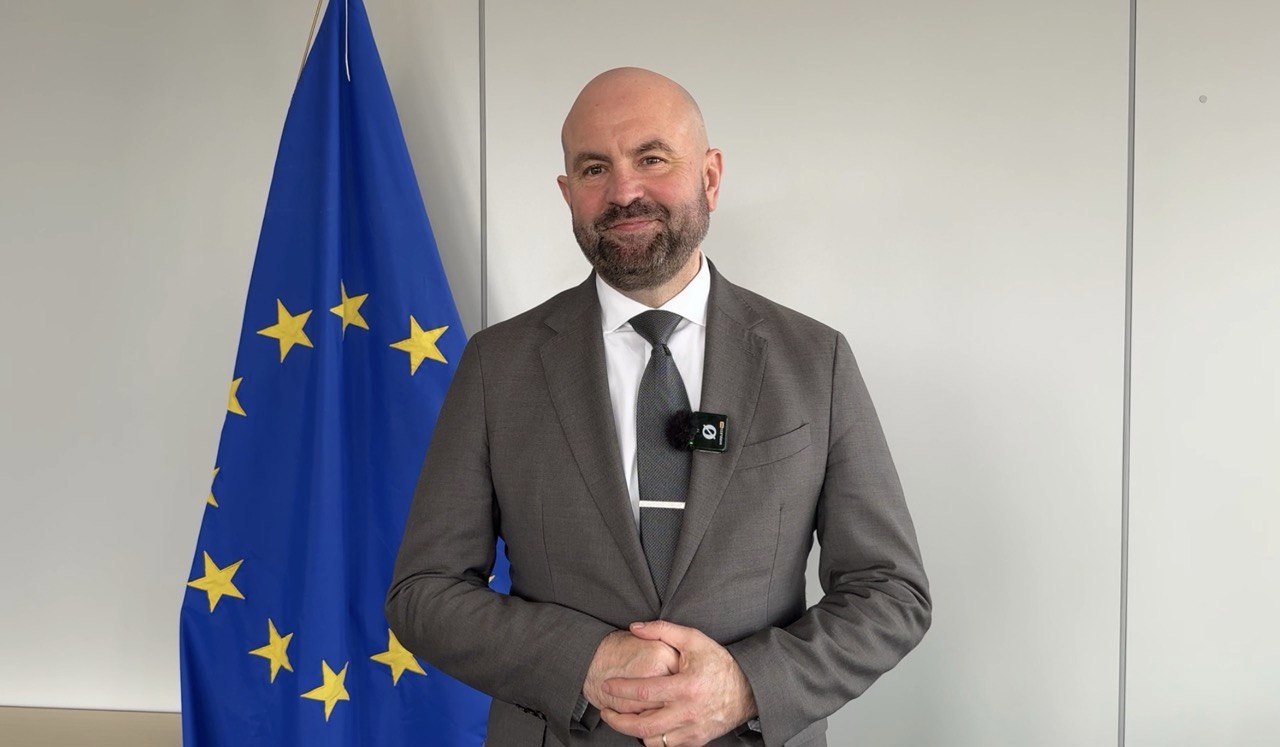
Vladimir Bolea: Moldova could become a key logistics hub in Eastern Europe
The initial 5.1 kilometers of highway will be constructed in the Republic of Moldova, with Romania's support. In April 2026, Romania will sign a contract with the company responsible for the construction work.
The announcement was made by Vladimir Bolea, the Deputy Prime Minister and Minister of Infrastructure and Regional Development of the Republic of Moldova, during a high-level dialogue in Brussels on March 5 and 6. This event brought together representatives from the European Commission, Romania, and Ukraine and focused on enhancing regional cooperation in transportation and coordinating efforts to develop logistics routes in the region.
In an exclusive interview with Moldova 1, Bolea mentioned that Romania plans to sign a contract with a construction company in April 2026 for the first 5.1 km of highway on Moldovan territory, extending to Berești in Suceava County, Romania. This section is part of the A1 highway and connects to the end of Romania’s A8 highway via the Ungheni Bridge.
Bolea expressed gratitude to the European Union for including Moldova in the SAFE program, stating, “This money is being offered to Romania in the form of a loan, and it will fund the construction of this 5.1 km segment of the A1 highway within the Republic of Moldova.”
The agenda for the quadrilateral meeting, which included representatives from the European Commission's Directorate-General for Mobility and Transport (DG MOVE), led by Director-General Magda Kopczyńska, as well as the Deputy Ministers for Community and Territorial Development from Ukraine, Andrii Kashuba and Serhiy Derkatch, and the Secretary of State of Romania's Ministry of Transport, Irinel Ionel Scrioșteanu, involved an assessment of the current transportation situation in the region. This discussion addressed challenges caused by the energy crisis, limitations on certain routes, and security risks.
When asked how the Republic of Moldova would benefit from the solidarity corridors established on its territory after Russia’s large-scale invasion of Ukraine in 2022, Bolea highlighted that Moldova was one of the routes' initiators. The Ministry of Infrastructure is currently working on their development in light of Ukraine's reconstruction needs following a potential peace agreement.
“Right at the start of today’s meeting, I informed them that we will put the third railway bridge into operation in April-May 2026. This bridge, the Cantemir - Fălciu bridge, has been closed to freight traffic since 1993. The railway line has been nearly completely rebuilt and can accommodate both European and broad gauge. The construction was funded by the national budget. Additionally, we will complete the Văleni section in April, which connects Cahul with Giurgiulesti. Thus, the Republic of Moldova is working to fully restore its functional railway network throughout the country,” the minister stated.
Bolea also mentioned that the Government will propose to European Union countries, in the context of Ukraine's reconstruction, to utilize resources within the Republic of Moldova, potentially turning it into a significant logistics hub in Eastern Europe.
During the 3rd European Union - Republic of Moldova Transport Dialogue, Minister Bolea held several official meetings, including discussions with Raffaele Fitto, the European Commission's Executive Vice-President responsible for Cohesion and Reforms, and Themis Christophidou, the Director-General of DG REGIO, which manages regional and urban policy at the European Commission.
The Moldovan delegation discussed various topics during these meetings, including an audit of the National Fund for Regional and Local Development (FNDR) to prepare for accessing pre-accession funds. "The fund operates under national legislation, but when you receive European financial resources, it must comply with EU requirements. Therefore, we are interested in establishing a group of experts to come to the Republic of Moldova, conduct an audit, and formulate recommendations to modernize the FNDR. This will help us access European funding for village development, not just for water, sewage, and roads but also for multifaceted investments aimed at improving the quality of life in rural areas," Bolea said.
Additionally, at the high-level meeting with representatives from Ukraine and Romania, alternative transport routes, cooperation on the Danube, and infrastructure projects financed through the Connecting Europe Facility (CEF) were discussed. The technical agenda also included the Ungheni-Chisinau railway project, currently in the feasibility study stage, the restructuring of the Moldovan Railway Company (CFM), and aligning Moldovan legislation with European standards in the transport sector under the Transport Community Treaty.