Groundwater extraction for bottling declines in recent years, ecologist says it's encouraging
The volume of water extracted from underground sources has decreased in recent years, a change that environmentalists welcome. However, the amount of water brought to the surface each year still totals hundreds of millions of tons. Experts point out that, unlike surface water, groundwater does not replenish itself.
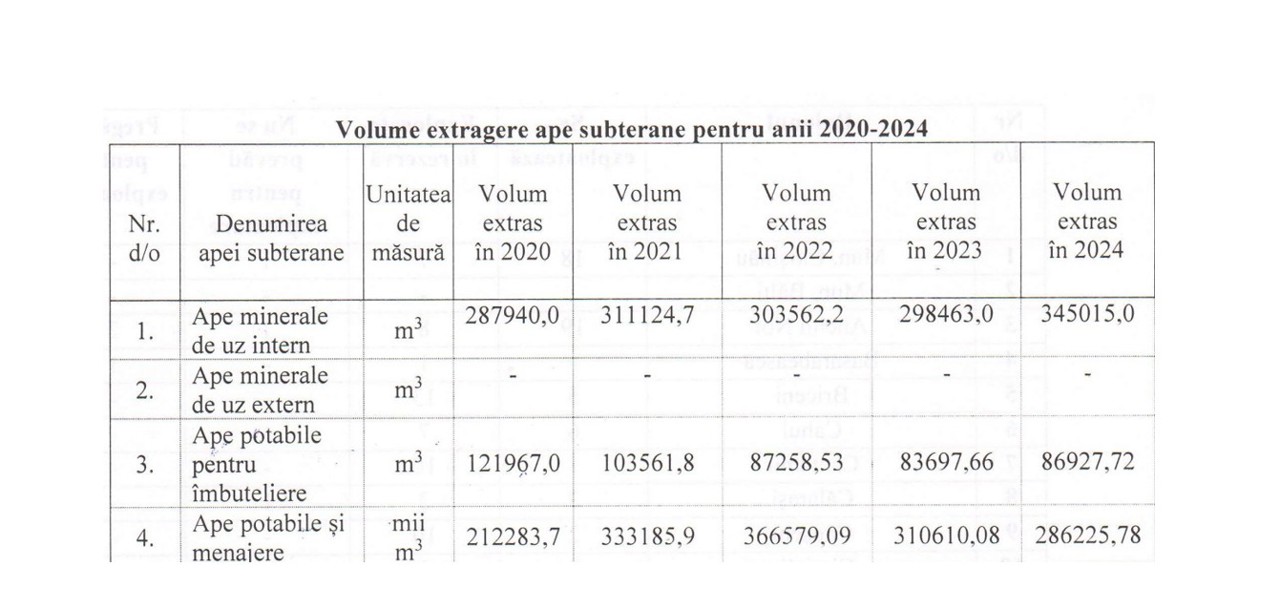
Data from the Ministry of Environment, provided at the request of Teleradio-Moldova, indicate that the total volume of groundwater extracted between 2020 and 2024 exceeded 1.2 billion tons. The largest volume extracted occurred in 2022, with nearly 367 million tons brought to the surface.
The majority of this extraction was for drinking and domestic water. Official statistics show an increase in extraction volumes from 2020 to 2022, reaching almost 366.5 million cubic meters, the highest level recorded during the analyzed period. Following this peak, the quantities dropped to over 310 million cubic meters in 2023 and approximately 286 million cubic meters in 2024.
The extraction of mineral water for domestic use has also varied in recent years, amounting to a total of 1.5 million tons extracted.
In terms of groundwater extracted for bottling, the trend has been downward, with a significant decrease between 2020 and 2023. The volume extracted fell from 121,967 cubic meters in 2020 to 83,697 cubic meters in 2023. In 2024, nearly 87,000 cubic meters were extracted.
Ecologist Vladimir Garaba noted that companies that produce bottled water by extracting it from deep layers have reduced their production volumes.
“This is encouraging, because the rate of extraction of waters that are no longer naturally replenished is decreasing. Water in rivers or ponds is replenished by rain, but deep groundwater is not. The less we extract, the more there will be for future generations,” Vladimir Garaba told Teleradio-Moldova.
Polluted groundwater
Deep waters in most areas do not meet sanitary standards for direct consumption, especially in the south and center of the Republic of Moldova, the ecologist said.
"In Chisinau, Orhei and the northern districts, the water is good to drink, but only after proper treatment. In Taraclia, there is no artesian well that meets the standards. In Hancesti and some villages, the extracted water is technical, used only for washing and sanitary purposes. Basically, we have good water in about half the country or maybe a little less", the ecologist told us.
According to him, the layer containing the water has high concentrations of heavy metals and other substances. These waters cannot be drunk when the salt concentrations exceed the standards. They may contain hydrogen sulfide, ammonia, or other harmful microelements.
Water pollution is determined by both natural factors and human activity.
"In Criuleni district, for example, artesian wells were contaminated with ammonia by livestock farms in the area. However, 40,000 - 50,000 heads in past years have left their mark on the water quality,", the specialist found.
Garaba emphasizes that pollution reduction measures are possible by using filtering devices and eliminating contamination sources.
"Strong sources of pollution must be eliminated and control rules must be respected. Some types of polluted water cannot be transformed into drinking water without expensive technologies that are 10 times more expensive than treating clean water. In Taraclia district, where there is no water, people install high-performance filters to obtain drinking water", the expert concluded.
Boiling water is not always an effective method
High concentrations of salts, heavy metals, hydrogen sulfide in water affect people's health, warns Cristina Bîscal, a gastroenterologist at the Institute of Emergency Medicine in Chisinau.
"The human body contains 70-80% water, and this participates in all chemical reactions in the body. If water is polluted, all systems suffer: digestive, neurological, emotional. High concentrations of salts, heavy metals, hydrogen sulfide affect our health. Pathological germs that develop especially in summer can cause gastroenteritis, enterocolitis and chronic colon pathologies. Heavy metals are stored in the bone marrow and can subsequently generate hematological pathologies", the gastroenterologist warned.
The boiling method is not effective against heavy metals, Cristina Bîscal said.
"It can only be useful if germs are present. For heavy metals, there are state-of-the-art filters that can decontaminate the water and help the population in the affected areas," the doctor said.