INFOGRAPHIC | EU GDP per capita is over five times higher than Moldova’s

The European Union remains the Republic of Moldova's primary trading partner, accounting for more than two-thirds of Moldovan exports. However, noticeable differences still exist between our country and the European average in areas such as income, the labor market, health, education, energy, and production.
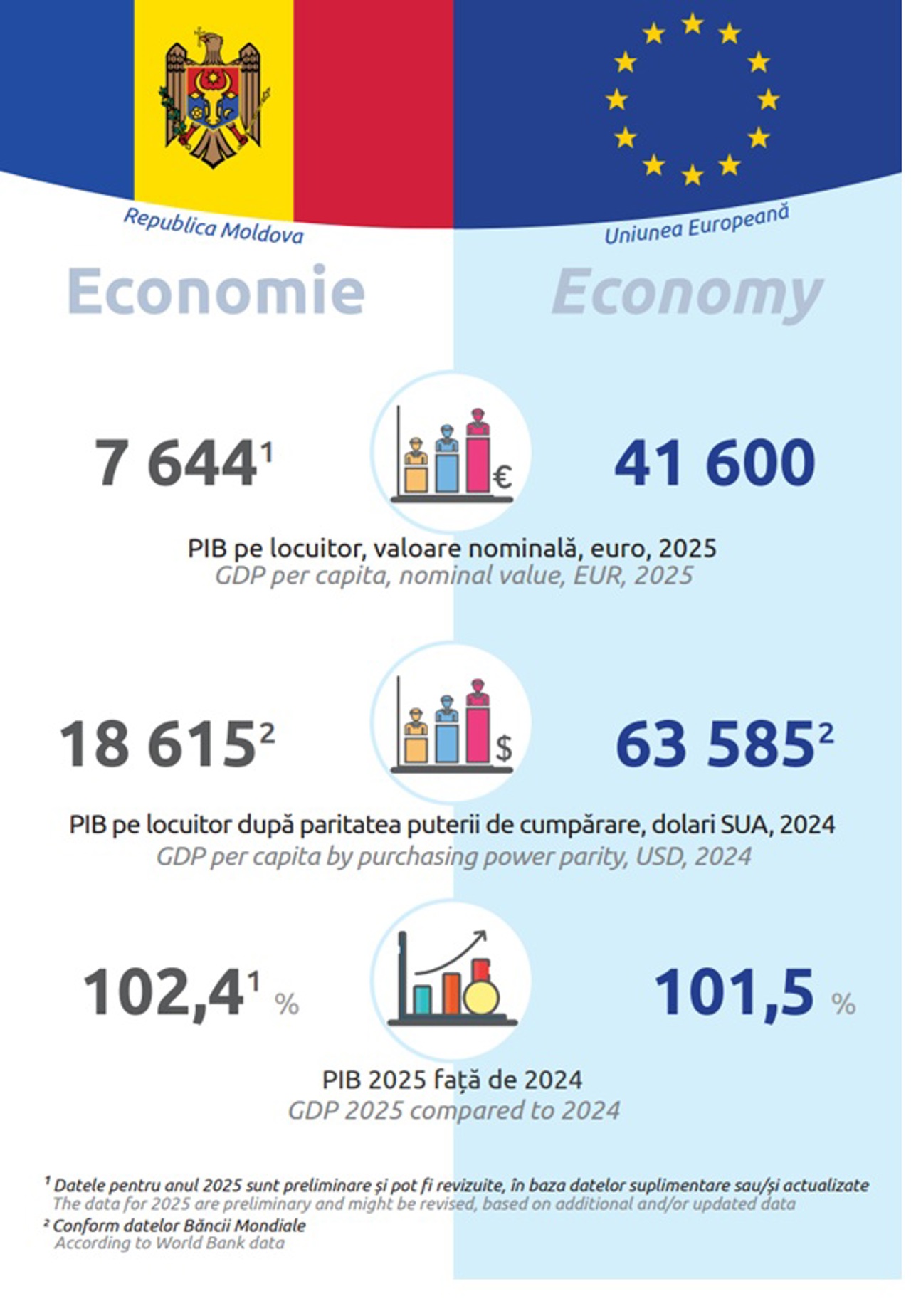
According to data from the National Bureau of Statistics (NBS), the Gross Domestic Product (GDP) per capita in the Republic of Moldova is 7,644 euros, whereas the average GDP per capita in the European Union is 41,600 euros. This means that the EU's GDP per capita is 5.4 times that of the Republic of Moldova.
Additionally, the GDP calculated at purchasing power parity stands at 18,615 dollars in the Republic of Moldova, compared to 63,585 dollars in the EU.
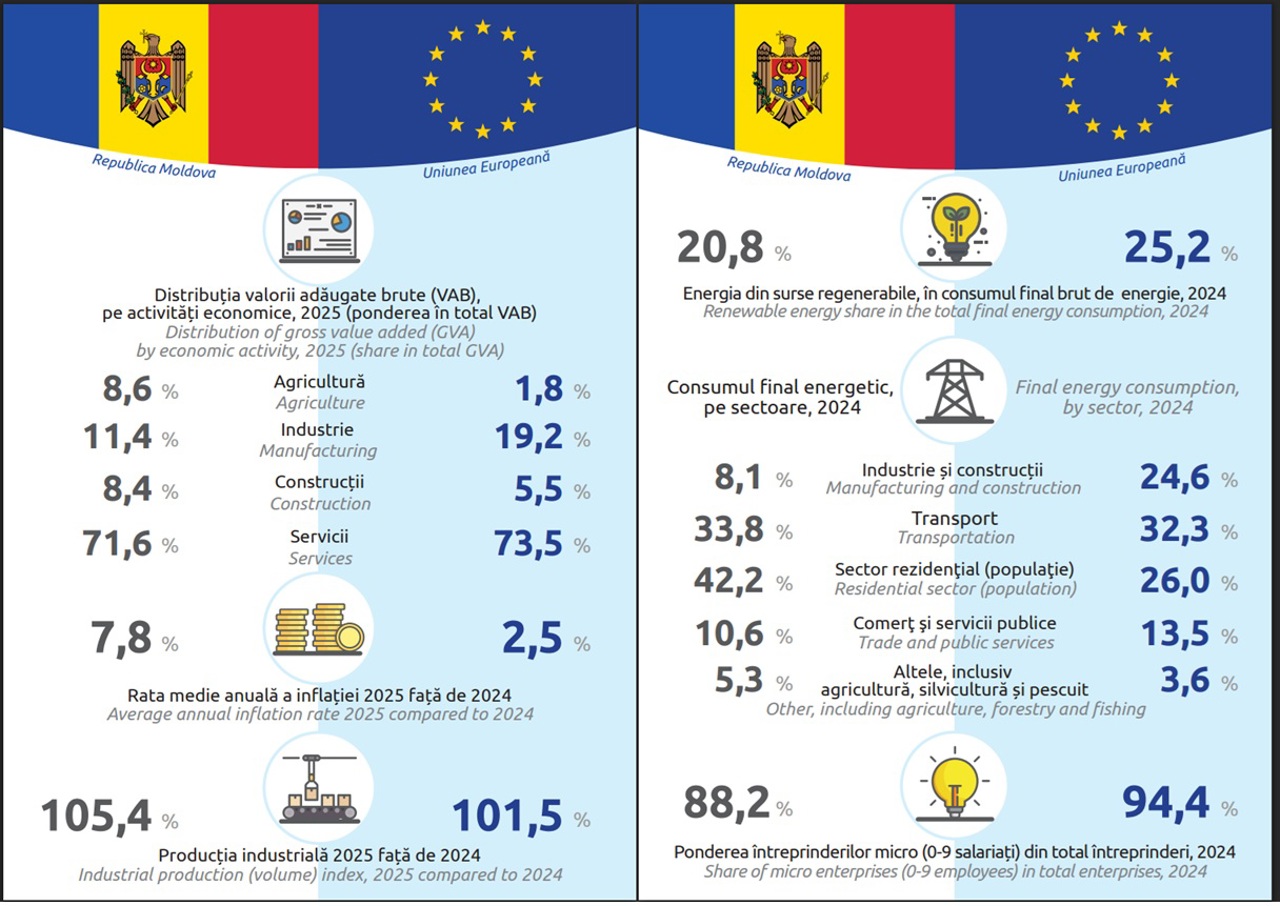
The structure of the Moldovan economy continues to differ from that of the European Union. In the Republic of Moldova, agriculture contributes 8.6% of gross value added, whereas in the EU it accounts for only 1.8%. Meanwhile, services account for 71.6% of Moldova's economy, compared to 73.5% in the European Union.
The industrial sector in Moldova accounts for 11.4% of gross value added, noticeably lower than the EU's 19.2%.
Significant differences are also apparent in the energy sector. In Moldova, 20.8% of gross final energy consumption comes from renewable sources, while the European Union’s figure is higher at 25.2%.
Additionally, the residential sector in the Republic of Moldova accounts for 42.2% of final energy consumption, compared to only 26% in the EU. This indicates a greater reliance on energy resources for household consumption in Moldova.
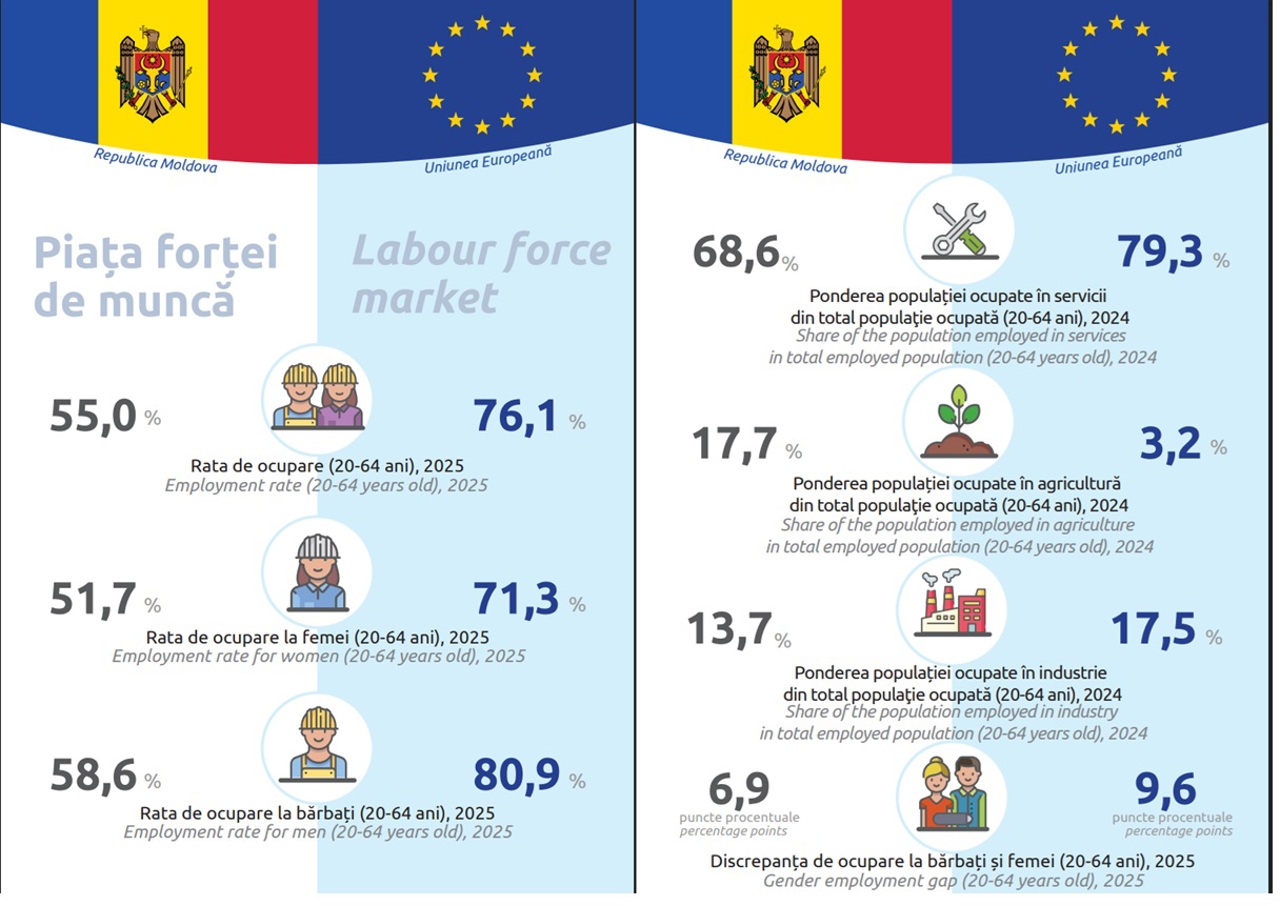
In the Republic of Moldova, the employment rate for individuals aged 20 to 64 stands at 55%, significantly lower than the European Union (EU) average of 76.1%. The employment rate for women in Moldova is 51.7%, while for men it is 58.6%. In comparison, the EU averages are 71.3% for women and 80.9% for men.
Additionally, the gender pay gap in Moldova is higher, at 16.6%, compared to 11.1% in the EU.
On a positive note, Moldova's unemployment rate is lower than the EU average, at 3.9% compared to 6%. Youth unemployment in Moldova is also lower, at 7.4%, compared with 15.2% in the European Union.
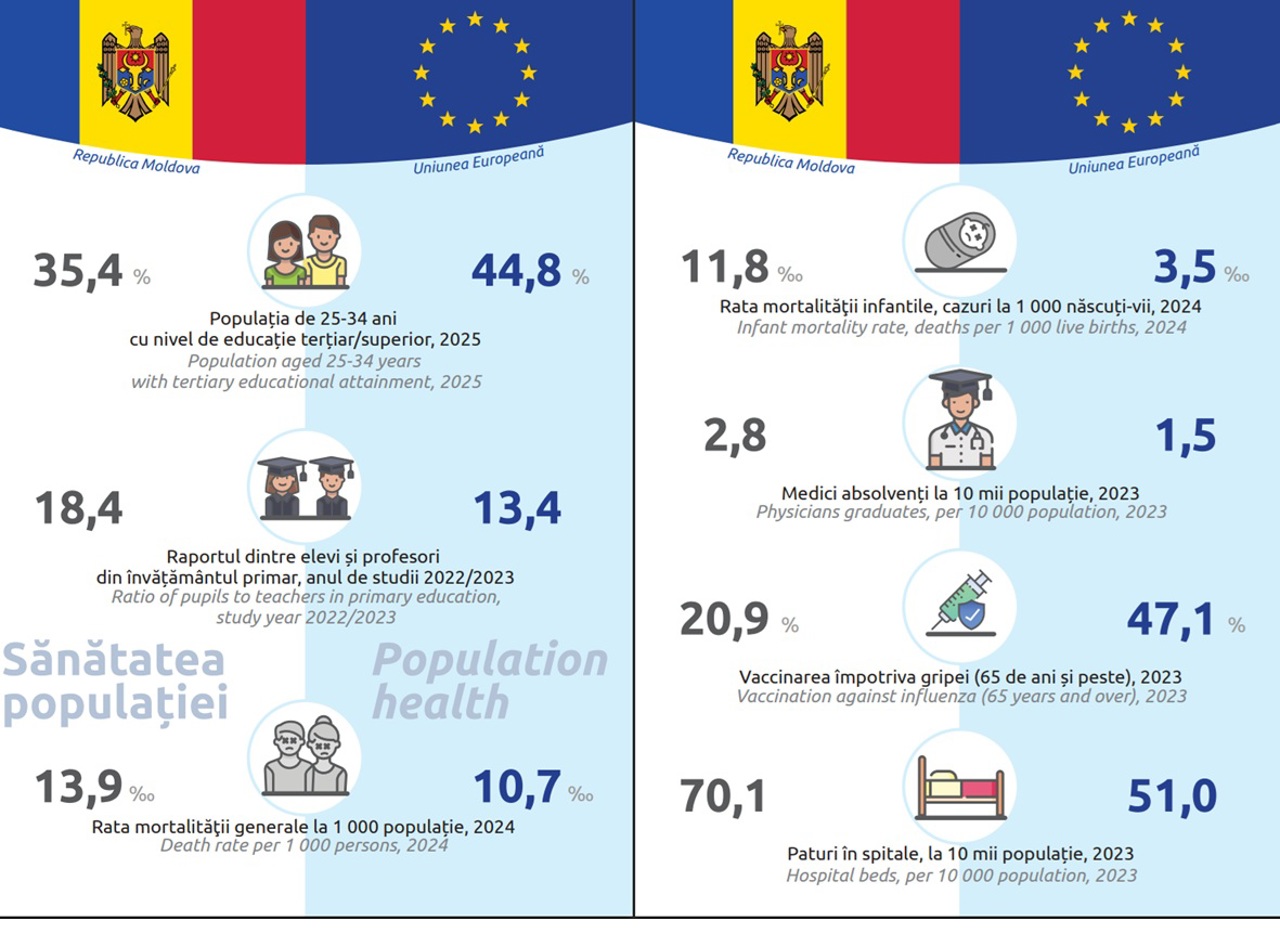
In the Republic of Moldova, 77.6% of young people aged 20-24 have completed at least high school or higher education. In comparison, this rate is 85.7% in the European Union. Additionally, 35.4% of individuals aged 25-34 in Moldova hold a higher education degree, compared with 44.8% in the EU.
Social and health indicators also reveal significant gaps. Life expectancy in the Republic of Moldova is 72 years, while in the European Union, it is 81.5 years. Furthermore, the infant mortality rate in Moldova is 11.8 cases per thousand live births, which is more than three times higher than the European average.
The data is available in the statistical brochure titled "Republic of Moldova versus European Union (EU-27)," published by the National Bureau of Statistics to commemorate Europe Day, which is observed on May 9. This brochure presents the most recent data on the Republic of Moldova's socio-economic situation, compared with the European Union average, and is based on official national statistics and the Eurostat database.