Electronic identity wallet to be unveiled at Moldova Digital Summit 2026
Chisinau will host the 15th edition of the Moldova Digital Summit at the beginning of this summer. The event is scheduled for June 5 and 6 and will gather representatives from the government, the IT industry, the education sector, and international experts in digital technologies. The organisers emphasise that this event highlights the rapid growth of the ICT sector in the Republic of Moldova and the country's increasing integration into the European digital ecosystem.
Digital technologies have become an essential part of everyday life, going beyond serving as simple communication tools. According to Ana Chirița, the director responsible for strategic projects at the National Association of ICT Companies, the development of digital infrastructure and the diversification of applications used in education, business, or entertainment demonstrate a profound transformation of society.
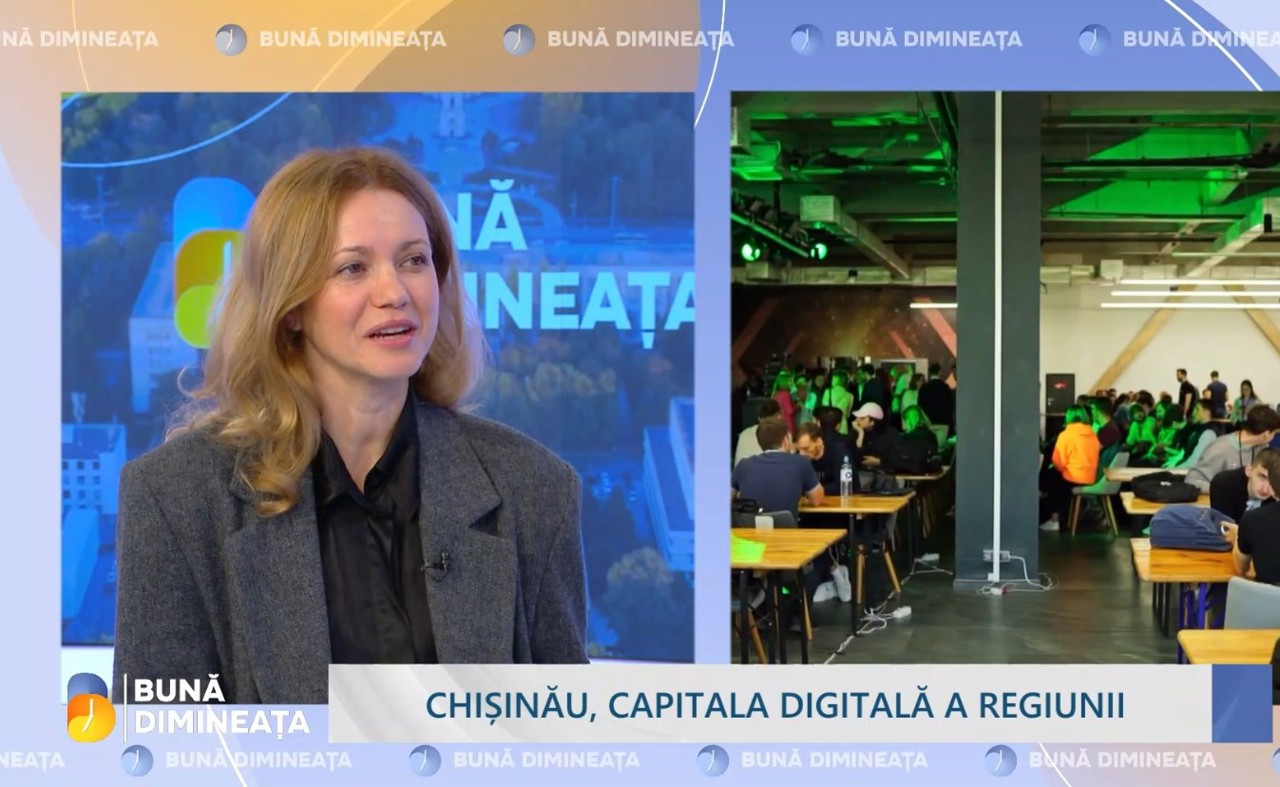
“Technologies are changing very quickly, in fact. It is very good to use them, because they are advancing so much”, said Ana Chirița, on the Bună dimineața show on Moldova 1, the May 19 edition.
The IT industry in the Republic of Moldova has exceeded the threshold of one billion dollars in annual revenues for the first time, an objective set by the authorities and the private sector several years ago.
“One billion is a figure that we set as a target several years ago, both the industry and the Government of the Republic of Moldova. At the same time, taking into account that we are at a crossroads, where new or emerging technologies, especially artificial intelligence, quantum technologies, everything related to speed, computing power and so on, are growing exponentially, here we have the capacity to create new products and services that would have a much higher added value,”, explained Ana Chirița.
Prime Minister Alexandru Munteanu and Commissioner for Enlargement, Marta Kos, will open the summit
The development of emerging technologies, such as artificial intelligence, quantum computing, and advanced processing solutions, offers new opportunities to create products and services with higher added value.
According to Ana Chirița, the approximately 30,000 ICT employees already contribute significantly to the country's economy, and the Moldova Digital Summit will become a platform for presenting new technological solutions developed by both the public sector and private companies. The event will include panels dedicated to business, public administration, education and the exchange of international experience.
The summit will be inaugurated by the Prime Minister of the Republic of Moldova, Alexandru Munteanu, together with Marta Kos, European Commissioner for European Neighborhood Policy and Enlargement Negotiations. At this year's edition, the focus will be on European digital integration and the interoperability of electronic services.
Ana Chirița emphasized that the ICT industry supports the development of digital public services and the elimination of bureaucracy by interconnecting state information systems.
“The ICT industry and other related industries want a country where services, whatever they are, are accessible in electronic format to eliminate any time-related, queue-related or human factor issues that require you to stand somewhere or get a document, or to be able to process certain payments, or to be able to get certain statements that you need. Moreover, all systems should be interconnected and a lot of work has been done so that you can present a document from one institution to another. The delivery times for these things are extremely fast. There is still more work to be done, but I think that an innovation that will be presented at the Moldova Digital Summit is that electronic identity wallet which, in fact, will be based on on the EVO service that we have heard about at the Moldova Digital Summit for several years, but which will have certain new elements, including allowing business access to data and other elements that could help it be more efficient”, Ana Chirița also said on the national television station.
Digital literacy of the population, essential
The event will bring together international experts and speakers, including specialists involved in developing electronic identity wallets at the European level. The organizers state that the Republic of Moldova already has examples of good practices in the field of digitalization, including the EVO platform, appreciated and awarded internationally.
According to the representative of the National Association of ICT Companies, the Republic of Moldova's small size enables faster testing of new technologies and more efficient adaptation to innovations. She recalled that some telecommunications services were initially launched in Moldova precisely because of the local market’s ability to quickly adopt new solutions.
At the same time, Ana Chirița drew attention to the need to educate the population in the correct use of information technologies. Although the Republic of Moldova benefits from high-performance infrastructure and extensive coverage of 3G, 4G, and 5G services, the efficient use of these technologies also depends on the population's digital literacy.
"Every citizen must be accustomed to using any technology in order to be able to consume and use the services that are offered. But there is also a need to educate the population in the correct use of information technologies", Chirița noted.
The second day of the summit will be dedicated exclusively to education and the use of digital technologies in schools. During the event, discussions will take place between educational institutions, authorities and the private sector on the integration of new technologies into the educational process. Participants will also be able to interact with various technological demonstrations, including 3D printing, robots and other interactive applications presented by participating companies and organizations.
According to statistical data, approximately 75% of the world's population uses the Internet, while in Europe the rate exceeds 90%. In the Republic of Moldova, the degree of use would be over 80%, with a tendency to approach the European average.