Iulian Groza: Chișinău is ready to advance in all negotiation clusters
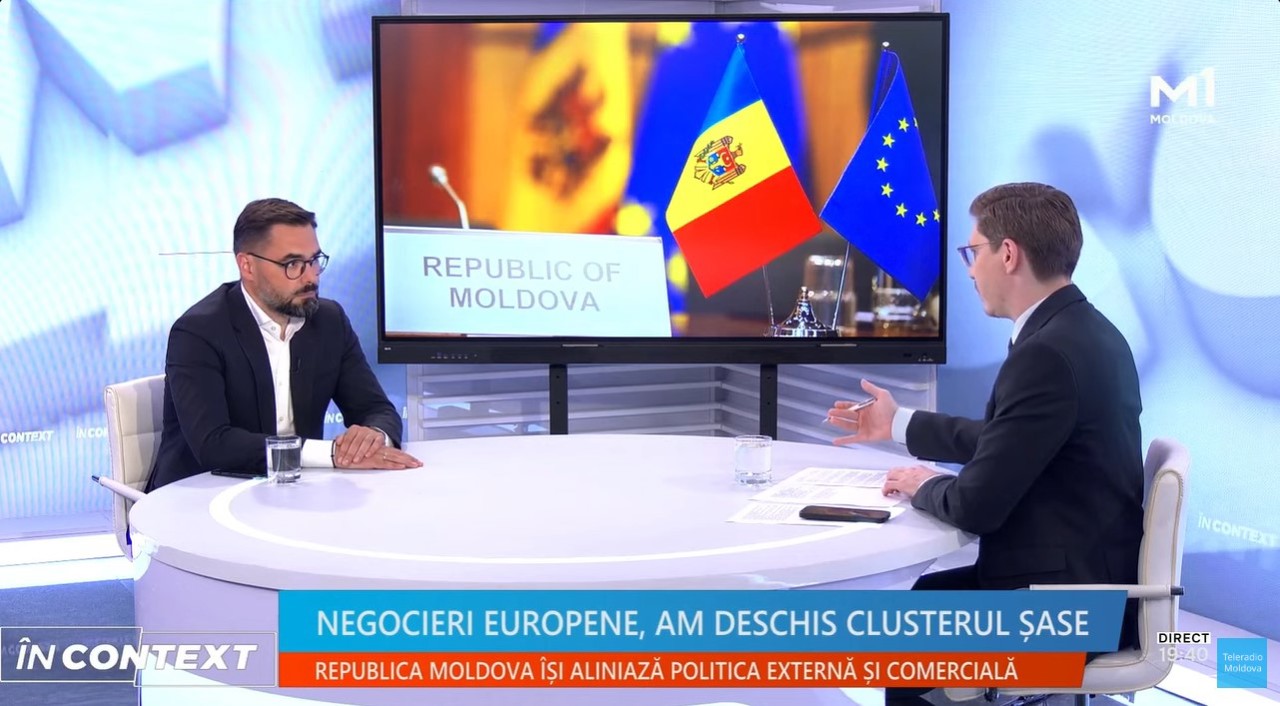
The opening of Cluster 6 confirms the Republic of Moldova's advanced level of preparation in the fields of foreign, trade, and security policy and represents a new step towards the European Union (EU). According to the director of the Institute for European Policies and Reforms (IPRE), Iulian Groza, the goal of accession in 2030 remains ambitious, but the current pace of negotiations offers a chance to obtain member state status.
"Moldova is ready to open negotiations on all groups of chapters. It is a political matter of consensus that is being built within the Council. The important thing is that we are moving. The important thing is that we have launched negotiations on Cluster 1, we are launching negotiations on Cluster 6 and already, in the next period, during the Irish presidency, I believe that Moldova will be in a position to move forward and open negotiations on all groups of chapters", declared Iulian Groza in the IN CONTEXT show on Moldova 1.
The expert explains that the Republic of Moldova has gradually harmonized its trade policy with the European one since the signing of the Association Agreement, and the process will continue during the negotiations stage.
"We will still have to align our trade policy, generally, external, with that of the European Union. (...) This helps us, it is happening. And, in fact, since we signed the Association Agreement, all multilateral or bilateral free trade agreements have gradually been aligned with the European Union's trade policy. Obviously, there are several older agreements that must be denounced," Groza detailed.
Also, he emphasizes that the adaptation of the legislative framework regarding investments and humanitarian aid is already underway:
"There are also laws that have been adopted in Parliament that align the national framework to allow this mechanism that the Republic of Moldova can implement", the IPRE director said.
Groza also states that the Republic of Moldova must demonstrate that the institutions created in recent years are effectively functioning and can contribute to the European policy of cooperation and humanitarian assistance.
"We already have the Free Trade Agreement. Moldova is part of the Central European Free Trade Agreement, CEFTA. Moldova held the presidency of this format of organization that has already concluded agreements with other economic, trade areas, such as the European Economic Area, which also includes other countries that are not EU members, such as, for example, Norway, Iceland or Switzerland", noted Iulian Groza.
The expert recalls that the authorities have strengthened their compatibility with the EU's foreign and security policy, but the next stage is to achieve an almost complete level of alignment.
“Moldova started aligning itself with EU statements over 12 years ago. It became mandatory when we began implementing the Association Agreement. That’s exactly what mattered. And indeed, all the mechanisms at the national level, all the legislation was created. Now we are at the stage where we need to ensure that all the mechanisms that we have created at the national level are working,” the expert said.
He says the next goal is to achieve full convergence with European positions.
"If, until recently, our degree of alignment was, I think last year it reached almost 80%. Accordingly, to ensure progress and the closure of this criterion in Chapter 31, we must achieve a rate of 100% in alignment with all European Union declarations. (...) The Republic of Moldova has a comparably high rate compared to most Balkan countries", said Iulian Groza.
The expert believes that the European security and defense policy goes beyond the legal dimension of solidarity and extends to the development of the defense capabilities of partner states.
“At the EU level there is a similar provision, it is Article 42.7 of the Treaty on European Union, which establishes this solidarity and the same principle that is established in Article 5. But the security and defense policy of the European Union today means more than this article. We know that at this time the European External Action Service and the European Commission, together with the Member States, are working on a new European security strategy that will be published in the coming months. And we see this security strategy adapting to the new challenges and the new realities and security risks that the EU is facing”, explained Iulian Groza.
At the same time, it highlights the extent of European support provided to the Republic of Moldova to strengthen security.
"The EU has become one of the main partners in the development of the Republic of Moldova, in strengthening our defense and security sector. Just on the eve of today's conference, the European Commission announced, the Council of the European Union announced a new tranche of 120 million euros, funds that are mobilized within the European Peace Facility. We already know that Moldova is the country that receives the most support from this facility after Ukraine. Obviously, the objective reasons are clear, but Moldova is also an important beneficiary from the European Union. If not long ago this figure reached 250 million euros, now the figure has increased to over 370 million euros in the last four years, plus another 2-3 that are to be utilized", said the IPRE director.
In his assessment, the expert states that there is a real chance of closing some chapters of negotiations if the pace of reforms is maintained, especially in the fields of justice and combating corruption.
"In terms of dynamics, if we look at Cluster 6, there is the most progress, most of the criteria are already being met. We must ensure a positive dynamic, and if we want to advance in the negotiations, I believe we are in a position to be ambitious and begin closing the negotiation chapters. (...) For this to happen, it is very important for us to ensure progress on the intermediate criteria as well, to ensure progress on the conditions related to justice, anti-corruption, internal affairs and human rights", concluded Groza.
The Republic of Moldova began accession negotiations for Cluster 6, titled “External Relations,” on the evening of July 14 in Luxembourg. This marked the first time since 2002 that the EU organized four accession conferences simultaneously with Ukraine, Albania, and Montenegro. The common position of the 27 Member States was adopted unanimously on July 10, and the intergovernmental conference on July 14 formalized this decision.
During the conference, European Commissioner for Enlargement, Marta Kos, emphasized that Moldova is already contributing to European security, noting that its experience in combating hybrid threats is valuable for the entire European Union. She highlighted that Cluster 6 is one of the most important parts of the accession negotiations, as it outlines a state's role in the EU's common foreign and security policy. The other clusters are technically prepared and can be opened as soon as possible during the Irish Presidency of the Council of the EU.
Cluster 6 consists of two negotiation chapters. Chapter 30, “External Relations,” encompasses the EU’s common commercial policy, humanitarian aid, and development cooperation, requiring alignment with EU trade legislation and international commitments. Chapter 31, “Foreign, Security, and Defence Policy,” addresses alignment with the EU’s foreign policy positions, political declarations, sanctions, and restrictive measures. According to the Ministry of Foreign Affairs in Chisinau, it is fully responsible for coordinating Chapter 31 and the international cooperation aspects of development and humanitarian assistance covered in Chapter 30.
With the two chapters in Cluster 6 added to the five chapters in Cluster 1, which were opened on June 15, 2026, the Republic of Moldova now has seven negotiation chapters open out of a total of 33. However, no chapter has been provisionally closed yet.
The Chisinau government has publicly set a 2028 deadline for concluding the accession negotiations. The European Commission confirmed in the November 2025 enlargement package that the Republic of Moldova had met the conditions to open three clusters—1, 2, and 6—and indicated that the remaining clusters would become eligible by the end of the year. Two of these were opened in 2026.