Ukrainian refugees with temporary protection in the EU now total 4.43 million

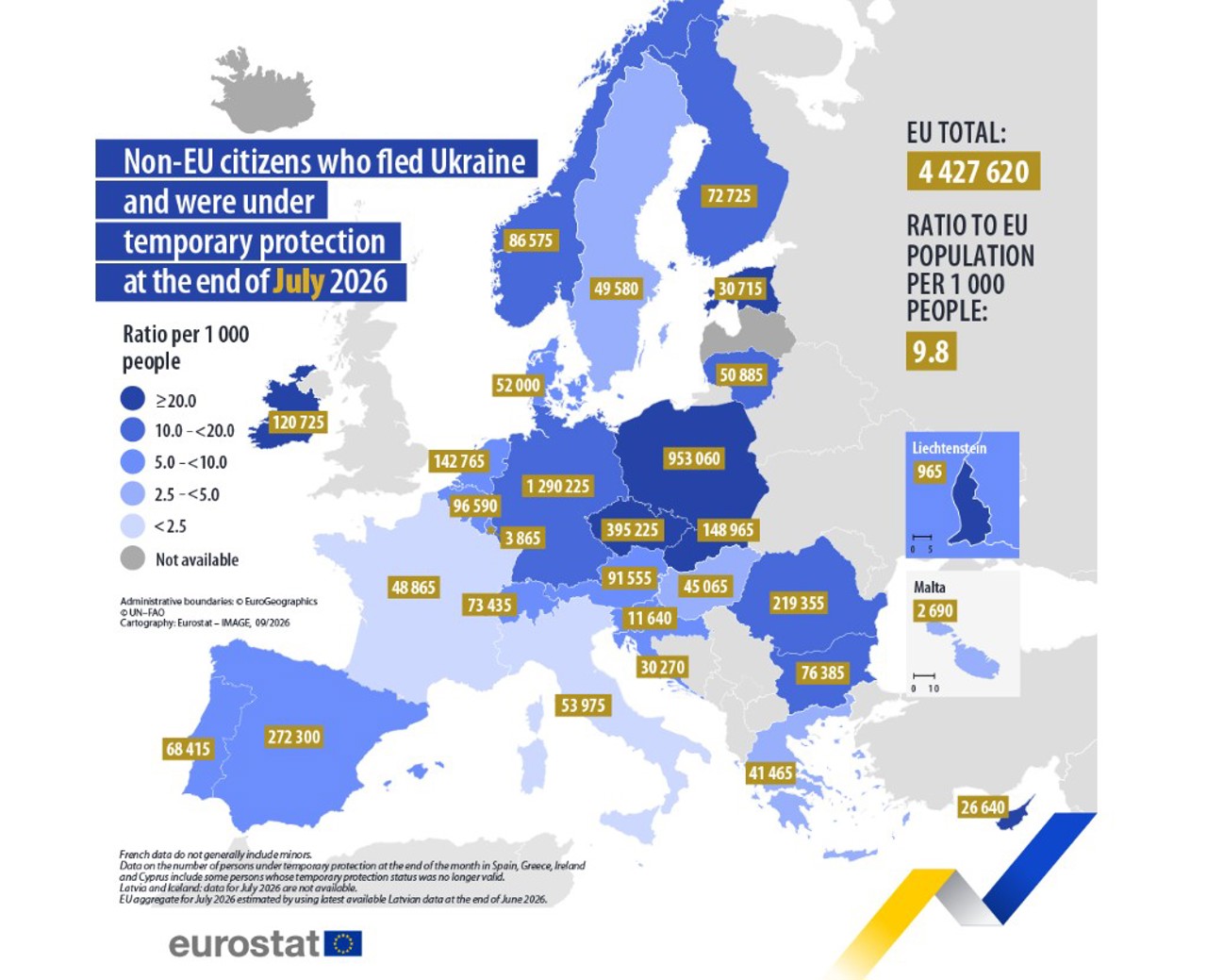
As of July 31, 2026, more than 4.4 million people who had fled Ukraine are receiving temporary protection in the European Union. This number reflects an increase of nearly 20,000 compared to the previous month, according to data from Eurostat, the European Union's statistical office.
As of now, 4.43 million non-EU citizens who left Ukraine are benefiting from temporary protection status in EU countries. This number represents an increase of 19,945 individuals, or 0.5%, compared to the end of June.
Germany has the highest number of beneficiaries, with 1,290,225 registered individuals, accounting for 29.1% of the EU total. Following Germany, Poland has 953,060 beneficiaries (21.5%), and the Czech Republic has 395,225 (8.9%).
Since June, the number of people under temporary protection has increased in 23 out of the 26 EU member states for which data is available. The largest increases in absolute numbers were seen in the Czech Republic (up by 4,415 individuals, or +1.1%), Romania (up by 4,055, or +1.9%), and Germany (up by 3,995, or +0.3%). Conversely, three countries reported fewer beneficiaries: Poland saw a reduction of 8,110 (-0.8%), France reduced its number by 475 (-1.0%), and Cyprus decreased by 110 (-0.4%).
In terms of population proportion, the Czech Republic has the highest rate of temporary protection beneficiaries, with 36.2 per thousand inhabitants. Slovakia (27.5) and Cyprus (26.7) follow. The EU-wide average stands at 9.8 beneficiaries per thousand inhabitants.
As of July 31, Ukrainian citizens made up over 98.5% of temporary protection beneficiaries in the EU. Among these beneficiaries, adult women made up 43.4%, adult men 27.1%, and minors 29.4%.
Temporary protection was established following the EU Council's decision on March 4, 2022, in response to the significant influx of displaced persons from Ukraine due to Russia's war of aggression. In June 2025, the European Council decided to extend this measure, ensuring that temporary protection will remain valid until March 4, 2027.
The breakdown of beneficiaries by age and gender is calculated based on available data, excluding cases where such information is unknown.
Eurostat notes that the methods for removing individuals under temporary protection from state records vary by country. Some states also report data with specific characteristics.
In France, the available data typically exclude minors. Data for July 2026 is not available for Latvia and Iceland, and for Latvia, the EU total for July was estimated based on June's data. Furthermore, the figures reported for Spain, Greece, Ireland, and Cyprus may include some individuals whose temporary protection status was no longer valid at the end of the month.
The war launched by Russia has triggered an unprecedented exodus, resulting in a number of Ukrainians leaving their country equivalent to the entire population of three Republics of Moldova. Experts note that this significant demographic loss profoundly affects Ukraine's economy and future.
Russia's attack on Ukraine has initiated the largest migration crisis that either Ukraine or Europe has faced since World War II. Millions of people have crossed borders, and for many, a journey that was expected to last "a few weeks" has turned into a new beginning "from scratch," thousands of kilometers away from home.
According to the latest data published by the General Inspectorate for Migration, as of July 9, 2026, 53,964 displaced persons from Ukraine were benefiting from temporary protection in the Republic of Moldova.