Moldova rises to 68th in the 2026 Global Innovation Index
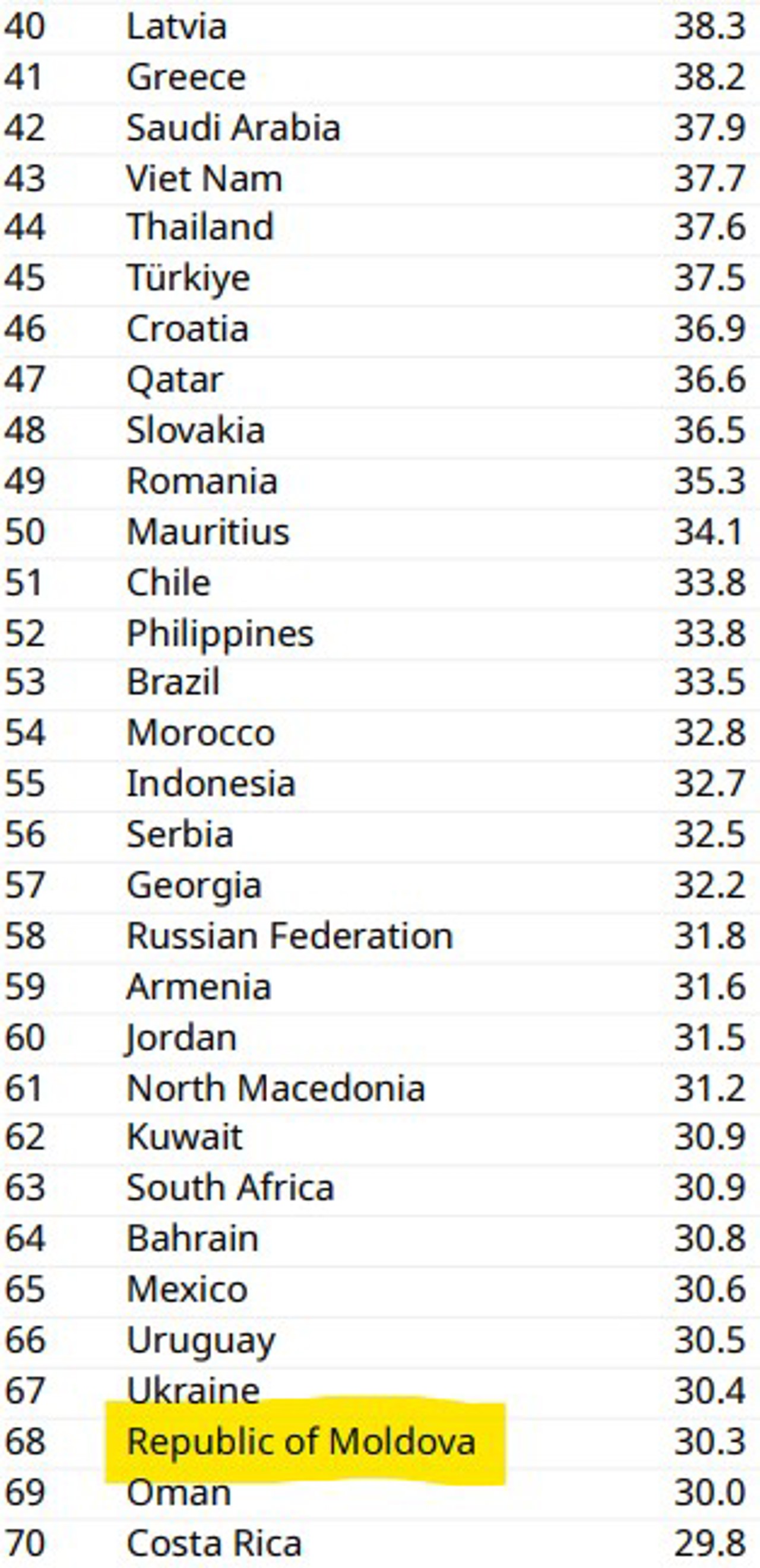
The Republic of Moldova has climbed six places in the global innovation rankings, reaching 68th place out of the 139 economies analysed by the World Intellectual Property Organisation (WIPO). At the same time, the country has rejoined the group of economies performing above expectations for their level of economic development, according to the new edition of the Global Innovation Index 2026.
This year's edition analyzes 139 economies and tracks the evolution of innovation ecosystems, ranging from research and development investments and digital infrastructure to technological outputs, intellectual property assets, and creative products.
With a score of 30.3, the Republic of Moldova ranks 68th globally, marking a six-place improvement over the previous edition, when it ranked 74th. The country also ranks 15th out of the 35 economies in the upper-middle-income group.
At the regional level, the Republic of Moldova scores below the European average across all seven analyzed pillars, ranking 35th out of 39 European economies.
A notable aspect highlighted by WIPO is the Republic of Moldova's return to the group of economies whose innovation performance exceeds expectations for their level of economic development. In 2026, this group comprises 21 economies, marking the 15th time our country has appeared in this category across GII editions.
The Republic of Moldova’s profile in the 2026 GII highlights a significant gap between innovation inputs and the outputs generated from them. The country ranks 94th in innovation inputs, while ranking 51st in outputs.
According to WIPO, this positioning reflects the economy's ability to transform relatively limited resources into innovation outcomes, with a significant contribution from digital components. Compared with the 2025 edition, the results show improvement in both the overall ranking and performance in inputs and outputs. In 2025, the Republic of Moldova ranked 89th in inputs and 62nd in outputs.
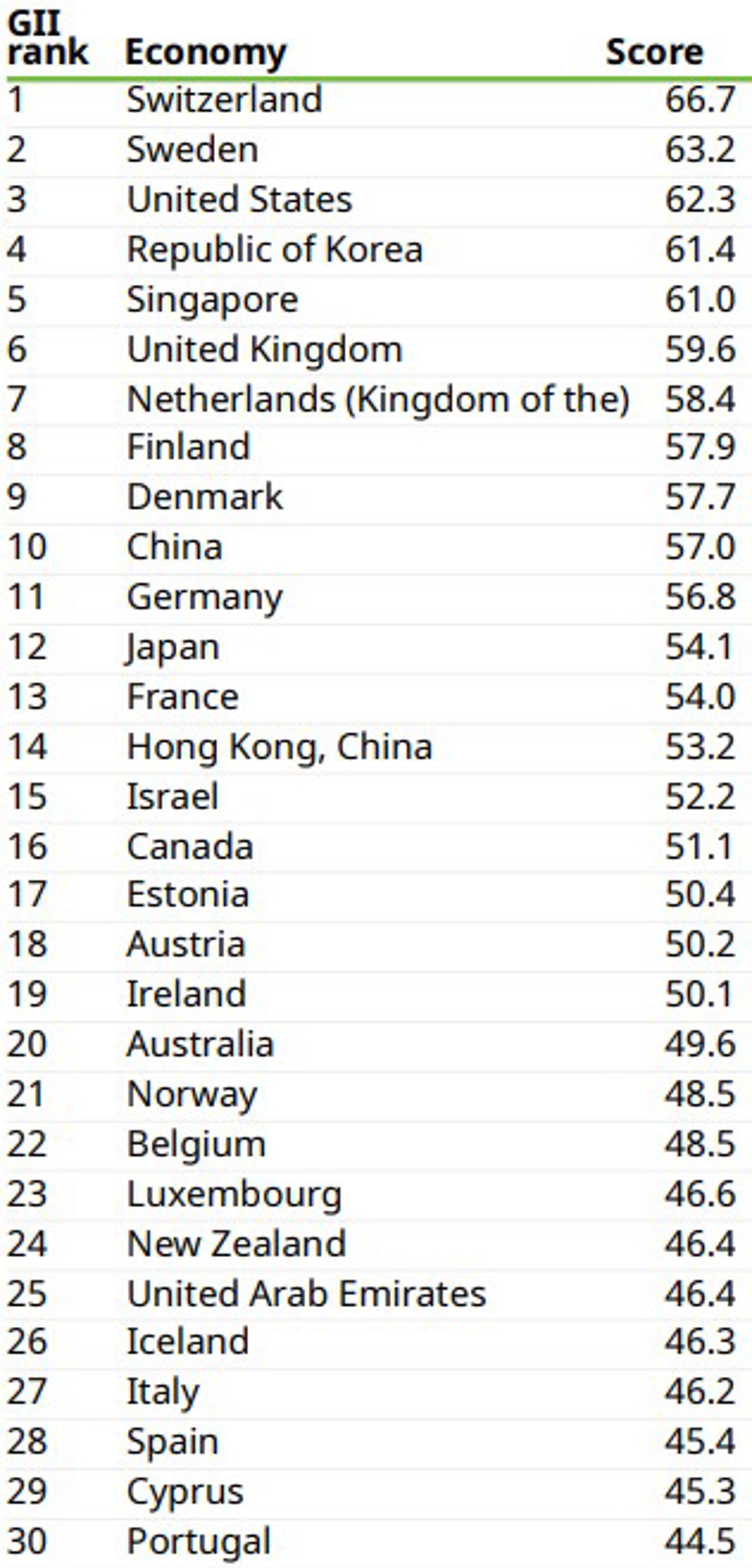
Globally, Switzerland, Sweden, and the United States retain the top three spots in the GII 2026 rankings, followed by the Republic of Korea and Singapore. Switzerland holds the number one global position for the 16th consecutive year.
The 2026 edition of the Global Innovation Index features a special theme focused on transforming frontier research into new industries, highlighting science-based startups and the conditions required for them to turn research and intellectual property into scalable commercial businesses.
The Global Innovation Index evaluates each economy based on seven pillars distributed across two broad categories. On the one hand, innovation "resources" (inputs) are analyzed: institutions, human capital and research, infrastructure, market sophistication, and business sophistication.
On the other hand, innovation "results" (outputs) are evaluated: knowledge and technology outputs, as well as creative outputs.
Thus, the GII measures not only how much a country invests in innovation but also how effectively it transforms those investments into tangible results.