Moldova could provisionally close 25 EU chapters in 2027
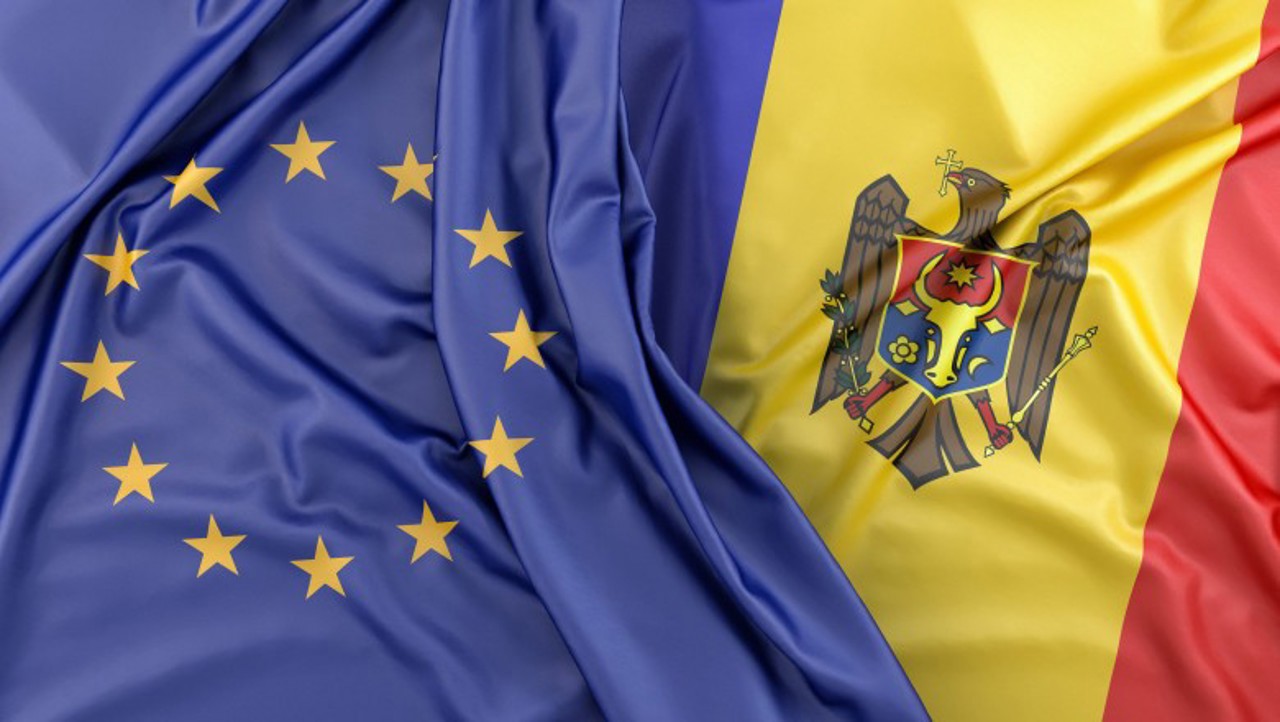
The European Commission is due to present its 2026 Enlargement Package on Wednesday, November 4, setting out indicative milestones that could allow Moldova to provisionally close 25 accession chapters in 2027.
Four frontrunners in the EU accession process
The Commission’s report marks a symbolic and strategic milestone, highlighting four countries it considers frontrunners in the accession process: two Western Balkan states, Montenegro and Albania, followed by the Republic of Moldova and Ukraine.
All four countries are set to receive what the Commission has described as an accession roadmap, entitled “A Roadmap for the Accession Negotiations with Moldova – An Outlook for 2027”.
The current landscape of EU accession bids
Four countries are making significant progress: Montenegro, Albania, Moldova and Ukraine. Three others are largely standing still: North Macedonia, Bosnia and Herzegovina, and Kosovo, whose application for EU membership has not yet been formally recognised as an official candidate bid.
Three more countries have regressed for the second consecutive year: Serbia, Georgia and Türkiye. This is the current picture across the ten countries seeking closer ties with Europe: nine official candidate countries and Kosovo, a potential candidate.
Kosovo’s independence remains unrecognised by five EU member states, including Romania, as well as by some candidate countries, among them Moldova and Serbia.
The enlargement process is now advancing at a pace not seen in the past quarter-century. Against this backdrop, the office of European Commissioner for Enlargement Marta Kos has prepared individual roadmaps, which are due to be made public following approval by the College of Commissioners on Wednesday, November 4.
For Moldova, the most significant development is that the draft document, which is expected to require only formal approval by the Commission, indicates that the country could provisionally close as many as 25 negotiation chapters in 2027.
Montenegro, meanwhile, is expected to provisionally close all its remaining chapters this year, while Ukraine could close seven chapters next year. That would be a remarkable achievement given the strain on the country's economy and society amid the ongoing war.
The four frontrunners – Montenegro, Albania, Moldova and Ukraine – are therefore set to receive their long-promised accession roadmaps on Wednesday, November 4.
Assuming that reforms continue at the current pace and are effectively implemented, Moldova could provisionally close nine chapters in the first half of 2027 and another 16 in the second half. That would bring the total to 25 chapters in a single year.
The roadmap also lists the chapters that could be provisionally closed next year. This means that much now depends on the authorities in Chișinău, while the Commission has largely delivered on its promise to provide concrete milestones intended to reassure both the public and investors.
These milestones cover 2027. A new roadmap setting out targets for 2028 is expected in the autumn of next year.
If Montenegro completes the process as anticipated, it could sign its accession treaty as early as June 2027. The treaty would then have to be ratified by the parliaments of all 27 EU member states, potentially paving the way for the next countries in the leading group: Albania and the Republic of Moldova.
The European Commission’s roadmap for Moldova
The roadmap forms part of the European Commission’s annual Enlargement Package. Similar documents have been prepared only for the most advanced candidate countries: Montenegro, Albania, Moldova and Ukraine.
The legal basis is provided by the negotiating framework, which stipulates that at each intergovernmental conference the EU indicates which clusters and chapters could be opened or provisionally closed during the following year.
The innovation is both procedural and substantive. For the first time, the Commission is moving beyond general references to progress and the need for further efforts, setting out a timetable specifying which clusters should be opened by the end of 2026 and which chapters could be provisionally closed in each half of 2027.
The document explicitly describes the roadmap as both “a path and an anchor” for Chișinău and EU member states.
The Commission also includes its usual safeguards. The timetable is “indicative”, does not prejudge “either the outcome or the pace” of negotiations, and is described as a “living document” that will be updated in line with Moldova’s progress.
Step 1: Opening the final two clusters by the end of 2026
Moldova has already opened four of the six negotiating clusters: Cluster 1, Fundamentals, and Clusters 2, 3 and 6.
Two remain:
- Cluster 4: Green Agenda and Sustainable Connectivity.
- Cluster 5: Resources, Agriculture and Cohesion.
The Commission considers that Moldova “has met the necessary conditions” and urges EU member states to “make every effort” to ensure that both clusters are opened by the end of 2026.
The wording is unusually emphatic and is directed primarily at EU capitals rather than at Chișinău.
Step 2: Interim benchmarks on the rule of law
Before any negotiation chapter can be provisionally closed, Moldova must meet the interim benchmarks for the chapters covering the rule of law. This is the gateway to the next stage of accession negotiations.
The Commission considers Moldova to be “well advanced” and says it will submit to the Council its assessment of the interim benchmarks, together with a draft Interim Common Position.
Only after the member states approve the document, expected towards the end of this year, can the process move towards provisional closures.
Step 3: The 2027 timetable for provisional chapter closures
This is the genuinely new element. Moldova has not yet provisionally closed any of its 33 cluster-based negotiation chapters, nor has it completed the Fundamentals cluster.
A chapter can be provisionally closed only after the EU verifies that the relevant closing benchmarks have been met and both sides agree on any necessary transitional arrangements.
Taking into account the complexity of each chapter and Moldova’s level of preparedness, the Commission proposes an initial list of priority chapters.
First half of 2027: nine chapters
- Science and research.
- Education and culture.
- Free movement of capital.
- Intellectual property law.
- Digital transformation and media.
- Customs union.
- Fisheries and aquaculture.
- External relations.
- Common Foreign and Security Policy.
Second half of 2027: 16 chapters
- Right of establishment and freedom to provide services.
- Economic and monetary policy.
- Social policy and employment.
- Free movement of goods.
- Free movement of workers.
- Company law.
- Competition policy.
- Financial services.
- Consumer and health protection.
- Taxation.
- Enterprise and industrial policy.
- Transport policy.
- Trans-European networks.
- Energy.
- Environment and climate change.
- Food safety, veterinary and phytosanitary policy.
In total, therefore, 25 of the 33 cluster-based chapters could be provisionally closed in 2027. The Commission also leaves room for further progress: if the pace of reforms allows, the timetable could be revised to include “faster or additional” provisional closures.
What is missing from the timetable
The ten chapters without a provisional closure deadline are just as revealing as those included in the schedule.
Most belong to the Fundamentals cluster or concern particularly sensitive institutional and financial matters. They include the judiciary and fundamental rights (Chapter 23), justice, freedom and security (Chapter 24), public procurement (Chapter 5), statistics (Chapter 18) and financial control (Chapter 32).
The remaining chapters concern agriculture (Chapter 11), regional policy (Chapter 22), financial and budgetary provisions (Chapter 33), institutions (Chapter 34) and other issues (Chapter 35).
These are also the areas where the most difficult negotiations are likely to take place, including, very probably, the issue of the separatist authorities in Tiraspol and the left bank of the Dniester.
The Fundamentals cluster will remain the one that “determines the overall pace” of accession negotiations.
One amusing detail: although Moldova is a landlocked country, it could be among the first to provisionally close the chapter on fisheries and aquaculture.
What the document does not say
One point must be stressed: the roadmap does not set a specific date for the conclusion of accession negotiations, nor does it establish a date for Moldova’s accession to the European Union.
Its time horizon is limited to 2027. For the first time, it provides concrete, dated milestones: the opening of the remaining clusters by the end of 2026, progress on integration throughout 2027 and the provisional closure of negotiation chapters during the two halves of that year.
It does not, however, establish a final accession timetable. As with all candidate countries, progress remains conditional on meeting the EU’s requirements and the principle of “own merits”.
Translation by Iurie Tataru
RELATED COVERAGE
- EU to deliver accession roadmap to Moldova on October 28
- Moldova opens two key EU accession clusters in Luxembourg
- Moldova needs justice and anti-corruption results to close EU accession chapters
- Moldova outlines EU education and research priorities
- Moldova could close two EU negotiation chapters by March 2027