STUDY | Nearly half of female vocational students view sexual harassment as inevitable

Nearly half (46.3%) of female students in vocational schools believe that sexual harassment by teaching staff is unavoidable, having become an inherent part of their educational experience. Consequently, these young women avoid turning to the institution's administration for help.
On International Students' Day, the "Partnership for Development" Center (CPD) released a report titled "Safe places to study" which highlights a profound vulnerability within the educational system.
While the sense of insecurity in universities and colleges ranges from 5.9% to 6.8%, in vocational schools, 22.1% of respondents do not feel safe from sexual harassment—a risk more than three times higher.
Among those who did not report the incidents, 37.9% felt that the situation "was not serious enough" while one-third of respondents believe that those who are harassed provoke the situation through their attire or behavior.
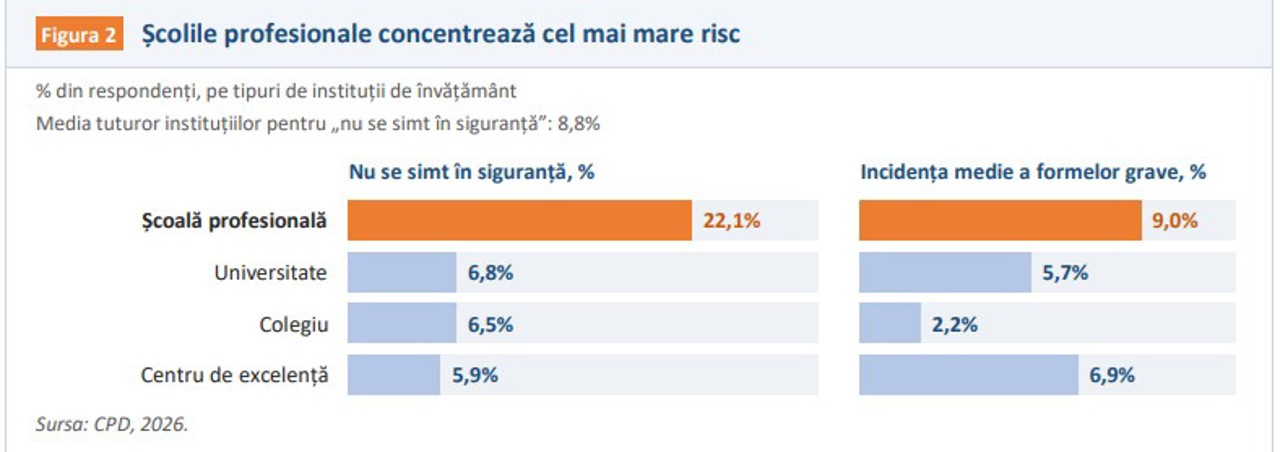
Vocational school students lack access to the protections afforded to university students
The authors of the document highlight a concerning trend of abusive relationships within vocational schools, alongside a complete lack of trust in the protection that these institutions are expected to provide.
Another finding points to a so-called "culture of silence." When faced with such situations, young people frequently choose to remain silent: nearly 28% of those who have experienced harassment have never reported it.
The report underscores that legislative barriers contribute to this lack of security. Although the Ministry of Education and Research (MEC) has recently approved a framework regulation, it applies exclusively to higher education.
For instance, a 17-year-old student in a vocational school does not have access to the same procedures available to a university student, even though she faces a considerably higher risk.
CPD proposes the establishment of a National Ethics Council
The "Partnership for Development" Center (CPD) recommends extending the protection standards set out in the framework regulation to include vocational, technical, and general education, with procedures tailored to the students' age.
Furthermore, the organization argues that the Education Code should be amended to include a distinct chapter on the prevention and combating of violence and harassment across all types of educational institutions.
A National Ethics Council would monitor the situation, with a clear mandate to investigate and sanction abuses committed by teaching staff.
“An educational environment becomes safe when every young person knows whom they can turn to and trusts that reporting an issue will lead to protection,” says Alina Andronache, a gender expert in public policy, advocacy, and civic lobbying at the CPD.
The CPD study is based on a survey that included 842 pupils and students from 58 vocational, technical, and higher education institutions.