Residential construction in Moldova rose 26% in one quarter
Construction activity for residential buildings in the Republic of Moldova saw significant growth in the third quarter of 2026. The volume of work on apartment blocks and other residential buildings was 26.1% higher than in the same period last year. Data from the National Bureau of Statistics (NBS) indicate that this growth trend has persisted throughout the first nine months of the year, with an 8.6% increase recorded.
Growth during the July–September period contrasts with the overall trend in the construction sector. While work on residential buildings increased by more than a quarter, the total volume of construction activity rose by only 4.0% compared to the third quarter of 2025.
According to the BNS, the same period also saw a 5.2% increase in civil engineering construction. Conversely, work on non-residential buildings—such as those intended for commercial, industrial, or administrative use—declined by 14.1%.
Nearly half of all construction work is for new projects
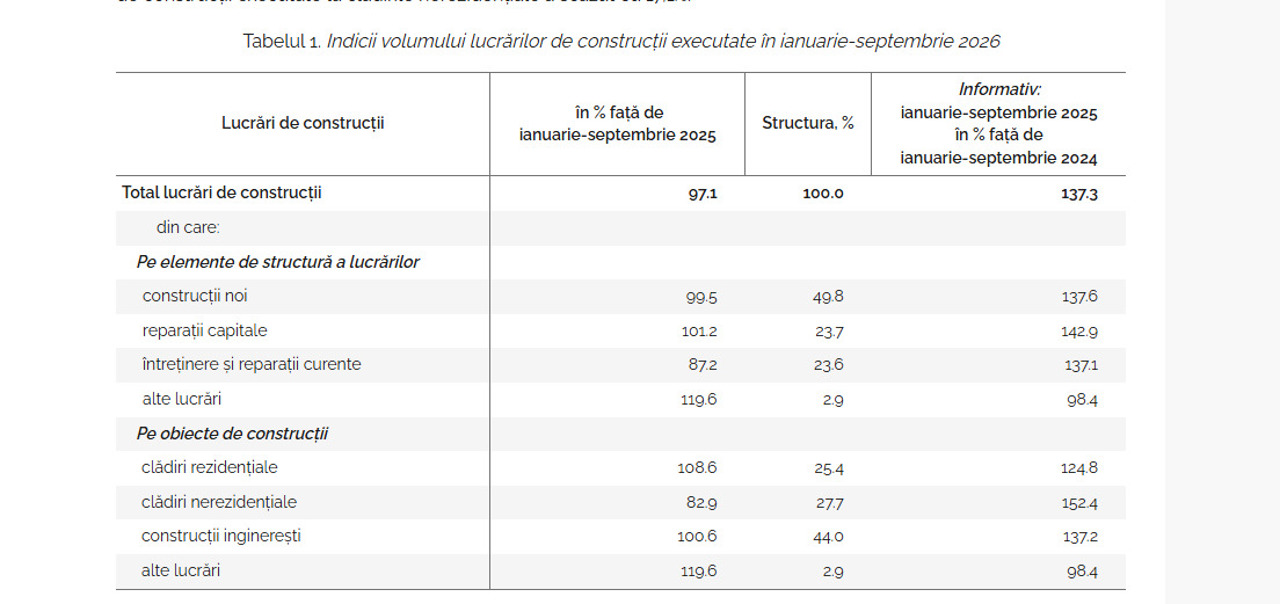
Statistical data for January to September 2026 show that work on residential buildings increased by 8.6% compared with the same period last year. This accounted for 25.4% of the total volume of construction work carried out during the first nine months.
At the same time, new construction projects represented the largest share of activity in the sector, accounting for 49.8%. However, the volume of such work was 0.5% lower than in the first nine months of 2025.
Routine maintenance and repair work also declined by 12.8%. Conversely, major repairs (capital repairs) increased by 1.2%, while other types of work—including demolitions and site preparation—saw an increase of 19.6%.
Total volume of construction work has declined since the beginning of the year
Despite the growth recorded in the third quarter, the figures for the first nine months of the year show a 2.9% decrease in the total volume of construction work compared to the same period in 2025.
This trend was driven mainly by a reduction in routine maintenance and repair work, as well as a slight decline in new construction.
By category, residential buildings and civil engineering works saw increases of 8.6% and 0.6%, respectively. Conversely, work on non-residential buildings fell by 17.1%.
The real estate market in Chișinău is showing signs of recovery following a period of stagnation; however, apartment prices remain high, driven by strong demand and limited supply. In the third quarter of 2026, 3,732 apartment transactions were recorded in the capital and its suburbs, compared to 3,607 during the same period last year.
According to real estate expert Victor Cernomorcenco, the market grew by 48% over the first nine months of the year, based on a comparison of transaction volumes between the first and third quarters. Meanwhile, economic expert Veaceslav Ioniță attributes the high demand to internal migration: approximately 10,000 people relocate from villages and smaller towns to the capital each year.
Nevertheless, Ioniță anticipates that, in the coming years, apartment prices may rise at a slower pace than wages. His forecast suggests incomes could grow by 7–8% annually, while housing prices are expected to rise by about 5%.