Moldova projects €1B deficit in 2027 budget, minister says
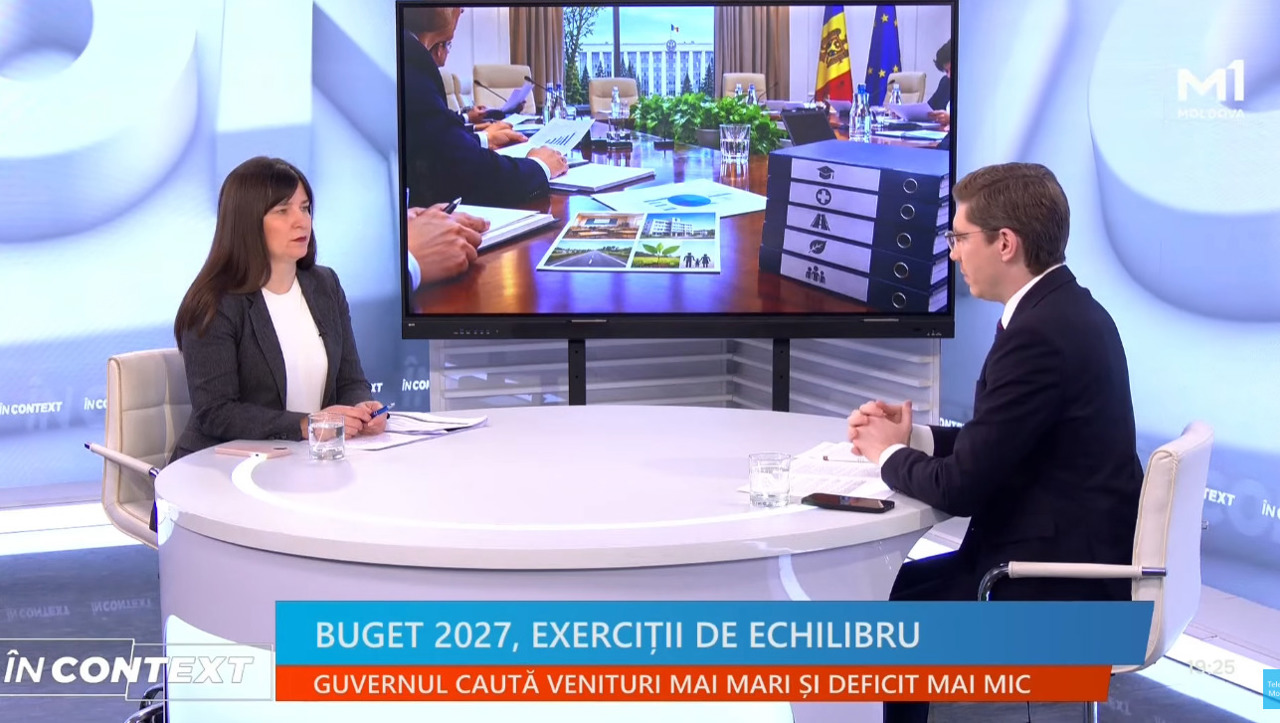
Moldova plans a 2027 state budget deficit of nearly €1 billion (approx. 20 billion MDL), or 4.7% of GDP, while debt servicing costs will exceed €398 million, Finance Minister Victoria Belous said on November 23.
Speaking on Moldova 1’s “În Context” program, Belous said public debt remains manageable but warned that borrowed funds must generate long-term economic returns.
Not a crisis budget
Belous rejected claims that the 2027 draft constitutes a crisis budget, noting that the government is expanding capital spending on infrastructure and local development rather than cutting investments.
“Not quite a crisis budget, because in a crisis you do not increase allocations for investments and repairs,” Belous said. “For 2027, we are increasing capital spending for localities and roads, as well as investments in education, healthcare, and social assistance. I consider this budgetary effort more responsible than a crisis reaction.”
Drafting the budget proved challenging, however, as authorities worked to cut the deficit by more than one percentage point of GDP from the 6% approved for 2026. Belous said the reduction relies on government reforms, wage policy adjustments, and stricter spending reviews across public institutions.
Addressing calls for administrative savings, she noted that central ministry staff account for only about 2,000 of the more than 172,000 public sector employees. “The largest impact comes from education, local public authorities, public order and defense, social assistance, and healthcare—people who directly provide services to citizens,” Belous said.
Revenues and fiscal discipline
The Ministry of Finance projects 2027 state budget revenues at €4.59 billion and expenditures at €5.58 billion. The broader national public budget—including social security, health insurance, and local budgets—is expected to reach roughly €7.51 billion.
Value-added tax (VAT) and excise duties will supply a major share of revenue. While inflation can boost tax intake, Belous stressed that forecasts also account for slower growth in household purchasing power and remain realistic.
New fiscal measures introduced this year, including taxes on postal parcels, are performing in line with projections. In the first two weeks of enforcement, parcel taxation generated €1.24 million, with several major operators choosing to include VAT directly in customer checkout prices.
Debt ceilings and project delays
To avoid a debt spiral, authorities track two strict benchmarks, Belous explained. “For us, the parameters are that public debt must not exceed 45% of our GDP, and debt servicing costs must not exceed 10% of state budget revenues,” she said.
Both thresholds are met in the 2027 draft, with public debt projected to reach 44.2% of GDP by year-end. Still, Belous acknowledged that direct traceability applies mainly to project-specific international loans, such as national road contracts, rather than general budget support.
For 2027, the government has earmarked €149.2 million for rural development, €199 million for the Road Fund, €119.4 million for agriculture, and over €10 million for environmental projects, alongside €398 million in transfers to mandatory health insurance funds.
Belous admitted that many funded investment projects face execution delays. “Unfortunately, from launch to team identification and company selection, we usually deviate from the initial schedule, and later we face delays by contractors obligated to implement the project,” she said.
EU Growth Plan and public sector wages
The economic impact of the European Union’s Growth Plan will materialize gradually, Belous said, as funds targeting businesses, nurseries, rural roads, and water infrastructure require time to yield measurable returns.
“It is premature to expect effects at the moment the money is spent,” she noted, adding that business-focused grants cannot be fully quantified within their first year.
Under the 2027 draft approved by the Cabinet on November 18, public sector wages will rise by an average of 15.7%, led by defense (over 20%), public order (nearly 15%), and education (14.4%). The forecast average monthly gross wage will reach €935, while the minimum wage will rise to €348.
Pensions will be indexed by 8.2% on April 1, 2027. Major sector allocations include over €1.24 billion for social protection, €1.22 billion for education, €497.5 million from the state budget for healthcare (plus €616.9 million from mandatory health insurance funds), over €447.7 million for security and public order, and €114.4 million for defense.
The budget is built on projected GDP growth of 2.8% and average annual inflation above 6%. Economist Viorel Gîrbu previously described the 2027 draft as a “crisis budget,” warning that its growth and inflation assumptions may be overly optimistic.
Translation by Iurie Tataru
RELATED COVERAGE
- Victoria Belous: 2027 budget forecasts could be revised based on economic developments
- Moldova's 6% budget deficit puts pressure on economy
- Chișinău is preparing a new investment package of over two billion euros, adding to the 1.9 billion from the Growth Plan
- EU Growth Plan may bring Moldova another €157 million
- Moldova to receive €168 million EU Growth Plan tranche by March