EU, China clash on Ukraine, trade at pivotal Beijing summit
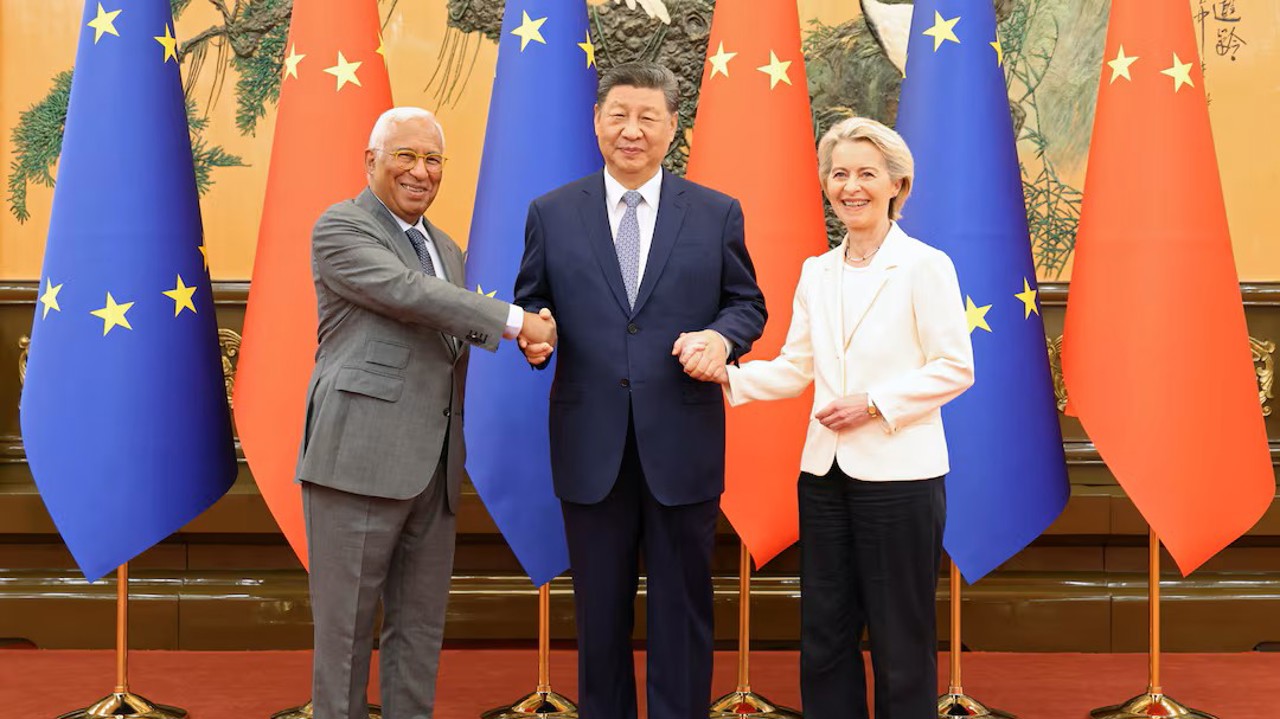
At the EU-China summit held on Thursday in Beijing, European leaders urged China to use its influence over Russia to end the war in Ukraine, while Chinese President Xi Jinping strongly criticized recent trade measures taken by Brussels against Chinese exports.
The event marked 50 years of diplomatic relations between the European Union and China but was overshadowed by tensions related to the trade imbalance, the war in Ukraine, and increasingly tougher rhetoric from the EU. The summit, initially planned for two days, was reduced to just one day at China's request, according to international media reports.
"We call on China, as a permanent member of the UN Security Council, to use its influence over Russia to compel it to respect the UN Charter and end its war of aggression against Ukraine," said European Council President António Costa, addressing Chinese leader Xi Jinping directly, according to AFP.
For her part, European Commission President Ursula von der Leyen stated that bilateral relations had reached a turning point. "As our cooperation has deepened, imbalances have grown. We have reached an inflection point. Re-evaluating our bilateral relations is extremely important," von der Leyen said, referring to the EU's record trade deficit with China, which reached 305.8 billion euros last year.
European officials also raised concerns regarding Chinese electric vehicle (EV) exports and China's control over rare earth metal exports, which temporarily disrupted supply chains in the European automotive industry in May. Despite these restrictions, exports of rare earth magnets from China to the EU increased by 245% in June compared to the previous month.
In the face of these criticisms, President Xi Jinping rejected the idea of a trade confrontation and called for dialogue and cooperation.
"The current challenges facing Europe do not come from China," the Chinese leader said, quoted by Xinhua. "Improving competitiveness cannot be based on building 'walls and fortresses.' Decoupling and breaking supply chains will only lead to isolation," Xi added.
He urged the EU to keep trade and investment markets open and avoid using "restrictive economic and trade tools."
Additionally, Xi urged Brussels to make "correct strategic decisions" and emphasized that, despite their differences, "both sides can find common ground."
"The more complex the international landscape, the more important it is for China and the EU to strengthen their contacts, mutual trust, and cooperation," said the Beijing leader.
At the conclusion of the summit, European and Chinese officials reiterated their desire to keep channels of dialogue open and identify areas for cooperation, especially concerning tackling climate change.
Translation by Iurie Tataru