Record student interest in Moldova's universities
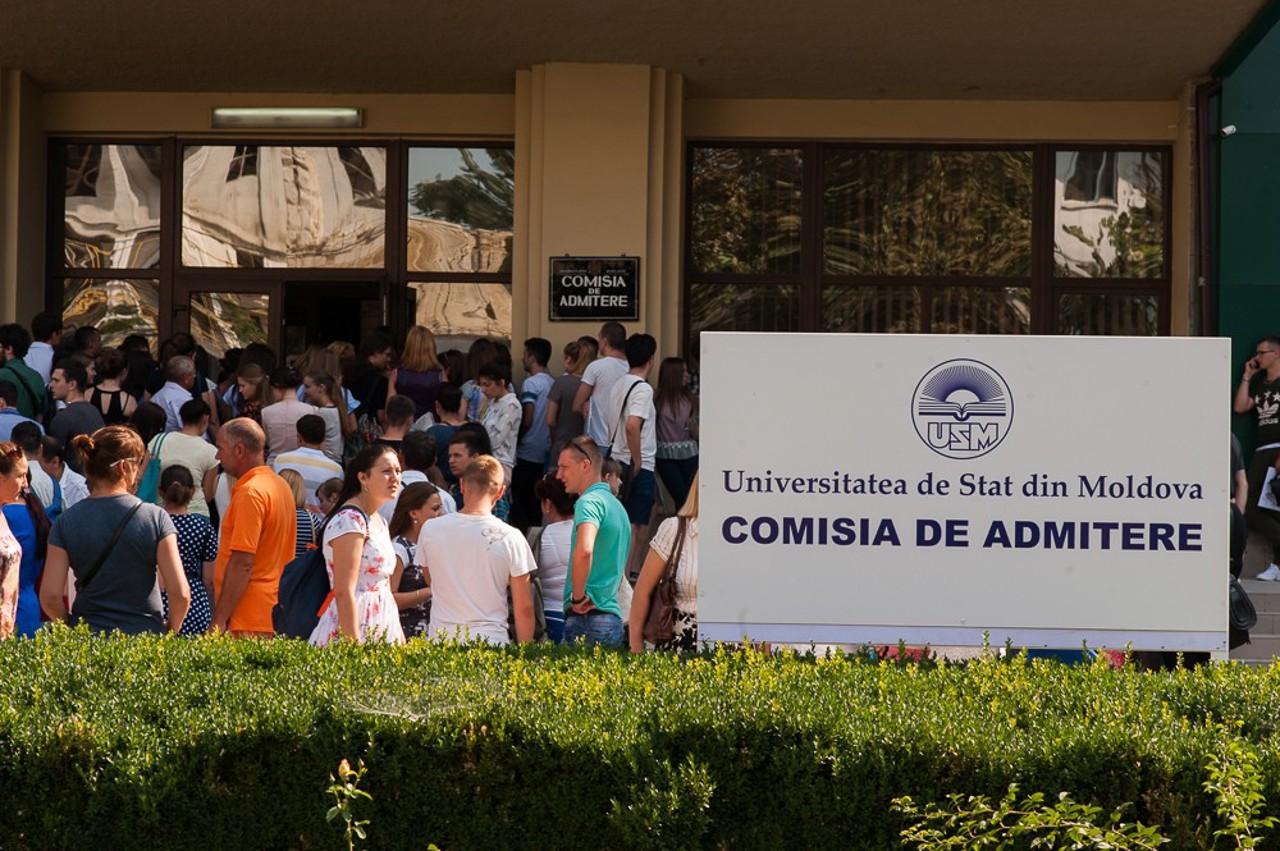
Nearly 28,000 students have applied for a place at university in Moldova this year. According to the Ministry of Education, this represents a record number of applications.
Government officials estimate that some 3,000 more students will enrol this year.
"Last year, we had at least 21,000 students enrolled in their first year. This included 9,000 choosing bachelor's degrees and more than 5,000 for master's," a state secretary from the Ministry of Education said. "Officials expect at least 3,000 more students to enrol this year."
The results of a supplementary admission session are expected soon.
Top subjects at UTM
The Technical University of Moldova (UTM) had the largest number of government-funded places on offer, with competition for some subjects particularly fierce.
A secretary for the UTM Admissions Committee, Radu Melnic, said he was pleased that study programmes that were less popular in previous years, such as Energy and Electrical Engineering, had now filled all their government-funded places in the first round.
Economic, legal, and Psychology fields remain among the most popular.
For example, there were more than 800 applications for just 20 government-funded economics places at UTM - the equivalent of 40 candidates for a single place. The Marketing and Logistics subject also attracted more than 200 candidates, while Business and Administration attracted over 150.
In the IT sector, Cybersecurity has surpassed Software Engineering in popularity, although the latter remains a highly sought-after subject.
Average Admission Grade for Teaching is 6.5
At the "Ion Creangă" State Pedagogical University (UPSC), the most requested undergraduate courses are in the educational and social fields.
Lucia Cepraga, a Vice-Rector for academic affairs, said the most popular undergraduate subject was Special Needs Education. "Preschool Education is also quite popular. Primary School Education is another very requested field. Psychology and Social Work programmes are highly sought-after and are top of the list of requests," she said.
Still, universities are struggling to form classes for some hard sciences, such as Chemistry or Biology.
"There are situations in the hard sciences where we struggle to form classes, or we risk forming classes in the education field, given that education is a pillar and a strategy that is important for society," Ms Cepraga added.
For the field of Educational Sciences, the average admission grade is 6.5, while for other subjects it starts at 5. This shows a promising start in training future teachers, according to the UPSC Vice-Rector.
A state secretary for the Ministry of Education, Adriana Cazacu, said they had cut the number of government-funded places for some subjects to ensure they did not admit students with very low grades.
A number of government incentives have been introduced to encourage young people to pursue teaching careers. These include a doubling of student bursaries to 3,400 lei and an increase in a one-off hiring bonus to 200,000 lei.
Thousands of foreign students at Moldovan universities
Healthcare, Law and Economics remain some of the most popular courses, with government-funded places filling up quickly. At the "Nicolae Testemițanu" University of Medicine, all places were taken in the first round of admissions.
Additionally, universities are focusing on internationalisation. New English-language programmes are attracting more and more foreign students, especially from India, Israel, China, Ukraine, and Romania.
"Our country provides educational services, just like any other country. Out of 56,000 students, some 5,000 are foreigners," Ms Cazacu said. "We want to be different from our colleagues in neighbouring Romania and Ukraine and offer other programmes. This year, at least five new programmes were launched at all universities in the country," she pointed out.
Furthermore, 100 government-funded places were offered to students from the diaspora, distributed among various universities in the Republic of Moldova.
Interim admission results
The interim results of the supplementary session will be announced on August 20, and the final results will be published on August 24.
In the main admission session, held between July 21 and 28, 11,986 students enrolled for a bachelor’s degree and 3,794 for a master’s.
This meant the government's enrollment plan was covered by about 80% for bachelor's degrees and 82% for master's degrees.
Translation by Iurie Tataru