Veteran Andrei Eremia on Moldova 1 TV: “It could have been like Ukraine if we hadn’t resisted fully”
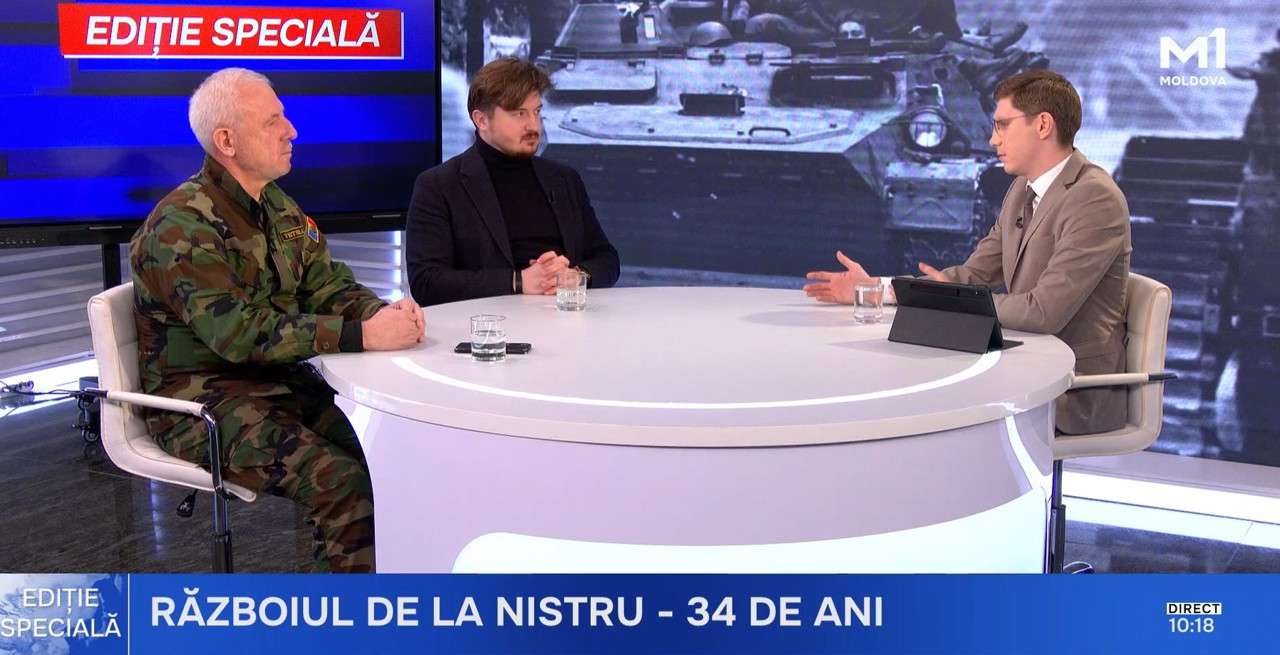
Thirty-four years after the armed conflict along the Nistru, the Republic of Moldova is urged to acknowledge its history, commemorate its heroes, and openly discuss the sacrifices made by those who defended the country’s independence. Experts emphasize that the authorities should also place greater focus on the veterans of the Nistru.
Veteran Andrei Eremia says he carries with him “deep memory and gratitude” for the comrades who fought for the Republic of Moldova.
“It is very important for us to discuss the events of 1992 so that our descendants are aware of them. Those who do not commemorate, neglect veterans, or fail to talk about history risk repeating it. A state that does not care for its veterans may end up supporting foreign invaders,” Eremia stated as vice-president of the Veterans Association “For the Nation and the Country,” during a special edition of Moldova 1 dedicated to the Day of Memory and Gratitude, observed annually on March 2.
According to Eremia, the Republic of Moldova does not fully honor its war veterans, despite the sacrifice and courage they displayed.
“It does not satisfy the veterans, nor do I think it satisfies society at large. Only recently have people begun to discuss those events. We have a law, adopted two years ago—Law 317—that confirms a veteran's status. Prior to that, we were merely referred to as combatants or whatever label was convenient for those who participated in conflicts. I want to emphasize that it was a war. This law has granted us the status of war veterans—those who defended the land and the Republic of Moldova, our homeland. However, it still does not fully meet our expectations. It is not adequately addressed in schools; the curriculum includes only two or three words about that time. We see what is happening in Ukraine now, and it could have been the same for us if we had not taken a stand and offered total resistance against a well-trained army of mercenaries,” Eremia emphasized on public television.
The veteran also believes that “the Soviet Union did not disappear,” but was merely “renamed” as the Russian Federation. He argues that a foreign army “should not exist” in the territory of Moldova.
“The Russians spread chaos in Moldova, Armenia, Georgia, Ossetia, and Chechnya. While we were caught in this chaos, they equipped and reorganized themselves, waiting for the right moment to strike. Therefore, we must remove this foreign army from our territory. The integration of the right bank with the left must be made more appealing, so that people can connect naturally,” he pointed out.
Security expert Pavel Horea, present at the event, remarked that authorities need to place greater emphasis on this conflict and primarily support the veterans.
“We do not yet have a state policy addressing these tragic events in the early history of the Republic of Moldova. The Republic of Moldova was subjected to aggression by the Russian Federation, a fact supported not only by citizen testimonies but also by official documents signed at the end of that war between distinct parties: the Republic of Moldova and the Russian Federation. I believe that the authorities must increase focus on this conflict because it is integral to our history and our formation as a state. First and foremost, they must prioritize the veterans—those who fought on the front lines and those in nearby communities who also suffered. The government needs to place much greater emphasis on supporting veterans to enhance their level of care,” Horea stated on Moldova 1.
We remind you that on March 2, 2026, it will be 34 years since the fighting began in 1992 to defend the territorial integrity and independence of the Republic of Moldova.
Approximately 30 thousand soldiers, police officers and volunteers took part in the armed conflict, over 300 people lost their lives during the fighting, and dozens more are still missing. During these years, negotiations took place in various formats, but the Transnistrian conflict was not resolved.