Expert: 2009 leadership exploited youth protests to keep Moldova under Russian influence
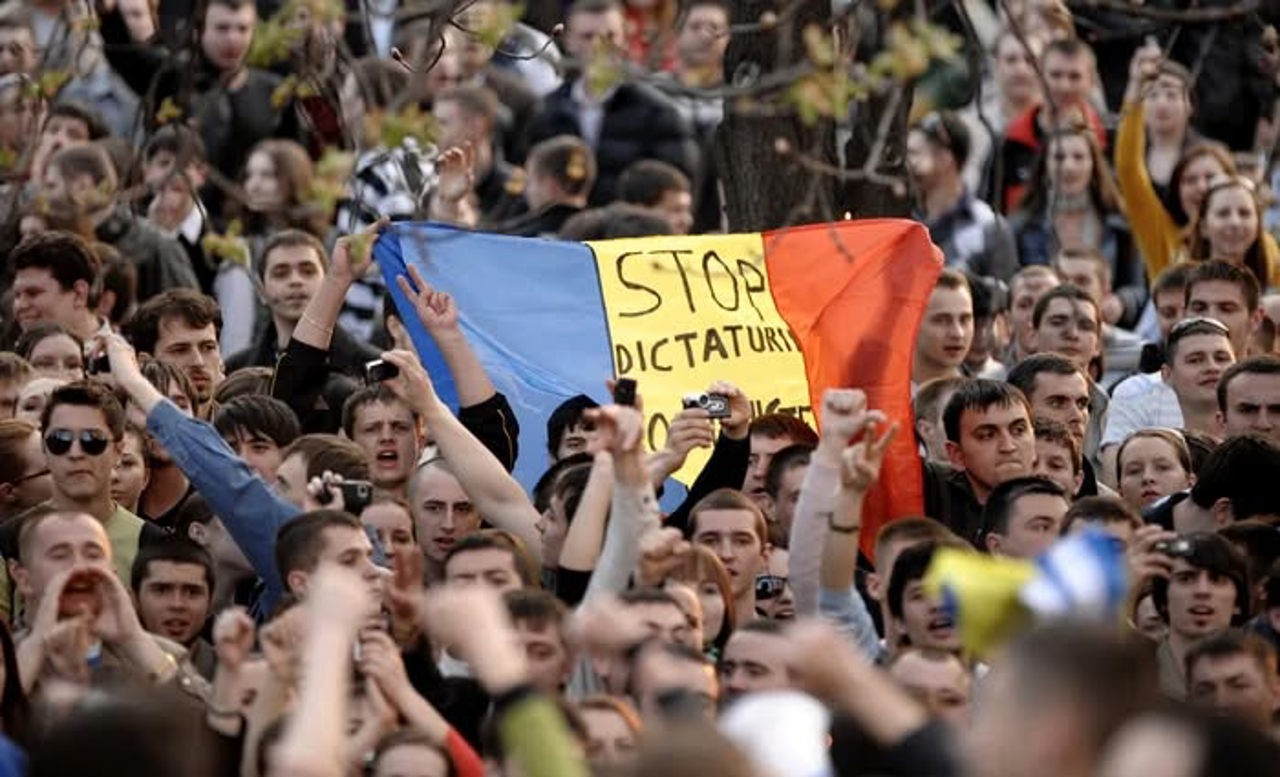
The protests on April 7, 2009, began as a popular uprising but were subsequently taken over by obscure interests. These forces aimed to undermine the European aspirations of the youth and to maintain the Republic of Moldova under the influence of the Russian Federation. This viewpoint was expressed by political analyst Ion Tăbârță in an interview with Radio Moldova.
"It was a protest, a genuine revolt of the European segment of Moldovan society, particularly among the youth, who sought a different developmental perspective for the Republic of Moldova—one aligned with the European Union. In contrast, the Republic of Moldova remained mired in the past, under a Soviet-style communist party. It was evident that the communist leadership aimed to keep the Republic of Moldova within the sphere of influence of the Russian Federation,” stated political analyst Ion Tăbârță during the “Zi de Zi” show on Radio Moldova.
The conflict of generations and the myth of the “coup d’etat”
Another notable observation is the stark contrast between the peaceful intentions of the initial demonstrators and the violent scenarios that unfolded. While the youth protested amid suspicions of significant electoral fraud, the power structures and external actors prepared to counter their movements.
"A large portion of our society wanted a different future because there was a feeling that the vote had been stolen. No one expected the communists to secure 60 mandates in Parliament. Administrative resources were fully exploited, and the election campaign did not meet the standards required to declare that we had free, fair, and genuinely uninfluenced elections. Young people took to the streets to protest, but other forces seized upon their sincere revolt and sought to redirect and compromise those protests. An attempt was even made to blame Romania, which was accused of orchestrating a coup d'état," explained Ion Tăbârță.
Provocateurs prepared for mass destabilization
The analyst highlights the involvement of Russian interests, with trained individuals from the separatist region aiming to incite chaos through coordinated actions.
"Many crucial testimonies and evidence that could have been useful in the immediate aftermath of April 2009 have been lost or destroyed, and many individuals are no longer with us. It will be complicated to address this. However, the government or any pro-European leadership, paired with a reformed justice system, should clarify those events. At the very least, from a moral and symbolic standpoint, it is necessary to acknowledge those events and condemn the individuals behind them. Multiple forces—both internal and external—were involved, particularly the Russian Federation. Some individuals among those young people who threw stones and vandalized the Parliament and Presidential buildings were provocateurs from the Transnistrian region, specifically prepared for mass destabilization. Several forces were involved, and many actors operated in the shadows," the commentator said.
"Events must be elucidated and condemned"
Finally, Ion Tăbârță cautions that the lessons of 2009 have only been partially learned, as control mechanisms have now been commandeered by "pseudo-European" interest groups. "The overarching logic of those events must be clarified and condemned politically, if legal condemnation is not possible," the expert concluded.
"Revolutions are initiated by romantics, but their outcomes are exploited by pragmatists; that is the lesson of 2009. While we achieved change, many of the practices from Voronin's regime later resurfaced in the structures of the new government from 2016-2019, where European integration was merely superficial. To respect democratic processes, it is imperative to take actions aligned with genuine pro-European principles. Thus, it is vital that our integration into the European Union occurs correctly, in line with the institutional methods of the European Union," concluded Tăbârță.
The April 2009 protests were a pivotal moment that led to the overthrow of the communist government and paved the way for free elections. These events underscored both the public's desire for change and the fragile nature of national unity.
Over 30,000 demonstrators, primarily young people, gathered in the center of the capital. Although the protests began peacefully, they soon escalated into riots characterized by violence and chaos after the authorities responded with excessive force.
More than 600 young individuals were arrested, and many were beaten and tortured in police custody. While only the death of Valeriu Boboc, who was beaten to death in the Great National Assembly Square, was officially recognized, civil society groups reported that five people lost their lives due to police brutality.
Seventeen years later, the victims continue to seek justice. The criminal investigation is ongoing, but the complete truth remains elusive. According to a response from PCCOCS to Teleradio-Moldova's inquiry, as of November 2021, 11 individuals involved in the violent repression of the protests have been convicted.
April 7 is now recognized as "Freedom Day," honoring the young people who demonstrated peacefully for democracy.