Satoshi will perform 16th in the Eurovision 2026 final in Vienna, in the second half of the show

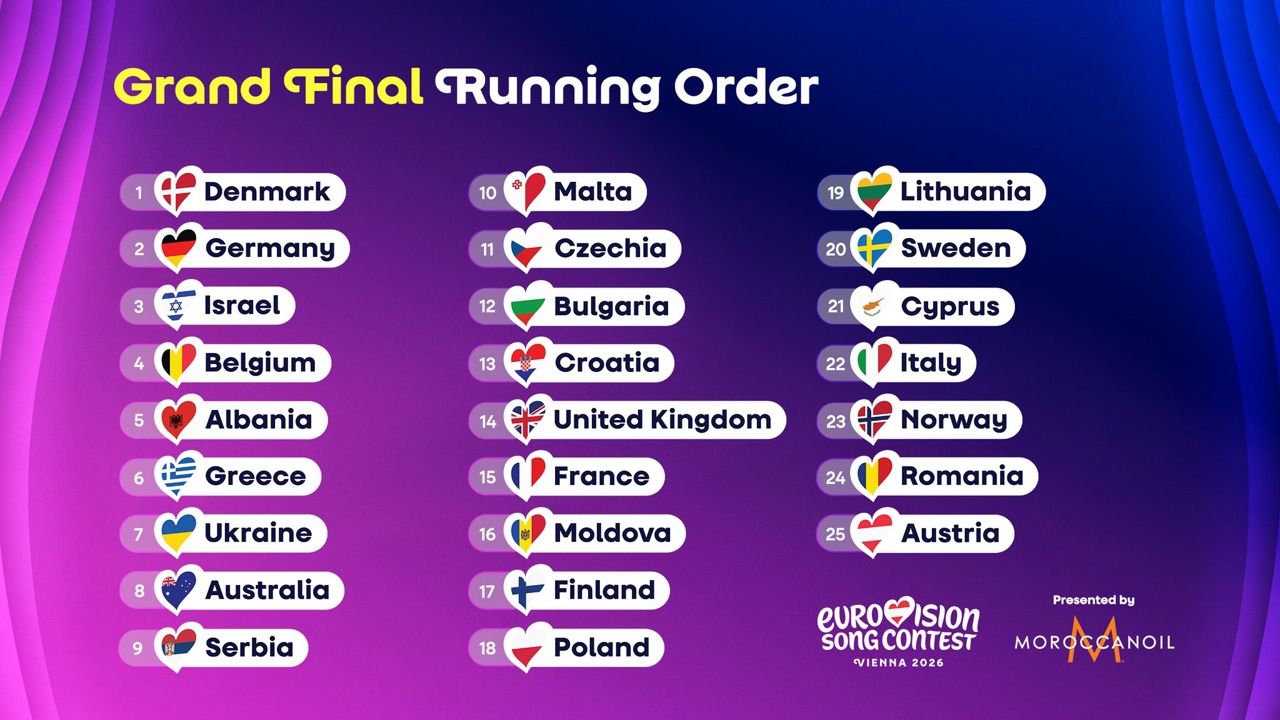
Moldova's representative for Eurovision 2026, Satoshi, will perform in the second half of the final, taking the stage as the 16th country. Ukraine will perform earlier in the competition, in the seventh position, while Romania's representative, Alexandra Căpăținescu, will sing towards the end, in the 24th position.
The Eurovision 2026 final will be opened by Denmark, and Austria will close this year's competition.
Running order in the Eurovision 2026 final:
- Denmark
- Germany
- Israel
- Belgium
- Albania
- Greece
- Ukraine
- Australia
- Serbia
- Malta
- Czech Republic
- Bulgaria
- Croatia
- United Kingdom
- France
- Republic of Moldova
- Finland
- Poland
- Lithuania
- Sweden
- Cyprus
- Italy
- Norway
- Romania
- Austria
We remind you that the Republic of Moldova has qualified for the final of the Eurovision Song Contest 2026. This achievement follows their performance in the first semi-final, held on May 12 in Vienna.
The country's representative, Satoshi, opened the contest with the song "Viva, Moldova!" and secured one of the 10 available spots in the grand final, scheduled for May 16.
In addition to the Republic of Moldova, the countries that qualified for the final include Greece, Finland, Belgium, Sweden, Israel, Serbia, Croatia, Lithuania, and Poland.
The countries that advanced after the second semi-final, held on May 14, are Romania, Ukraine, Bulgaria, Norway, Australia, Malta, Cyprus, Albania, Denmark, and the Czech Republic.
Eurovision 2026 Final: How to vote for your favorites Live on Moldova 1 TV
The Grand Final of the Eurovision Song Contest 2026 will take place on May 16 and can be watched live on Moldova 1 TV starting at 10:00 PM. You can also tune in online at moldova1.md.
Voting for the final will begin immediately after the live performances of the 15 participating countries.
There are several ways for the public to vote, depending on their country: through the official Eurovision Song Contest app, via online voting on the www.esc.vote platform, by SMS, or by phone call. The voting numbers will be provided by national television stations during the live broadcast.
For this year's contest, organizers have introduced a limit on the number of votes each viewer can cast. Each individual will be allowed a maximum of 10 votes for each voting method, down from 20 in previous years. This change aims to prevent excessive concentration of votes on a single competitor.
Fans can vote for multiple competitors, but they cannot vote for their own country.
Members of the diaspora can support the Republic of Moldova's representative by voting from their country of residence.
Unlike the semi-finals, where public and jury votes directly determine qualification, the voting system in the grand final differs slightly in terms of transparency and result announcement.
National juries from all participating countries will cast their votes, and their scores will be announced live by spokespersons from each national delegation during the famous "score round" of the final. Subsequently, the public vote will be calculated and announced separately, typically creating a moment of maximum suspense.
Both the jury and public votes have equal weight in the final score. The country with the highest cumulative scores from both the juries and the public, including those from the "Rest of the World" category, will be declared the winner of Eurovision 2026.