Maia Sandu: Russia intentionally sends drones, expelling ambassador won't stop it
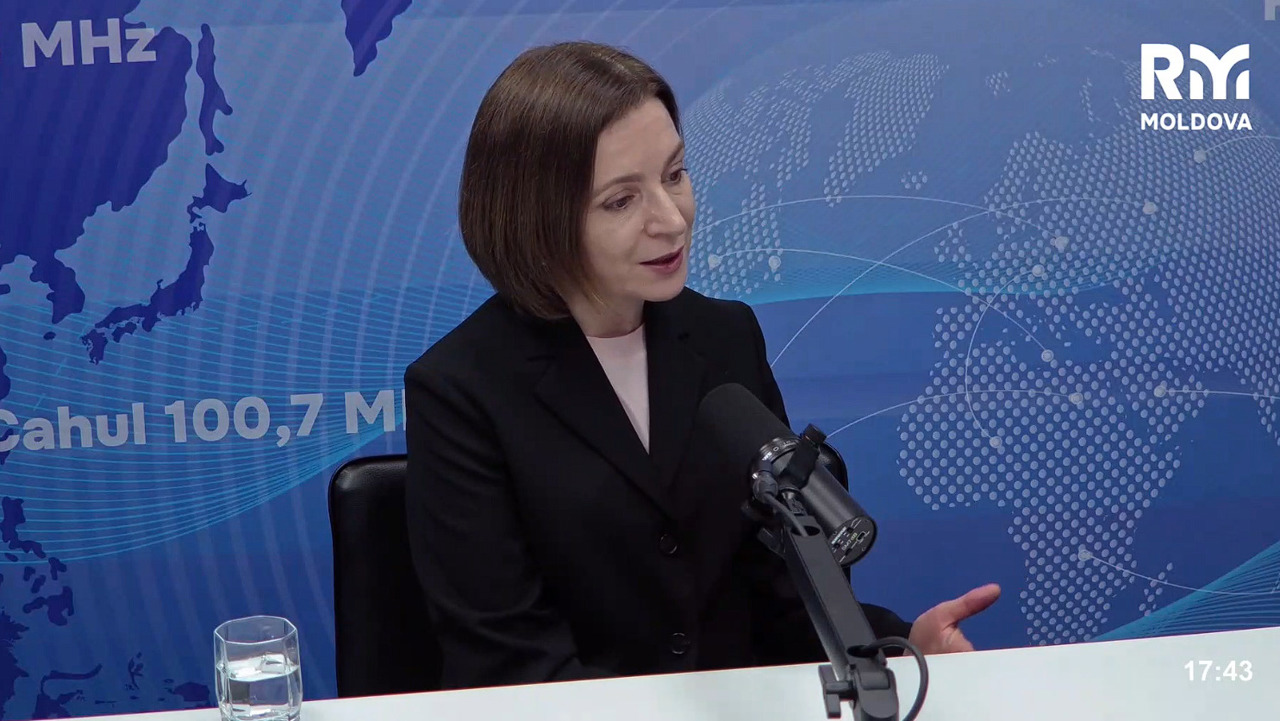
President Maia Sandu stated that the expulsion of Russian ambassador Oleg Ozerov would not halt the incursions of drones illegally flying over the airspace of the Republic of Moldova. During the show "La 360 de grade" on Radio Moldova, she emphasized that some drones enter the country's territory by accident, while others are sent intentionally.
Oleg Ozerov, the Russian Federation’s ambassador in Chisinau, has yet to receive his credentials. He has been repeatedly summoned to the Ministry of Foreign Affairs to address protest notes regarding violations of Moldovan airspace by Russian drones. President Maia Sandu acknowledged that these diplomatic measures have limited impact.
“The Russian Federation does not care about the protest notes or the messages sent by all countries affected by Russia’s aggression. Do you think this method will stop Russia from its actions? I don’t think so. Yes, it can be done, but do you believe this will prevent Russia from violating airspace?” the president stated on Radio Moldova on August 17.
Based on the trajectory of drones increasingly flying over Moldova’s airspace, authorities can distinguish between those sent intentionally and those that end up in Moldova by accident.
“I believe some drones arrive by chance, while others are intentionally sent, not only into our airspace but also into the airspace of other countries in the region. I have observed this in Romania and Poland. In both cases, these drones have violated our airspace and pose a danger to people. The only party to blame for these incidents is the Russian Federation, which started this war”, Maia Sandu said.
"Russia can no longer blackmail us"
In recent years, the Republic of Moldova has significantly reduced its dependence on Russia in three key areas: commercial trade, remittances, and energy. The country’s commercial reliance on the Russian market has declined from over 30% in 2010 to just 2-3% currently. Additionally, remittances from Russia, which constituted more than half of Moldova's total in 2012-2014, are now negligible, the president said.
“In recent years, we have managed to reduce and even eliminate our dependency in the energy sector. I believe this was the most serious form of dependence because whenever the Kremlin disagreed with events in Chisinau, it would cut off the natural gas supply, leaving the country in the dark. Today, Russia can no longer blackmail us,” declared Sandu.
In the absence of these direct levers, the president explained, Russia has resorted to more sophisticated methods, particularly information manipulation.
“Even though we have severed economic ties with Russia, its influence in the information space remains. Our citizens speak Russian and, as a result, consume entertainment shows and so-called news that are not genuine news but forms of propaganda,” stated the head of state.
"Russia is meddling everywhere"
The President also commented on the recent investigation by The New York Times, which described the Republic of Moldova as the Kremlin's second priority after Ukraine, emphasizing that the investigation confirms what state institutions have been saying for a long time - that Russia aims to use the territory of our country to destabilize Ukraine and the EU.
"I don't think this is new. We are talking and state institutions are talking about these plans of Russia. Russia is meddling everywhere. We are interesting to Russia from the perspective of the war in Ukraine, first of all, because Russia would like to strike Ukraine from our side, from our border, and, at the same time, we would be a bridgehead to the European Union," the head of state concluded.
The New York Times investigation published on August 14 details an unprecedented Russian operation involving paramilitary camps for Moldovan youth in Serbia, Bosnia, and near Moscow. In these camps, instructors from the Russian secret service trained the youth in the use of assault weapons and taught them how to create incendiary devices.
Simultaneously, Moscow invested hundreds of millions of dollars in a vote-buying scheme that was financed by fugitive oligarch Ilan Shor and operated from Skolkovo. Over 150,000 Moldovans were drawn into Shor’s network, with 38,000 activists receiving nearly $20 million in payments during the four months leading up to the 2024 EU referendum. Hundreds of priests signed contracts with a Russian bank linked to the Russian Defense Ministry, agreeing to propagate anti-European integration messages in exchange for approximately $1,000 per month.
On the day of the parliamentary elections on September 28, 2025, provocateurs trained in Serbia were poised to instigate chaos in Chișinău, while Russian hackers had infiltrated the Central Election Commission. Fortunately, Moldovan authorities, with the support of Western partners, managed to neutralize these attacks. The Action and Solidarity Party secured just over 50% of the vote, largely due to the support from the diaspora.
According to NYT journalists citing Western intelligence officials, Moldova is a significant focal point in this operation. Within the Kremlin's hierarchy of priorities, the conquest of Ukraine ranks first, with the aim of taking control of Moldova coming second. Although Moldova is not a member of the European Union or NATO, it holds a strategically important position, situated between NATO member states and Ukraine.
Officials noted that Moldova would serve an ideal role for Russia in any future aggression against Ukraine or the West. They added that Putin still aspires to seize territory in southern Ukraine to create a land corridor linking Russia to Moldova.