Vasile Tofan urged Russia to withdraw its troops from Moldova at the UN
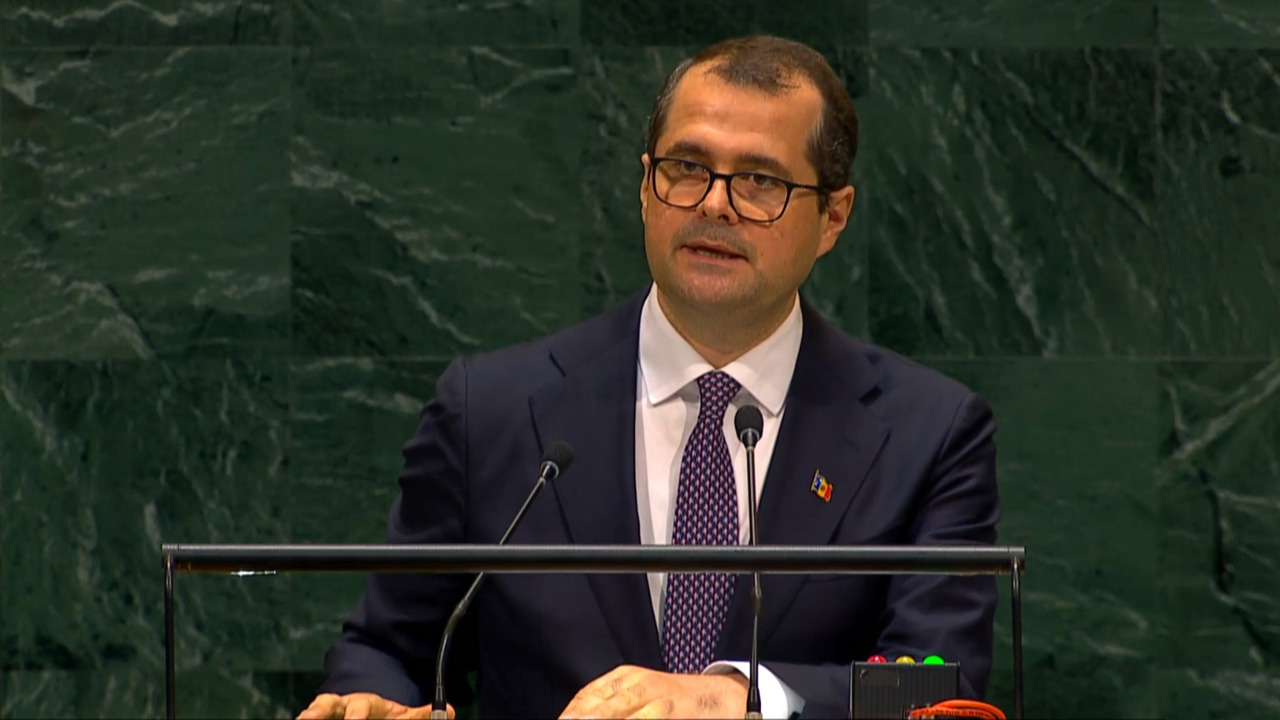
"Countries are not buffer zones. Nations are not bargaining chips." Prime Minister Vasile Tofan delivered this message on Saturday, September 26, from the podium at the UN General Assembly, where he accused Russia of pressuring the Republic of Moldova and called for the withdrawal of Russian troops from the Transnistrian region. Tofan stated that the Republic of Moldova determines its own future and that European integration is its national project. At the same time, the Prime Minister announced Moldova's bid for the presidency of the 82nd session of the UN General Assembly.
The Republic of Moldova no longer accepts others deciding its future
Prime Minister Vasile Tofan began his speech by addressing the sovereignty of the Republic of Moldova and the transformation the country has undergone over its 35 years of independence. The Prime Minister said that, after a period when Chișinău’s decisions were influenced from the outside, the Republic of Moldova has begun making its own choices.
"For a long time, many of these choices were made by others on our behalf. Soviet authorities deported our families to Siberia, imposed a different alphabet on our Romanian language, and told us it went by a different name. After independence, Moscow used natural gas and trade embargoes as tools to pressure our country. Step by step, we began to make our own choices. Today, I stand before you as the new Prime Minister of a country that has made its own choice," Tofan declared at the start of his speech.
Tofan stated that a country's size does not determine its power and that sovereignty must remain equal for all states.
"Small countries choose neither their geographical location nor their size. Yet, being small does not mean being powerless. Nations, like individuals, are shaped by the choices they make: whom they trust, whom they choose to lead them, whom they consider friends, and how they react when the odds turn against them," the Moldovan official added.
"Moldovans responded that their country is not for sale"
The Prime Minister spoke about the Republic of Moldova's efforts to reduce its economic dependence on Russia, as well as the Kremlin's ongoing attempts to undermine the Moldovan state through hybrid means, including illicit financing and disinformation.
"We have also reduced Russia's ability to exert economic pressure on us. We have diversified our gas supply sources. In just five years, the share of energy from renewable sources has risen from nearly zero to around 30%. Our power grid is increasingly integrated with Romania's and the European network, and our companies sell their products in some of the most demanding markets in Europe and the world," Tofan stated.
However, the Prime Minister emphasized that this progress has not stopped Moscow's attempts to interfere in the country's democratic processes, particularly in the context of last year's elections.
"The Kremlin has persisted in its attempts. Moldova has faced illicit financing, disinformation, cyberattacks, and vote-buying. Russia spent the equivalent of approximately two percent of our GDP trying to influence last year's elections. Moldovans responded that their country is not for sale," Tofan said.
The European path: "our national project"
The European path took center stage in the Prime Minister's address. Vasile Tofan said accession to the European Union is the Republic of Moldova's national project and that accession negotiations are already underway.
"European integration has become our national project. The Republic of Moldova has been a candidate country for accession since 2022; accession negotiations are underway, and we are making rapid progress. Our ambition is clear: to firmly anchor Moldova within the European family," the head of government emphasized.
The Prime Minister rejected the notion that moving closer to the EU implies replacing one sphere of influence with another. According to Tofan, the European choice is primarily about the citizens' right to determine their own future.
"For us, joining the European Union does not mean replacing one sphere of influence with another. It means the exact opposite. It means our citizens are exercising their right to choose. To choose democracy. To choose prosperity. To choose peace," he added.
The Prime Minister also noted that the Republic of Moldova's European path complements, rather than conflicts with, the country's transatlantic relationship. "This European choice goes hand in hand with a strong transatlantic partnership. For Moldova, these paths are not mutually exclusive. The United States is a key partner in strengthening our security, energy independence, and resilience. We want the next chapter of this relationship to focus increasingly on trade, investment, technology, and projects we can build together," the Prime Minister stated.
"Small size does not mean weakness"
In a key part of his speech, Tofan argued that being a small country does not necessarily mean a disadvantage; instead, it can be a competitive advantage through agility and the capacity for rapid regulation—particularly in fields such as technology and artificial intelligence.
"Moldova does not have a massive domestic market. We cannot match the financial resources of the largest economies. Therefore, we must compete through other means: issuing permits in days rather than months, clear regulations, digital public services, and rules that are changed when they are no longer relevant. Almost everywhere, technology advances faster than regulation, and artificial intelligence is widening this gap. This is an area where small countries can hold a natural advantage," Tofan explained.
The Prime Minister elaborated on his vision for creating regulatory sandboxes—environments where companies and authorities can collaborate directly to develop rules tailored to new technologies. "We want Moldova to become a place where emerging technologies can be responsibly tested within regulatory testbeds—so-called 'sandboxes'—where regulators learn alongside companies, rules are adjusted based on evidence, and good ideas do not wait years to reach the real economy. When an entrepreneur introduces a technology that legislation has not yet kept pace with, the answer should not simply be: 'There is no regulation for this.' It should be: 'Let’s find a safe way to test it,'" the Prime Minister said.
Tofan expanded this idea into a broader reflection on the relationship between a state's size and its sovereignty, within a regional context marked by Russia's aggression against Ukraine.
"Power has never been distributed equally. And it never will be. But an inequality of power must never become an inequality of sovereignty. Countries are not buffer zones. Nations are not bargaining chips. Nowhere is this principle being put to a more brutal test today than in our neighboring country," the Prime Minister declared.
"Countries are not buffer zones. Nations are not bargaining chips"
The Prime Minister then shifted focus to regional security and the war in Ukraine. He stated that small states must not be treated as buffer zones or bargaining chips in confrontations between great powers.
"Power has never been distributed equally. And it never will be. But inequality of power must never become inequality of sovereignty. Countries are not buffer zones. Nations are not bargaining chips," the Prime Minister continued.
Tofan also spoke about his own experience in Ukraine, noting that he had lived there for nearly 15 years, including at the onset of the Russian invasion on February 24, 2022.
"Security is not an abstract concept for me. Kyiv was my home for nearly fifteen years, including on February 24, 2022. That morning, as parents, we found it difficult to explain to our three boys—then aged one, ten, and twelve—what war actually means," he said.
Russian drones: "The fact that a violation is repeated does not make it acceptable"
The Prime Minister stated that the war in Ukraine has come to be perceived as an everyday reality, even by children. He cited a family from Kyiv to illustrate how the war has altered daily life. Tofan linked this reality to the situation in the Republic of Moldova, where Russian drones have repeatedly violated the country's airspace.
"In Moldova, we cannot compare our suffering to that of Ukraine. And yet, Russian drones repeatedly violate our airspace and crash onto our territory. The danger is that what is unacceptable might start to seem normal to us," the official noted.
The Prime Minister insisted that the recurrence of such incidents does not make them acceptable.
"For us, too, it is a matter of our families' safety. We must not get used to this. The fact that a violation is repeated does not make it acceptable," Tofan added.
The Prime Minister explicitly held Russia responsible for starting the conflict and stated that Ukraine did not choose this war. Tofan rejected the notion that the war was a tragedy without a perpetrator.
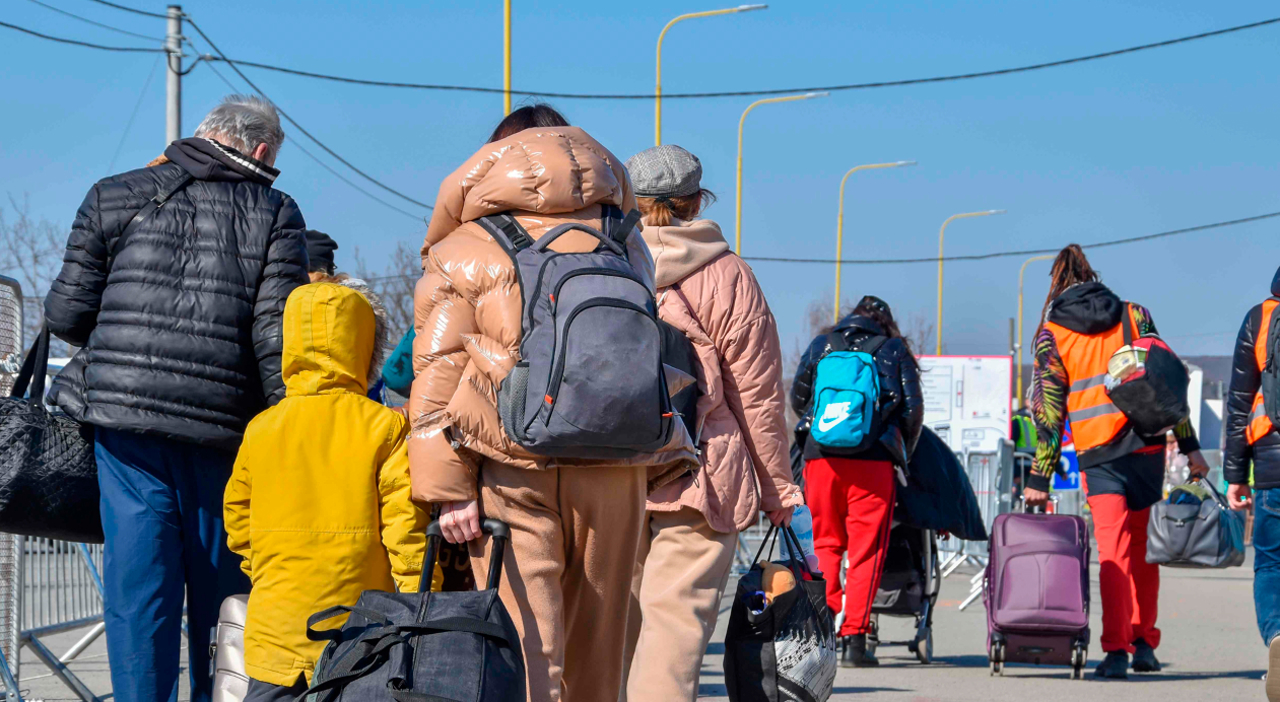
"This is not a tragedy without a perpetrator. Russia launched a war of aggression against a sovereign neighboring state. It occupied territories and continued to attack Ukrainian cities. Ukraine did not choose this war. Russia chose it," the head of government emphasized. Tofan said that the Republic of Moldova could not decide whether war would break out nearby, but it could decide how to react. He highlighted support for refugees and Ukraine, including maintaining transport routes and reducing rail transit costs for Ukrainian grain.
"Moldova could not choose whether this war would break out next to us. But we could choose how to respond," he stated.
Withdrawal of Russian troops from Transnistrian region
In another direct message at the UN, the Prime Minister addressed the Transnistrian region. Vasile Tofan called for the unconditional withdrawal of Russian troops and reiterated the goal of the peaceful reintegration of the Republic of Moldova.
"The Russian army continues to be stationed illegally and without our consent in the Transnistrian region of the Republic of Moldova. We will continue to insist on their unconditional withdrawal. We desire the peaceful reintegration of our country, with full respect for the sovereignty and territorial integrity of the Republic of Moldova. We want people on both banks of the Nistru to live together in a peaceful, democratic, and prosperous Moldova," Vasile Tofan emphasized.
Message to Moldovans: "Let us stand together"
In a direct address to the citizens of the Republic of Moldova, Vasile Tofan spoke in Romanian about the war in Ukraine, Russian drones, and the upcoming winter. The Prime Minister said the Government must prepare for a difficult period and support those most vulnerable. "I know that many of you are anxiously following the news about the war next door and the increasing number of Russian drones, and are already thinking about the coming winter. Yes, a difficult winter lies ahead. It is our duty—the Government’s duty—to prepare and to help, above all, those who have the least. But I want to ask one important thing of you: let us stand together. In difficult times, this has always helped us—not abandoning one another, and helping our neighbors, our parents, and those struggling the most. We may hold different opinions; we may vote differently. That is natural in a country where people think freely," the official noted.
Moldova bids for the Presidency of the UN General Assembly
In his speech, Vasile Tofan also announced Moldova's bid for the presidency of the 82nd session of the UN General Assembly. The Prime Minister said small countries must help shape the international system, rather than merely relying on decisions made by others.
"The Republic of Moldova has the honor of presenting its candidacy for the presidency of the 82nd session of the United Nations General Assembly. We wish to contribute to an organization that is more efficient, more inclusive, and results-oriented," the Prime Minister said.
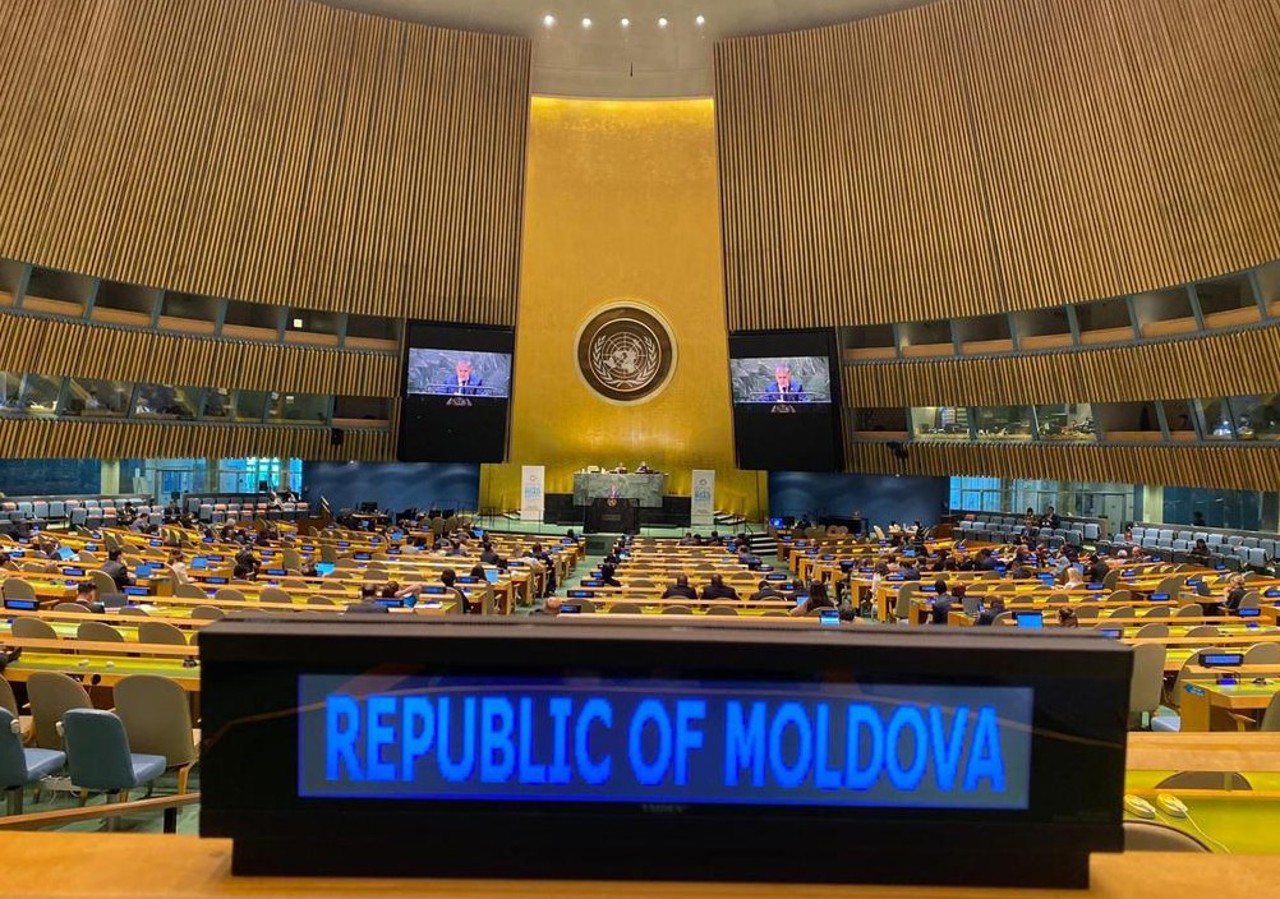
"Our future still lies in our own hands"
In closing, the Prime Minister returned to the central theme of his speech: the Republic of Moldova can determine its own future. He stated that the country's optimism does not stem from ignoring problems, but from the conviction that they can be overcome through the choices made.
"Not a naive optimism. Not the belief that problems vanish if we refuse to see them. But the optimism born of the certainty that our future still lies in our own hands. Moldova may never be a great power. Yet, we have everything it takes to be a country that achieves great things," concluded the Prime Minister of the Republic of Moldova.
Our country's delegation to the general debate of the 81st session of the UN General Assembly is led by Prime Minister Vasile Tofan and Deputy Prime Minister Mihai Popșoi; on the sidelines of the gathering, they held several meetings and participated in international forums focused on security and the regional situation.
Prime Minister Vasile Tofan met with the Prime Minister of Ireland, Michael Martin, and his Dutch counterpart, Rob Jetten. The Head of Government also met with former US Secretary of State Mike Pompeo.
The Moldovan delegation also took part in other international forums. Foreign Minister Mihai Popșoi attended the Crimea Platform meeting held in Washington.
This week, the Republic of Moldova also joined a joint declaration signed by over 50 UN member states calling on the Russian Federation to implement a complete, immediate, and unconditional ceasefire in Ukraine and to return to negotiations for a just and lasting peace.
This year's meeting is dedicated to the transformations the international community is undergoing and to strengthening confidence in multilateral cooperation.